


The US may still draw the lion's share of the world's 1.9 million international students, but for the past several years, the numbers have dropped off slightly as competition in Europe and Asia grows.
Yet despite it all, the US government is preparing to launch a program that could reverse the flow of students even more and send 1 million American students abroad.
Students who need, want, or just have a yen to travel outside their country have an ever-growing wealth of choices at their fingertips as they pursue their bachelor's, master's or doctoral degrees -- whether in the US or elsewhere.
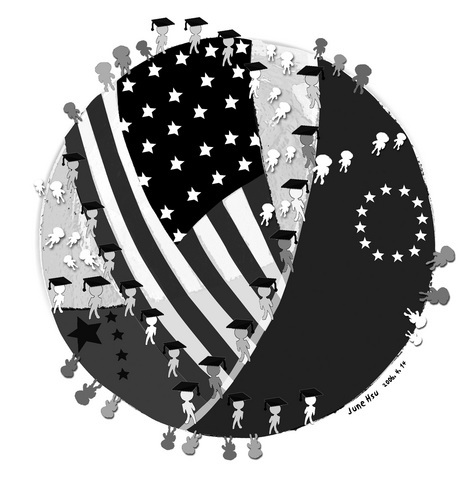
Beginning in 1954, international students started flocking to the US in large numbers, increasing every year from 34,000 to a whopping 586,000 by the 2002-2003 school year. But the trend went down for the first time ever over the last two years, with a 3.5 percent drop to 565,000 students, educators say.
On the surface, a glitch with visas after the 2001 terrorists attacks was blamed, but the real reason had already started by the mid 1990s, with the growth of globalization and the rise of rival English-language schools around the world.
Oddly, American educators don't seem alarmed -- in fact, they greet the increased competition as a tribute to their own private-public system of 4,000 colleges and universities, the largest and most diverse system in the world.
"It's very exciting," said Peggy Blumenthal, executive vice president at the New York-based International Institute of Education (IIE), an 87-year-old organization that administers 200 international study programs, including the famous Fulbright scholarships.
Other countries -- across Asia and Australia, but also more recently France and Germany -- have been fast figuring out the key to the success of the US system, which is driven by hard budget figures and funded by student fees, corporations, alumni and generous donors -- and not the heavy hand of the government, she said in a telephone interview.
"Other countries are now switching from totally government-funded studies to a fee-based financial base, so the incentive to get more fee-paying international students is large," she said.
That doesn't mean US colleges and universities are sitting down. Schools get their alumni living abroad to recruit and interview prospective students. They send their presidents, faculty members and admissions advisors on national and world tours to meet with groups and attend university fairs to meet students and raise money.
Nor does it mean that the US is happy to lose any of the US$13.3 billion brought into the country by more than half a million students for tuition, fees and living expenses -- at an average of US$22,000 a year -- and items such as cars and travel.
But what hurts almost as much as the financial losses, according to Allan Goodman, president and chief executive officer of IIE, is the loss of foreign brainpower on US campuses. Nearly half of all international students in the US study just three fields -- business and management, engineering and math and computer sciences.
Any losses in those ranks seriously undermines the pool of teaching assistants and researchers at leading US universities, he said.
"American students are simply not applying in sufficient numbers at the graduate level in these disciplines to support many of the fields in which America needs manpower and brainpower to sustain its academic edge and its groundbreaking research activities," Goodman told Congress in 2004.
Of almost equal importance is the general knowledge that international students bring to US campuses, in a country where less than 20 percent of the citizens own passports or have traveled abroad.
"Few Americans go abroad," Blumenthal said. "So at least they have classmates from countries where they will be doing business some day."
By the same token, foreign students return home with a "profound" understanding of America, even if they don't "agree with us," she said.
More than 50 of the world leaders called by US President George W. Bush to join the coalition against terror studied in the US or came on one of the international visitor programs, Goodman told Congress.
"An educational experience in America pays dividends to our nation's public diplomacy over many years," he said.
Students from India, China, South Korea and Japan make up about 40 percent of foreign students in the US. China in fact accounts for about 10 percent of the world's 1.9 million international students, UNESCO says, and India accounts for 4 percent. But even China has suddenly become a major host country with 100,000 foreign students.
Despite slacking international enrollments, US educators are determined to send abroad nearly twice as many American students as the number it now hosts from abroad. A special commission -- the Abraham Lincoln Study Abroad Fellowship Program -- is recommending to Congress a plan to boost the outflow five-fold, from less than 200,000 to 1 million a year by 2016.
The effort is named after the legendary Civil War president, who grew up a poor, writing his math with charcoal on the back of a shovel. As president, Lincoln put through the system of federal land grant universities that brought tertiary education to rural areas.
Combined with the proliferation of small colleges founded by the country's many religious groups, the state universities were a key step towards democratizing education in the US, where at least one-third of the college-age population currently seeks further education after high school.
The commission wants to further democratize the student body it now exports by boosting the already brisk 9.7 percent annual growth rate to 15 percent. Almost every US college or university already offers semesters or years abroad, but the Lincoln program would help push poorer and minority students overseas.
Recently, China launched another diplomatic offensive against Taiwan, improperly linking its “one China principle” with UN General Assembly Resolution 2758 to constrain Taiwan’s diplomatic space. After Taiwan’s presidential election on Jan. 13, China persuaded Nauru to sever diplomatic ties with Taiwan. Nauru cited Resolution 2758 in its declaration of the diplomatic break. Subsequently, during the WHO Executive Board meeting that month, Beijing rallied countries including Venezuela, Zimbabwe, Belarus, Egypt, Nicaragua, Sri Lanka, Laos, Russia, Syria and Pakistan to reiterate the “one China principle” in their statements, and assert that “Resolution 2758 has settled the status of Taiwan” to hinder Taiwan’s
Singaporean Prime Minister Lee Hsien Loong’s (李顯龍) decision to step down after 19 years and hand power to his deputy, Lawrence Wong (黃循財), on May 15 was expected — though, perhaps, not so soon. Most political analysts had been eyeing an end-of-year handover, to ensure more time for Wong to study and shadow the role, ahead of general elections that must be called by November next year. Wong — who is currently both deputy prime minister and minister of finance — would need a combination of fresh ideas, wisdom and experience as he writes the nation’s next chapter. The world that
Can US dialogue and cooperation with the communist dictatorship in Beijing help avert a Taiwan Strait crisis? Or is US President Joe Biden playing into Chinese President Xi Jinping’s (習近平) hands? With America preoccupied with the wars in Europe and the Middle East, Biden is seeking better relations with Xi’s regime. The goal is to responsibly manage US-China competition and prevent unintended conflict, thereby hoping to create greater space for the two countries to work together in areas where their interests align. The existing wars have already stretched US military resources thin, and the last thing Biden wants is yet another war.
Since the Russian invasion of Ukraine in February 2022, people have been asking if Taiwan is the next Ukraine. At a G7 meeting of national leaders in January, Japanese Prime Minister Fumio Kishida warned that Taiwan “could be the next Ukraine” if Chinese aggression is not checked. NATO Secretary-General Jens Stoltenberg has said that if Russia is not defeated, then “today, it’s Ukraine, tomorrow it can be Taiwan.” China does not like this rhetoric. Its diplomats ask people to stop saying “Ukraine today, Taiwan tomorrow.” However, the rhetoric and stated ambition of Chinese President Xi Jinping (習近平) on Taiwan shows strong parallels with


 RSS
RSS