


Imagine a residential home for children in care in a leafy smart suburb. It's a large old house with elegant high ceilings, set in a large garden. There's a delicious smell of supper coming from the kitchen where a child and a member of staff are preparing a meal. A couple of other children are chatting with two other staff round the big wooden table.
This is the Josephine Schneider House, in the suburbs of Copenhagen, and as I talk to the director, Thore Hirtshals, I can hear in the background the calm busy-ness reminiscent of family life.
The contrasts with the UK are immediate: high level of staffing; the proud declaration that the place has no rules; each child must be treated as a unique individual; and the fact that more than 60 percent of the children go on to higher education -- a far cry from the outcomes of looked-after children in the UK.
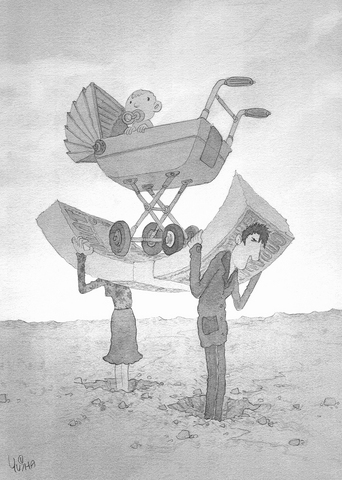
Josephine Schneider House epitomizes not just an approach to residential care but the character of the Danish state system of social services and education. The attention to the individual, the huge investment in highly qualified staff, and the priority of developing strong relationships are all are key principles of the Danish tradition of pedagogy.
It is a word for which there is no good English translation but finally, after nearly a century of indifference, the European traditions of pedagogy are beginning to generate keen interest in some quarters in the UK.
Pat Petrie, from the Lonon-based Institute of Education, has just completed a comparative study of children in care in England, Germany and Denmark for the UK government. Her conclusion is blunt: "Pedagogy is enormously important. If we don't take it on board, we will fail children."
Petrie argues that the new interest in pedagogy in the UK is being driven by the childcare issue and the related debates about quality and workforce. There is also an increasing desire to find new approaches in the children's care system, and pedagogy could provide the overarching principles for the increasingly close relationship envisaged between education and children's services.
The concept of pedagogy is central to a range of debates in the UK, from childcare and education to personalization of social services and the broader debate initiated by Lord (Richard) Layard, the London School of Economics professor and government adviser, about wellbeing and happiness. But if pedagogy is to catch on in the UK, it will first need a good definition -- and the English dictionary is not much help, defining it as the principles, practice or profession of teaching.
Pedagogy is best understood as a process of nurturing the development of other human beings, and pedagogues work with all ages, from children in kindergartens to older and mentally ill people.
Implicit within this idealistic aim is a profound set of principles about what constitutes human flourishing and well-being. Aspects that are particularly emphasized, and which inform all pedagogic method, are how pedagogues work to cultivate personal creativity and to facilitate in their clients the capacity for strong, easy relationships with others.
Staff at Josephine Schneider House all trained as pedagogues in a degree course lasting three-and-a-half years. The investment in highly trained staff is a dramatic difference from the UK residential care workforce, 80 percent of which have little or no qualifications. But Denmark is well aware that pedagogy doesn't come cheap. It represents a huge investment in human resources and in the quality of relationships with service users.
The pedagogues' degree course is very different from a UK social work course, with much attention given to personal development. At Copenhagen's Frbelseminariet, one of the oldest pedagogy institutes in the country, there are magnificent facilities for drama, art, craft and music. Instead of social work qualifications being about the acquisition of knowledge on the law, social policy and theory, the focus is on developing practical relationship skills with clients and with fellow pedagogues. How do you draw out a child who lacks confidence? How do you build trust with an adult with learning difficulties? How can you resolve problems as a team in an institution?
The contrast between the British and the Danish social services is stark, says Kieron Hatton, head of the Center for Social Work at Portsmouth University in south-west England, who has been running a joint program with Frbelseminariet since 1992 and is devising a new course with an emphasis on pedagogy. He says: "Danes who come to work in our residential homes for children comment on how rigid they are, how often we call in the police to deal with difficulties, and how scared of risk we are. They find how we work with young people very disturbing."
Hatton believes that what has driven the direction of UK policy in the last two decades has been an aversion to risk.
"The scandals in the children's services have permeated all social work," he says.
"We've become very risk averse, and residential units have been geared up for health and safety. Yet all the evidence shows that young people gain more from being exposed to some risk. We've been good at the protection of clients, but not their development," Hatton says.
Tanja Emanuelsen and Ulla Hansen, recent graduates of Frbelseminariet, have just returned from the program at Portsmouth, where they had placements in residential homes. They admitted they were shocked at the UK system.
"They showed me all these plans and how they had government inspection stars -- everything was supposed to be perfect," says Emanuelsen of the children's home where she worked.
"But they kept so distant in their relationship with the children. If the staff keep distance, then the clients will. You mustn't underestimate the client's ability to read you. What about building up a person's sense of who they are, what they like, where they've come from and how they react?" she says.
Hansen's experience of a center for adults with learning disabilities was similar.
One of the key elements of their training has been how to manage the complex balance of being engaged with clients at a personal level, yet remaining professional. One strategy is to use the "common third", an activity that the pedagogue and client can learn together, such as mending a car, making a poster or cooking a meal.
"In the UK, qualified staff spend a lot of their time putting information into a computer database," Hatton says.
"There's a lot about paper chasing in the care management approach, which is so widespread now. It involves care packages with measurable outputs, and targets," he says.
Petrie remarks on the way in which pedagogues' training enables them to be confident about using their personal judgment, rather than the more typical UK approach of relying on procedures, which often cannot accommodate individual circumstances.
The irony is that just as the UK begins to grasp something of the rich idealism of the concept of pedagogy, Denmark is beginning to import the Anglo-Saxon preoccupation with value for money and measuring effectiveness. The reforms the Danish government has been proposing may seem mild by UK standards, but they have provoked fierce resistance from pedagogues, who see it as the beginning of a slippery slope. There have been demonstrations by students, claiming that the government is "killing Danish pedagogy."
Much of the controversy centers on the issue of how to evaluate the work of pedagogues. Watch a pedagogue at work, -- as I did in a forest kindergarten (the children play in the forest all day) near Aarhus -- and it's the spontaneity and self-effacing way they facilitate group play that is so striking. How do you measure that?
Karen Prins, a senior lecturer at Frbelseminariet, says: "Someone asks a pedagogue what they did all day and they reply that they played a football match with homeless people. But people say: `Anyone can do that. Why do you need to study for a degree for three-and-a-half years?' It's very hard to defend and justify the skills of pedagogy."
Her colleague, Christian Aabro, adds: "We have never been able to measure what we do, and we used to just trust the professionals. Now value for money, proof of what works, are new concepts for us and there's a lot of admiration for the UK model in education and social work."
Petrie counters this by pointing out that pedagogy produces some obvious outcomes that can be measured and on which the UK scores very badly. She says: "Being a pedagogue is a very popular job -- even in areas such as residential care -- and they retain their staff."
The sense of pedagogy under scrutiny has even reached the peaceful Josephine Schneider House, and Hirtshals has felt forced to take a stand. He says: "All the policies and paperwork take the pedagogues away from time with the children. Now the council has asked us to do a questionnaire with the children on how satisfied they are living here, and I've refused. It's wrong. Children are not asked to assess their parents, so why should they assess this place? I don't mind questionnaires of older children who have been here, and we have had researchers do studies of them."
Hirtshals believes there is a point of principle at stake. He argues, after 20 years of running the home, that there are important things about human beings and relationships that you can't measure, and that it is absurd to believe you can.
The question now is whether the UK is going to learn more from Denmark, or Denmark learn more from the UK.

Could Asia be on the verge of a new wave of nuclear proliferation? A look back at the early history of the North Atlantic Treaty Organization (NATO), which recently celebrated its 75th anniversary, illuminates some reasons for concern in the Indo-Pacific today. US Secretary of Defense Lloyd Austin recently described NATO as “the most powerful and successful alliance in history,” but the organization’s early years were not without challenges. At its inception, the signing of the North Atlantic Treaty marked a sea change in American strategic thinking. The United States had been intent on withdrawing from Europe in the years following
My wife and I spent the week in the interior of Taiwan where Shuyuan spent her childhood. In that town there is a street that functions as an open farmer’s market. Walk along that street, as Shuyuan did yesterday, and it is next to impossible to come home empty-handed. Some mangoes that looked vaguely like others we had seen around here ended up on our table. Shuyuan told how she had bought them from a little old farmer woman from the countryside who said the mangoes were from a very old tree she had on her property. The big surprise
The issue of China’s overcapacity has drawn greater global attention recently, with US Secretary of the Treasury Janet Yellen urging Beijing to address its excess production in key industries during her visit to China last week. Meanwhile in Brussels, European Commission President Ursula von der Leyen last week said that Europe must have a tough talk with China on its perceived overcapacity and unfair trade practices. The remarks by Yellen and Von der Leyen come as China’s economy is undergoing a painful transition. Beijing is trying to steer the world’s second-largest economy out of a COVID-19 slump, the property crisis and
Ursula K. le Guin in The Ones Who Walked Away from Omelas proposed a thought experiment of a utopian city whose existence depended on one child held captive in a dungeon. When taken to extremes, Le Guin suggests, utilitarian logic violates some of our deepest moral intuitions. Even the greatest social goods — peace, harmony and prosperity — are not worth the sacrifice of an innocent person. Former president Chen Shui-bian (陳水扁), since leaving office, has lived an odyssey that has brought him to lows like Le Guin’s dungeon. From late 2008 to 2015 he was imprisoned, much of this


 RSS
RSS