


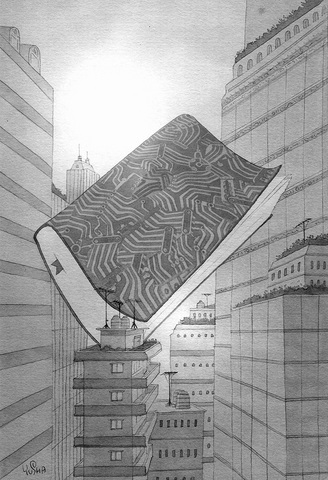
Every year at the Booker Prize, there's an odd little ritual in which six 21st century writers come face to face with the art and craft of the book as Chaucer knew it. Before the winner is announced, each writer is presented with a sumptuous, hand-tooled, hardback edition of their novel. Once a reaffirmation of a venerable, but vital, tradition, in years to come this ceremony may seem absurdly quaint. All the signs are that the book as we know it may be going the way of the codex and the illuminated manuscript.
This is paradoxical. Rarely in the UK has the book trade seemed so vigorous. In 1990, 65,000 new titles were published here. Last year, the total had risen to a staggering 161,000, far greater, pro rata, than France, Germany or even the US. Never mind the figures.
The UK's literary microclimate is tropical in its fever and Elizabethan in its profusion. Book festivals from the south coast to Scotland heave with visitors; book clubs and reading groups have become middle England's bingo; book prize news breaks ceaselessly.
And then there's the broadcasters. No genre of contemporary writing escapes the programmers.
If, on this evidence, you were tempted to call this a golden age of publishing, you should first talk to the publishers. To them, the IT revolution cuts both ways. It has inspired a boom, but it also threatens to turn the book world upside down.
"I spend four-fifths of my time worrying about technology," said Richard Charkin, president of the Publishers' Association.
In the near future, Charkin believes that book publishing will be unrecognizable.
The future might already be here. Microchips have transformed the music business (iTunes) and film and TV (DVDs).
"It's only a matter of time before this same type of functionality comes to the book world," said Paul Carr, editor in chief of Web-to-print publishing house the Friday Project.
"The moment someone invents a portable electronic reader that looks [and reads] like paper and that allows books to be downloaded on to it, there will be an explosion of e-books," he said.
When that invention arrives, and from where, is anyone's guess, but companies such as Sony and Philips are striving for the big breakthrough. As Carr points out, "digital time" is faster than "normal time." In 50 years, the industry is likely to experience the equivalent of 1,000 years of technological change. This, from a purist perspective, has already begun. Not since Johannes Gutenberg (German metal worker credited with inventing moveable type in the early 15th century) has technology so transformed the way we receive the written word. Text has already become electronic in so many ways: e-mail, Web sites, blogs, CD-Roms and text messaging.
In India, Macmillan recently launched a scheme with operator Airtel that enables subscribers to download definitions of English words to their mobiles for a fraction of a rupee each. How long will it be before the Oxford English Dictionary promotes a similar scheme to mobile users in the UK?
Almost every IT expert in the world is agreed that the book faces a revolutionary challenge from e-books and e-paper.
"In the next five to 10 years, maybe much sooner, we'll see a decent, ultra-lightweight, portable e-paper device that allows book lovers to download titles straight from the Internet, either legally or illegally," Carr said.
Dick Brass, a retired Microsoft vice-president with wide experience of e-readers, agrees: "Tablet devices are getting lighter and cheaper. Eventually, and I'm betting it will be before 2020, one of these devices, like the iPod in music, will offer an experience close enough to paper to shift the paradigm to digital distribution. That will mark the beginning of the end of the age of paper books."
Recently, in Las Vegas, these predictions seemed close to being fulfilled when Sony launched a brand-new e-reader, selling for US$300-US$500. The experience of the last generation of e-readers (launched in 2000) suggests that it's too soon to celebrate; these failed because they did not match the experience of book reading. The new Sony Reader, however, is said to be "everything the Librie [the first generation of e-book reader] should have been."
What will it be, this thing that replaces the book? In a jittery, competitive market, there is a lot of hearsay and disinformation.
Brass said that one problem is that there is no working model, like Apple's iTunes, to set an example to the industry.
"We still need high-quality, low-cost devices," he said, "that provide a user experience much closer to paper reading."
Almost certainly, any new e-reader will use E Ink, a display technology that forms text by electronically arranging thousands of tiny black-and-white capsules, achieving an experience similar to reading a printed page.
When it comes, the e-reader will store hundreds or thousands of titles and support a digital rights management technology that will allow publishers to police the way their copyrights are exploited.
They will not, for instance, want e-readers to be able to send books to their friends' readers. To retain commercial advantage, publishers may also want to allow access to a title for a limited time before it has to be repurchased.
The e-paper reader will be able to search the contents of a book at the touch of a button.
"Imagine a student having 50 law textbooks stored on their e-paper reader. They'll be able to see a case reference in one book, click on it and find the full text of the case in another book," Carr said.
Jacob Weisberg, editor of US e-magazine Slate, has a similar vision.
What the market needs is "a reading device the size of a paperback with a good screen and long battery life that can download book, newspaper and magazine pages," Weisberg said.
"It should also have a wireless Web connection and software that allows you to listen to an audio version and readily switch back and forth between reading and being read to. As with the iPod, most of the technology to do this already exists and is waiting for someone to market it brilliantly," he said.
Weisberg, a passionate bibliophile who delights in trawling secondhand bookshops for modern first editions, concedes that a book is a lovely thing and believes that hardback books will become more like illuminated manuscripts after Gutenberg.
"You will keep in your home only ones you find attractive, or have a sentimental connection to. Owning printed books will eventually become synonymous with collecting them," he said.
Cultural conservatives take an opposite view. John Updike has written: "Our notion of a book is of a physical object, precious even if no longer hand-copied on sheepskin by monks ... that books endure suggests we endure, our inner tale not writ in the water of e-ink."
Less mistily, there is the brilliant simplicity of the book. It remains a highly efficient "random access device," a point of view expressed by writer Nicholson Baker who, as long ago as 1995, wrote: "We've come up with a beautifully browsable invention that needs no electricity and exists in a readable form no matter what happens."
Necessity may turn out to be the midwife of innovation. Environmental pressure might provide the breakthrough.
As Brass puts it: "We cannot long sustain the un-green traffic in dead trees that lies at the root of the great paper-based empires -- newspapers, magazines, direct mail and books -- especially as the economies of China and India kick into high gear."
In the industrialized West, the IT revolution is now sending shock waves through the world of books. Last year, Google's proposed digitization of five great copyright libraries (Oxford, Stanford, Harvard, Michigan and the New York Public Library) threatened the very bone-marrow of the business: copyright.
It's no surprise to find one of Google's most outspoken critics, Nigel Newton, chairman of Bloomsbury, coyly hinting at "a very big announcement" in the course of this year. Newton is certain that "within seven to 10 years, 50 percent of all book sales will be downloads. When the e-reader emerges as a mass-market item, the shift will be very rapid indeed. It will soon be a dual-format market."
That prediction makes a lot of sense. E-books will not replace the old format any more than the motorcar replaced the bicycle, or typewriters the pen.
Digitization, meanwhile, has become the buzzword. Digitize or die is how Richard Charkin puts it. He is an advocate of the opportunities afforded by the new technology, but he doesn't believe that "people are going to read novels on the screen in a serious way. Non-fiction is a different genre."
The cutting-edge of e-book innovation lies in the reference and technical book divisions. Here, he said, echoing a widespread perception, "none of the big general UK book publishers [Random House, HarperCollins, Penguin] has really embraced the new technology."
At this point, the discussion morphs from the likelihood of an e-book within a decade to a conversation about what the IT revolution is doing to the book trade on the shop floor. For Charkin, the survival of the printed book lies with "on-demand printing," in which on-demand printers, installed in bookshops and service stations, will enable the reader to access a publisher's backlist and make a high-speed print-out of a single copy of a book.
"The technology is not there yet," said Charkin, "but in 10 years, who knows?" In this vision, publishers retain the copyright and, having digitized their back catalogues, also derive income from the trade. The on-demand book will lack the aesthetic appeal of a conventional hardback, but in the knowledge economy of the 21st century, this may not be significant.
Such speculation will not liberate the written word from its inalienable place on the page. The word, written and spoken, remains at the heart of our civilization. There is every reason to want to see the printed word enhanced by something more in tune with current information technology, but until the geeky entrepreneurs of MIT, Microsoft, Google, Amazon and the rest can come up with something that looks like a book, feels like a book and behaves like a book, those who handle such items every day, and marvel over the magical integration of print, paper and binding, will continue to read and enjoy books much as Gutenberg did.
Recently, China launched another diplomatic offensive against Taiwan, improperly linking its “one China principle” with UN General Assembly Resolution 2758 to constrain Taiwan’s diplomatic space. After Taiwan’s presidential election on Jan. 13, China persuaded Nauru to sever diplomatic ties with Taiwan. Nauru cited Resolution 2758 in its declaration of the diplomatic break. Subsequently, during the WHO Executive Board meeting that month, Beijing rallied countries including Venezuela, Zimbabwe, Belarus, Egypt, Nicaragua, Sri Lanka, Laos, Russia, Syria and Pakistan to reiterate the “one China principle” in their statements, and assert that “Resolution 2758 has settled the status of Taiwan” to hinder Taiwan’s
Singaporean Prime Minister Lee Hsien Loong’s (李顯龍) decision to step down after 19 years and hand power to his deputy, Lawrence Wong (黃循財), on May 15 was expected — though, perhaps, not so soon. Most political analysts had been eyeing an end-of-year handover, to ensure more time for Wong to study and shadow the role, ahead of general elections that must be called by November next year. Wong — who is currently both deputy prime minister and minister of finance — would need a combination of fresh ideas, wisdom and experience as he writes the nation’s next chapter. The world that
The past few months have seen tremendous strides in India’s journey to develop a vibrant semiconductor and electronics ecosystem. The nation’s established prowess in information technology (IT) has earned it much-needed revenue and prestige across the globe. Now, through the convergence of engineering talent, supportive government policies, an expanding market and technologically adaptive entrepreneurship, India is striving to become part of global electronics and semiconductor supply chains. Indian Prime Minister Narendra Modi’s Vision of “Make in India” and “Design in India” has been the guiding force behind the government’s incentive schemes that span skilling, design, fabrication, assembly, testing and packaging, and
Can US dialogue and cooperation with the communist dictatorship in Beijing help avert a Taiwan Strait crisis? Or is US President Joe Biden playing into Chinese President Xi Jinping’s (習近平) hands? With America preoccupied with the wars in Europe and the Middle East, Biden is seeking better relations with Xi’s regime. The goal is to responsibly manage US-China competition and prevent unintended conflict, thereby hoping to create greater space for the two countries to work together in areas where their interests align. The existing wars have already stretched US military resources thin, and the last thing Biden wants is yet another war.


 RSS
RSS