


When EU political leaders meet for their summer summit tomorrow, some of them are bound to recall an earlier summit.
The clear rejection of the EU constitution delivered by French and Dutch voters, rampant euro-skepticism in Britain and even growing doubt in Luxembourg, traditionally a pro-EU bastion, have sent an unmistakable message that the ordinary citizens are turning away.
This is exactly what the EU heads of state and government noted in the Laeken declaration of December 2001.
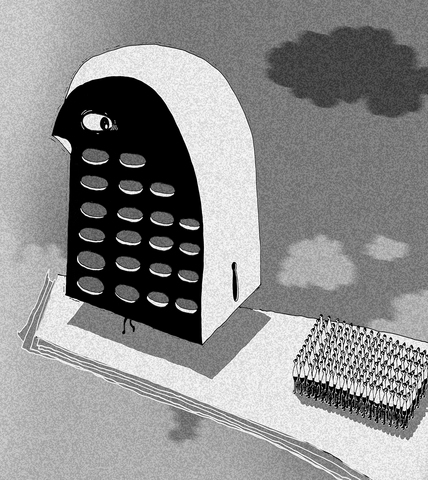
ILLUSTRATION: MOUNTAIN PEOPLE
"What counts is more results, better responses to practical issues and not a European superstate or European institutions inveigling their way into every nook and cranny," it said.
The declaration, named for the part of Brussels where it took place, is surprisingly frank about EU shortcomings.
It notes that EU citizens see its institutions as taking decisions over their heads and demand greater democratic control of EU decision-making bodies.
At Laeken, the leaders asked how they could bring the European project closer to EU citizens, in particular its youth.
"The union needs to become more democratic, more transparent and more efficient," the declaration says.
"It also has to resolve three basic challenges: how to bring citizens, and primarily the young, closer to the European design and the European institutions, how to organize politics and the European political area in an enlarged union and how to develop the union into a stabilizing factor and a model in the new, multipolar world."
The answers were to come from the convention set up immediately after Laeken which reported back in 2003 in the form of the first EU constitution. This calls for mere democracy and transparency and simplified decision-making.
It also outlines greater unity in the most important political areas, while at the same time reducing interference by Brussels in other areas.
But the citizens of the EU clearly do not see it this way.
In the Netherlands, the reason given by more than half of those rejecting the constitution was that they feared the loss of their own cultural identity and resented decisions being taken by remote EU institutions.
Although every household received an abbreviated version of the constitution, almost half of those asked said they felt ill-informed about the main issues.
The Dutch "Nee" earlier this month and the French "Non" days earlier have brought the politicians down to earth with a bang.
Either the questions posed at Laeken must receive a new set of answers or the citizens of the EU have to be convinced that the constitution is a sound and necessary one.
Moreover the reforms urgently needed, but now on ice as a result of the negative referendums, have to be implemented somehow if the enlarged union is to continue to function.
EU bureaucrats are agreed that the union can scarcely continue the way it is.
The question for many is not whether the lengthy constitution is past revival, but whether the ideas that underpin it still have any force for Europe's citizens.
Those citizens are still, as Laeken put it, waiting for a concept for "developing a Europe which points the way ahead for the world."
Could Asia be on the verge of a new wave of nuclear proliferation? A look back at the early history of the North Atlantic Treaty Organization (NATO), which recently celebrated its 75th anniversary, illuminates some reasons for concern in the Indo-Pacific today. US Secretary of Defense Lloyd Austin recently described NATO as “the most powerful and successful alliance in history,” but the organization’s early years were not without challenges. At its inception, the signing of the North Atlantic Treaty marked a sea change in American strategic thinking. The United States had been intent on withdrawing from Europe in the years following
My wife and I spent the week in the interior of Taiwan where Shuyuan spent her childhood. In that town there is a street that functions as an open farmer’s market. Walk along that street, as Shuyuan did yesterday, and it is next to impossible to come home empty-handed. Some mangoes that looked vaguely like others we had seen around here ended up on our table. Shuyuan told how she had bought them from a little old farmer woman from the countryside who said the mangoes were from a very old tree she had on her property. The big surprise
The issue of China’s overcapacity has drawn greater global attention recently, with US Secretary of the Treasury Janet Yellen urging Beijing to address its excess production in key industries during her visit to China last week. Meanwhile in Brussels, European Commission President Ursula von der Leyen last week said that Europe must have a tough talk with China on its perceived overcapacity and unfair trade practices. The remarks by Yellen and Von der Leyen come as China’s economy is undergoing a painful transition. Beijing is trying to steer the world’s second-largest economy out of a COVID-19 slump, the property crisis and
As former president Ma Ying-jeou (馬英九) wrapped up his visit to the People’s Republic of China, he received his share of attention. Certainly, the trip must be seen within the full context of Ma’s life, that is, his eight-year presidency, the Sunflower movement and his failed Economic Cooperation Framework Agreement, as well as his eight years as Taipei mayor with its posturing, accusations of money laundering, and ups and downs. Through all that, basic questions stand out: “What drives Ma? What is his end game?” Having observed and commented on Ma for decades, it is all ironically reminiscent of former US president Harry


 RSS
RSS