


Russia's residual neighborhood watch scheme in what was once the Soviet Union's tightly policed backyard took another knock last week when Ukraine, Georgia, Azerbaijan and Moldova joined forces in a new "union of democratic states."
Georgian President Mikhail Saakashvili, who has been a thorn in Moscow's side since Tbilisi's 2003 "rose revolution," said the grouping would "not act as a counter-balance or a reproach to anyone."
But then he offered a reproach anyway. Friendship based on independence and freedom, he said, was very different from belonging to "an alliance like the Warsaw Pact or an empire like the Soviet Union."
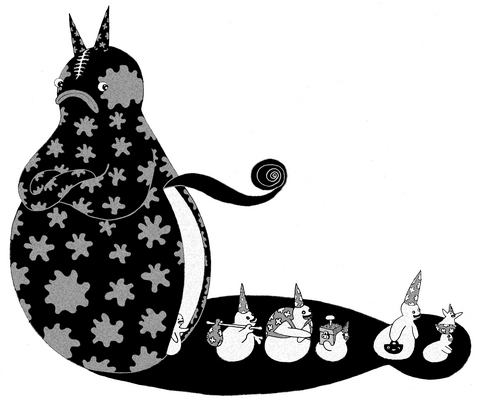
ILLUSTRATION: MOUNTAIN PEOPLE
The timing was probably not coincidental.
MOSCOW MEETING
Along with a host of world leaders, US President George W. Bush will be in Moscow on May 9 to mark the 60th anniversary of Nazi Germany's defeat.
Bush, who backed Ukraine's pro-democracy "orange revolution" last year, will also visit Georgia, where the US launched a US$50 million military training program on the weekend and where it has become Saakashvili's principal ally.
It is no accident, either, that the US leader will visit Latvia which, like Lithuania and Estonia, escaped Moscow's clutches in the 1990s and joined NATO and the EU. They are now viewed as role models by several post-Soviet states.
Last week's fleeting Kremlin visit by US Secretary of State Condoleezza Rice was meant to smooth the way for Bush's meeting with Russian President Vladimir Putin.
UNDIPLOMATIC REMARKS?
But Rice's comments on regional issues, coupled with the latest machinations of Moscow's unforgiving former satellites, exacerbated Russian geopolitical paranoia.
Denouncing the Belarus government of President Alexander Lukashenko as Europe's last dictatorship, Rice said it was "time for a change."
She hinted that forthcoming elections there could be the next target for the US "soft power" pro-democracy pressure tactics perfected in Serbia in 2000.
Unfortunately for Putin, benighted Belarus is just about the only Russian neighbor that still follows an unequivocal pro-Moscow line. Russian Foreign Minister Sergei Lavrov told Rice to mind her own business.
Russia's once unchallenged influence in central Asia is also slipping. The US has established military bases in the area since the Sept. 11 attacks. And, as recent upheavals in Kyrgyzstan suggest, regime change can be catching.
RUSSIAN PARANOIA
In this atmosphere, the post-Soviet Commonwealth of Independent States' summit scheduled for Moscow on May 8, which includes Ukraine and Georgia, could prove a schismatic and even terminal meeting.
In a country historically fearful of encirclement and fragmentation, these accelerating neighborhood trends are seen by many Russians as externally threatening and domestically destabilizing.
In his Cold Peace: Russia's New Imperialism, Janusz Bugajski said that Moscow's neighborhood botch stems from internal weakness as much as foreign policy bungling.
Russia "gained an empire before it became a state or a coherent nation," he wrote.
Contrary to its vital interests and despite reduced capabilities, Russia continued to brandish regional ambitions like "phantom limbs," Bugajski argued.
But while the result has been repeated humiliations, rising hardline nationalism and falling confidence in an increasingly dictatorial Putin, Russia's leader retains several trump cards.
PARTNERSHIP NEEDS
Rice admitted the US needed a "strategic partnership" on nuclear proliferation, the Balkans and the Middle East and terrorism.
And then there are Russia's vast energy resources, on which the West increasingly relies.
As at their Bratislava tete-a-tete in February, Bush can be expected to balance "freedom's cause" with pragmatic calculations when he meets Putin.
According to Anatol Lieven, an analyst, "Putin may be an uncomfortable partner but the West is unlikely to get a better one."
Washington hopes the democratic revolutions in the "post-Soviet sphere" will ultimately spread to Russia itself.
But it knows such a transformation runs the risk of a disastrous, post-Putin relapse into unrestrained authoritarianism and an anti-Western siege mentality.
Recently, China launched another diplomatic offensive against Taiwan, improperly linking its “one China principle” with UN General Assembly Resolution 2758 to constrain Taiwan’s diplomatic space. After Taiwan’s presidential election on Jan. 13, China persuaded Nauru to sever diplomatic ties with Taiwan. Nauru cited Resolution 2758 in its declaration of the diplomatic break. Subsequently, during the WHO Executive Board meeting that month, Beijing rallied countries including Venezuela, Zimbabwe, Belarus, Egypt, Nicaragua, Sri Lanka, Laos, Russia, Syria and Pakistan to reiterate the “one China principle” in their statements, and assert that “Resolution 2758 has settled the status of Taiwan” to hinder Taiwan’s
Singaporean Prime Minister Lee Hsien Loong’s (李顯龍) decision to step down after 19 years and hand power to his deputy, Lawrence Wong (黃循財), on May 15 was expected — though, perhaps, not so soon. Most political analysts had been eyeing an end-of-year handover, to ensure more time for Wong to study and shadow the role, ahead of general elections that must be called by November next year. Wong — who is currently both deputy prime minister and minister of finance — would need a combination of fresh ideas, wisdom and experience as he writes the nation’s next chapter. The world that
The past few months have seen tremendous strides in India’s journey to develop a vibrant semiconductor and electronics ecosystem. The nation’s established prowess in information technology (IT) has earned it much-needed revenue and prestige across the globe. Now, through the convergence of engineering talent, supportive government policies, an expanding market and technologically adaptive entrepreneurship, India is striving to become part of global electronics and semiconductor supply chains. Indian Prime Minister Narendra Modi’s Vision of “Make in India” and “Design in India” has been the guiding force behind the government’s incentive schemes that span skilling, design, fabrication, assembly, testing and packaging, and
Can US dialogue and cooperation with the communist dictatorship in Beijing help avert a Taiwan Strait crisis? Or is US President Joe Biden playing into Chinese President Xi Jinping’s (習近平) hands? With America preoccupied with the wars in Europe and the Middle East, Biden is seeking better relations with Xi’s regime. The goal is to responsibly manage US-China competition and prevent unintended conflict, thereby hoping to create greater space for the two countries to work together in areas where their interests align. The existing wars have already stretched US military resources thin, and the last thing Biden wants is yet another war.


 RSS
RSS