


With the weak dollar hanging like the sword of Damocles over the global economy, almost everyone laments America's spendthrift habits. But did it ever occur to anybody how hard Americans must work to make everyone else look good?
Thanks to the US' gaping trade deficits, the biggest headache of every developing country finance minister nowadays is trying to keep his or her country's currency from going up too fast against the dollar. When was the last time that happened? Chronic debt-crisis countries from Mexico to Russia to South Korea are all fighting off capital inflows from investors looking for an exit as the dollar collapses.
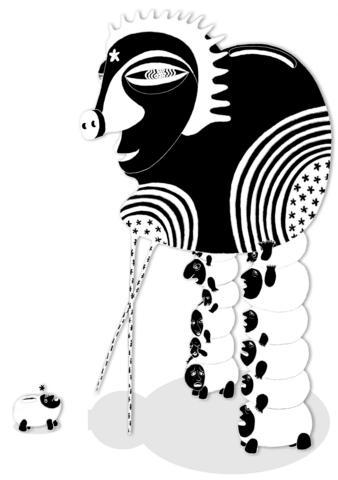
ILLUSTRATION MOUNTAIN PEOPLE
Ordinarily, as the world comes out of a downturn and global interest rates rise, at least one or two emerging market countries suffers a spectacular blowup. Not likely this time, at least for the next year.
True, policy in some countries has improved markedly. Brazil and Turkey, for example, have each instituted market-friendly policies that have made their economies more flexible and growth more durable. But can the same be said for Mexico, where reform has stalled, or for Russia, where reforms have been reversed? The US' reckless deficit spending is making all their currencies look like good investments for this year.
So non-Americans should be more appreciative of the US' deficits. Do people think it is easy for a US$12 trillion economy to spend beyond its means year after year just to prop up other countries' reputations for stability? It isn't. Going deep into debt when you have that much money to spend takes a lot of hard work.
Start with the US consumer, who consumes everything on earth (helping the US eat up 25 percent of world oil production) but saves essentially nothing. Thanks to America's gold-plated financial system, its consumers can buy fancy cars with almost no down payment. They can borrow more and more each year against the value of their homes, and spend every cent. They can retire earlier and earlier on their smaller and smaller savings. It takes nerve and energy to live like that.
Of course, the US government does it share, too, and more. When President George W. Bush took office in 2001, he was staring at giant budget surpluses as far as the eye could see. It was hard work engineering a US$5 trillion deterioration in the US' fiscal position.
Cutting taxes was easy, but hiking spending on virtually every program involves a lot of legislation. Sure, the decision to invade Iraq was a big help in pushing the country's finances off a cliff, but that is far from the whole story. So why is the world so ungrateful?
Maybe some Europeans and Japanese are upset that they have consistently earned such poor returns on their US investments. Part of the problem has been the sinking dollar, which makes dollar investments look bad when translated into yen or euro.
Part of the blame also lies with bad market timing. Many Europeans bought into the US stock market at its peak in 1999 and 2000, only to find themselves selling at steep discounts after the collapse of 2001.
The same happened to the Japanese in real estate. Japanese financiers bought up pricey trophy properties like Rockefeller Center in New York and the Pebble Beach Golf Club in California, and then had to sell later at rock-bottom prices. These investment failures have been great for Americans, who owe a lot less to foreigners than they would otherwise.
Unfortunately, this cannot go on forever. Foreigners are either going to start earning much better returns in the US, pushing American debt levels into unsustainable territory, or else they will pull back and invest elsewhere. Either way, the dollar collapse has to continue.
So how low can the dollar sink? By my calculations, the dollar still needs to go down another 15 percent if the US trade deficit is to go back toward balance. Ideally, Asian currencies would rise much more than 15 percent while European currencies would rise less.
Unfortunately, there is a real danger that we may see the opposite, with the euro going to US$1.50 or beyond. Governments may try to resist the fall of the dollar, but in today's world of deep and fluid capital markets, they will not succeed indefinitely, even in Asia.
Moreover, although US policy is making everyone else look good for now, things might not be so comfortable if the dollar collapse leads to skyrocketing interest rates and a sustained global slowdown. Some of the countries that look so strong today may suddenly experience the kind of financial crises that they thought they had left behind.
Even if countries avoid the immediate blow of a dollar collapse, they still have to watch for a boomerang effect. Exchange rates have a nasty habit of overshooting their equilibrium values, then knifing back on countries, especially those who have been spending too much based on inflated income valuations.
OK, so maybe it is too soon for the world to start toasting the US' insane consumption patterns. Even so, isn't it generous of the Americans to make everyone else look so sober and frugal, if only for the moment?
Kenneth Rogoff is professor of economics and public policy at Harvard University, and was formerly chief economist at the IMF.
Copyright: Project Syndicate
Recently, China launched another diplomatic offensive against Taiwan, improperly linking its “one China principle” with UN General Assembly Resolution 2758 to constrain Taiwan’s diplomatic space. After Taiwan’s presidential election on Jan. 13, China persuaded Nauru to sever diplomatic ties with Taiwan. Nauru cited Resolution 2758 in its declaration of the diplomatic break. Subsequently, during the WHO Executive Board meeting that month, Beijing rallied countries including Venezuela, Zimbabwe, Belarus, Egypt, Nicaragua, Sri Lanka, Laos, Russia, Syria and Pakistan to reiterate the “one China principle” in their statements, and assert that “Resolution 2758 has settled the status of Taiwan” to hinder Taiwan’s
Singaporean Prime Minister Lee Hsien Loong’s (李顯龍) decision to step down after 19 years and hand power to his deputy, Lawrence Wong (黃循財), on May 15 was expected — though, perhaps, not so soon. Most political analysts had been eyeing an end-of-year handover, to ensure more time for Wong to study and shadow the role, ahead of general elections that must be called by November next year. Wong — who is currently both deputy prime minister and minister of finance — would need a combination of fresh ideas, wisdom and experience as he writes the nation’s next chapter. The world that
The past few months have seen tremendous strides in India’s journey to develop a vibrant semiconductor and electronics ecosystem. The nation’s established prowess in information technology (IT) has earned it much-needed revenue and prestige across the globe. Now, through the convergence of engineering talent, supportive government policies, an expanding market and technologically adaptive entrepreneurship, India is striving to become part of global electronics and semiconductor supply chains. Indian Prime Minister Narendra Modi’s Vision of “Make in India” and “Design in India” has been the guiding force behind the government’s incentive schemes that span skilling, design, fabrication, assembly, testing and packaging, and
Can US dialogue and cooperation with the communist dictatorship in Beijing help avert a Taiwan Strait crisis? Or is US President Joe Biden playing into Chinese President Xi Jinping’s (習近平) hands? With America preoccupied with the wars in Europe and the Middle East, Biden is seeking better relations with Xi’s regime. The goal is to responsibly manage US-China competition and prevent unintended conflict, thereby hoping to create greater space for the two countries to work together in areas where their interests align. The existing wars have already stretched US military resources thin, and the last thing Biden wants is yet another war.


 RSS
RSS