


Recent news coverage showed Ken Lay, the former chief executive officer (CEO) of Enron, being led away in handcuffs. Finally -- years after Enron's collapse -- Lay faces charges for what happened when he was at the helm. As is so often the case in such circumstances, the CEO pleads innocence: he knew nothing about what his underlings were doing. Bosses like Lay always seem to feel fully responsible for their companies' successes -- how else could they justify their exorbitant compensation? But the blame for failure -- whether commercial or criminal -- always seems to lie elsewhere.
America's courts (like Italy's courts in the case of Parmalat) will make the final judgment over criminal and civil liability under existing law. But there is a broader issue at stake in such cases: to what extent should a CEO be held responsible for what happens under his watch?
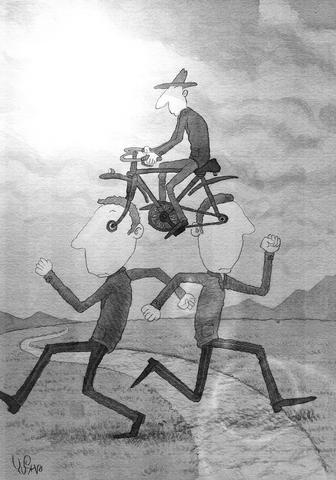
ILLUSTRATION: YU SHA
Clearly, no CEO of a large corporation, with hundreds of thousands of employees, can know everything that goes on inside the company he or she runs. But if the CEO is not accountable, who is? Those below him claim that they were just doing what they thought was expected of them. If they were not following precise orders, they were at least responding to vague pro forma instructions from the top: don't do anything illegal, just maximize profits. The result, often enough, is a climate within which managers begin to feel that it is acceptable to skirt the edges of the law or to fudge company accounts.
Even though a CEO cannot know everything, he or she is still ultimately responsible for what occurs in the company they run. They choose their subordinates, so it is their responsibility to ask the hard questions about what is going on under their watch. More importantly, it is their responsibility to create a climate that encourages, or discourages, certain kinds of activities. Simply put, it is their responsibility to be true leaders.
What's true for business bosses is doubly true for presidents and prime ministers. The US is in the process of choosing who will lead it for the next four years. President George W. Bush may claim that he didn't know that the information he was provided by the CIA concerning weapons of mass destruction in pre-war Iraq was so faulty. He may also claim that, with many thousands of troops under his command, it was impossible for him to ensure that US soldiers were not committing atrocities, torture, or violations of civil liberties.
But there is a fundamental sense in which Bush, like Lay, is culpable, and must be held accountable. Just as a CEO with a record not only of poor performance, but also of massive corporate misconduct, should be fired, so, too, should political leaders be held to a similar standard. Bush had a responsibility for the behavior of the people working for him. Instead, almost across the board in his administration, he chose as advisors people akin to Lay.
Bush chose as his vice-president a man who once served as CEO of Halliburton. Dick Cheney clearly cannot be held responsible for corporate misconduct after he left Halliburton, but there is mounting evidence about misconduct that took place while he was at the helm. Similarly, at the Securities and Exchange Commission, Bush appointed in the person of Harvey Pitt a fox to guard the chickens -- until public outrage forced Pitt's resignation.
Bush chose the people who provided him with faulty information about Iraq, or at least he chose the heads of the organizations that provided the faulty information. He chose his defense secretary and attorney general. He, and the people he appointed, created an environment of secrecy, a system in which the normal checks on the accuracy of information were removed.
Most importantly, Bush did not ask the hard questions -- perhaps because he, like those below him, already knew the answers they wanted. They created a closed culture, impervious to contradictory facts, a culture in which civil rights have been given short shrift and some people have been deemed not to deserve any rights at all.
Only such a culture -- one that undermined the longstanding presumption that an accused person is innocent until proven guilty -- could produce the Bush administration's niggling legal distinctions concerning what is and what is not torture. The abuses that have been documented at places such as Abu Ghraib and Guantanamo may not have been an inevitable consequence of the administration's legal memos, but surely those memos increased enormously the likelihood that torture would be viewed as acceptable.
Many Americans will reject Bush this November because of the poor performance of the economy or the quagmire in Iraq. Others will oppose him due to his environmental record or his budget priorities. But the intensity of opposition in America to Bush runs deeper than any single issue. There is a growing recognition that the values he and his administration reflect are the antithesis of what America has long stood for -- the values of an open society, in which differences of view are freely debated within a culture of civility and mutual respect for the rights of all.
The battle being waged in America today to restore these values is one that has been waged repeatedly around the world. Both in America and elsewhere, much hinges on the outcome, for it is nothing less than a battle to force our leaders to accept responsibility for their actions.
Joseph Stiglitz is professor of economics at Columbia University and a member of the Commission on the Social Dimensions of Globalization. He received the Nobel Prize in Economics in 2001. Copyright: Project Syndicate
Recently, China launched another diplomatic offensive against Taiwan, improperly linking its “one China principle” with UN General Assembly Resolution 2758 to constrain Taiwan’s diplomatic space. After Taiwan’s presidential election on Jan. 13, China persuaded Nauru to sever diplomatic ties with Taiwan. Nauru cited Resolution 2758 in its declaration of the diplomatic break. Subsequently, during the WHO Executive Board meeting that month, Beijing rallied countries including Venezuela, Zimbabwe, Belarus, Egypt, Nicaragua, Sri Lanka, Laos, Russia, Syria and Pakistan to reiterate the “one China principle” in their statements, and assert that “Resolution 2758 has settled the status of Taiwan” to hinder Taiwan’s
Singaporean Prime Minister Lee Hsien Loong’s (李顯龍) decision to step down after 19 years and hand power to his deputy, Lawrence Wong (黃循財), on May 15 was expected — though, perhaps, not so soon. Most political analysts had been eyeing an end-of-year handover, to ensure more time for Wong to study and shadow the role, ahead of general elections that must be called by November next year. Wong — who is currently both deputy prime minister and minister of finance — would need a combination of fresh ideas, wisdom and experience as he writes the nation’s next chapter. The world that
Can US dialogue and cooperation with the communist dictatorship in Beijing help avert a Taiwan Strait crisis? Or is US President Joe Biden playing into Chinese President Xi Jinping’s (習近平) hands? With America preoccupied with the wars in Europe and the Middle East, Biden is seeking better relations with Xi’s regime. The goal is to responsibly manage US-China competition and prevent unintended conflict, thereby hoping to create greater space for the two countries to work together in areas where their interests align. The existing wars have already stretched US military resources thin, and the last thing Biden wants is yet another war.
Since the Russian invasion of Ukraine in February 2022, people have been asking if Taiwan is the next Ukraine. At a G7 meeting of national leaders in January, Japanese Prime Minister Fumio Kishida warned that Taiwan “could be the next Ukraine” if Chinese aggression is not checked. NATO Secretary-General Jens Stoltenberg has said that if Russia is not defeated, then “today, it’s Ukraine, tomorrow it can be Taiwan.” China does not like this rhetoric. Its diplomats ask people to stop saying “Ukraine today, Taiwan tomorrow.” However, the rhetoric and stated ambition of Chinese President Xi Jinping (習近平) on Taiwan shows strong parallels with


 RSS
RSS