


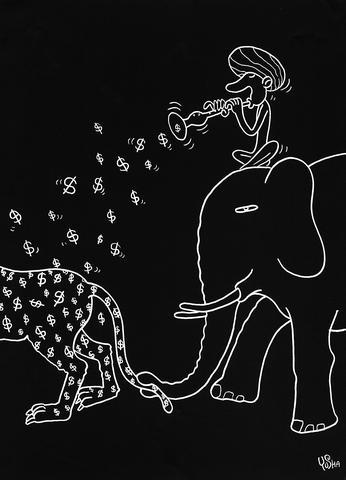
Has the Indian elephant finally mutated into a tiger? Its potential was never in doubt, but its stately pace has been a source of annoyance for some foreign investors and economists. Over the last few months, however, there has been a recognition of the improvements in India's macroeconomic situation.
The world is beginning to take notice of India as not just an IT power but also a sourcing hub for sectors such as auto components, textiles and pharmaceuticals. In the US$2.3 billion ITES (information technology enabled services) sector alone, India could grow to US$23 billion by 2008, according to industry estimates.
The economy is enjoying its best period ever, with a growth rate of about 8 percent this year, making it one of the best performing economies in the world. Agricultural production is up as a result of good monsoons last year, factories are running at full capacity, corporates are earning good returns, stock markets have been on an upswing, and, most important of all, there's a new optimism in the government and its policies.
YUSHA
"The average rate of growth during 1992 to 1997 was around 7 percent, and after 1997 was under 5 percent. But this year it's been between 7.5 percent and 8 percent. Overall, all sectors are looking up with agricultural production going up, stable prices, falling interest rates, political stability, and the most recent relationship with Pakistan," says Sanjaya Baru, chief editor of Financial Express, a prominent financial daily.
So what factors have led to this feel-good factor over the past year? The Federation of Indian Chambers of Commerce and Industry (FICCI) feels last year was "an exceptionally good year. Among the outstanding achievements, the two that stand out are the projected record increase in food grain production by around 38 million tonnes in 2003-04, and the increase in foreign exchange reserves to above US$100 billion on 19 Dec. 2003."
This is a long, long way from those dismal days of 1990 to 1991 when reserves had fallen below US$1 billion, and the country had to mortgage its gold to borrow.
Moody's last week upgraded India's long-term foreign currency rating due to rising foreign investment and economic growth. India's GDP is set to move above 7 percent in 2003-2004 for the first time in seven years. GDP growth touched 8.4 percent in the second quarter of 2003-2004, the highest quarterly GDP growth ever recorded.
A close look at the figures reveals that the services sector is accelerating at a fast pace and accounted for close to two-thirds of the pick-up in the GDP growth rate in the first half of the year, while industry contributed one-quarter (24.1 percent) and agriculture one-tenth (11.7 percent).
"Domestic growth is being driven by record consumerism in housing and automobiles, which makes it a very attractive market for investors," says one fund manager. According to a recent Goldman Sachs Report, the Indian economy is expected to be the third-largest in the world by 2032, after the US and China but overtaking that of France, Germany and Japan. The stock markets have been buoyant since May 2003, with the indices doubling over the last seven months.
Adam Matthews, Asia-region specialist with JP Morgan Fleming, which has huge fund exposures in India, says: "India is being rated even higher than China at the moment, and is a hot market right now."
Buoyed by a good performance in the recent assembly elections in three major states, the Vajpayee government decided to move in for an early kill with elections this April instead of September.
N.K. Singh, of the Planning Commission, who is scripting the policy road map for FDI in various sectors, says: "There's a new awakening in the economy, and we are on track by and large."
Only a fortnight ago, Finance Minister Jaswant Singh unveiled measures to sustain the "feel-good" factor across the urban middle-class, rural, small and medium enterprises and the infrastructure sector.
Analysts feel the reduction of peak customs duty on non-agricultural goods from 25 percent to 20 percent will enhance the competitiveness of the Indian manufacturing industry.
But will the impending elections result in a slowdown in the economic reform process? The corporate sector is trusting the government on this one and feels that reforms have been broadly accepted by the country and there are no chances of reversals. The FICCI feels that the next stage of reforms should be more focused on fiscal policies and labor market reforms, without abandoning the crucial infrastructure sector. So far, government efforts to woo foreign and private investment in major infrastructure projects such as ports, airports, and electric power have not met with much interest, because of red tape, corruption and regulations. According to a Confederation of Indian Industry (CII) Business Outlook Survey last year, other factors limiting enterprise are tax administration at the state and central government levels, lack of working capital and labor disputes.
While the road network is improving, power has emerged as one of most vexing problems still plaguing India, Inc.
The CII says: "The country has been following a reform program, but it is not the time to pause. We need to move fast in the infrastructure, finance and housing sectors, and make agriculture monsoon-proof."
An encouraging sign is that the states are now increasing their efforts to create a positive investment climate with road and electricity projects.
Tarun Das, director-general of CII, feels "India has so far been acknowledged as a leader in the services industry, but for the past one-and-a-half years it is emerging as a manufacturing hub."
India is now the world's second-largest small car market after Japan. Majors such as Suzuki and Hyundai are making it a sourcing base for their global markets.
More and more Indian companies are acquiring companies abroad, having pumped out over US$1 billion already. India is now the eighth-largest overseas investor in the UK. Reliance, India's largest conglomerate with interests from oil to telecoms, acquired the UK-based Flag Group for more than US$200 million. Wockhardt acquired a mid-sized pharmaceutical firm in Wales, Mastek's software runs London's congestion charge scheme, Ranbaxy took a part of Aventis operations in France and Infosys bought an IT firm in Australia.
The loosening of controls and entry of overseas players in the Indian market, though opposed initially, has made the corporate sector stronger.
"Due to the intense competition in the market with relaxing of the boundaries, Indian companies were so busy in the gym with no time to look in the mirror at their biceps, they did not realize how strong they had become. Now they are deriving the benefits of the work done," says Anand Mahindra, vice-chairman of automobile major Mahindra & Mahindra.
And India's strengths in the global marketplace include a large pool of low-wage, English-speaking graduates.
But there is still a long way to go. China could steal business away from India if it does not move fast enough with its reforms. The tiger may still be an endangered species.
The past few months have seen tremendous strides in India’s journey to develop a vibrant semiconductor and electronics ecosystem. The nation’s established prowess in information technology (IT) has earned it much-needed revenue and prestige across the globe. Now, through the convergence of engineering talent, supportive government policies, an expanding market and technologically adaptive entrepreneurship, India is striving to become part of global electronics and semiconductor supply chains. Indian Prime Minister Narendra Modi’s Vision of “Make in India” and “Design in India” has been the guiding force behind the government’s incentive schemes that span skilling, design, fabrication, assembly, testing and packaging, and
Singaporean Prime Minister Lee Hsien Loong’s (李顯龍) decision to step down after 19 years and hand power to his deputy, Lawrence Wong (黃循財), on May 15 was expected — though, perhaps, not so soon. Most political analysts had been eyeing an end-of-year handover, to ensure more time for Wong to study and shadow the role, ahead of general elections that must be called by November next year. Wong — who is currently both deputy prime minister and minister of finance — would need a combination of fresh ideas, wisdom and experience as he writes the nation’s next chapter. The world that
Recently, China launched another diplomatic offensive against Taiwan, improperly linking its “one China principle” with UN General Assembly Resolution 2758 to constrain Taiwan’s diplomatic space. After Taiwan’s presidential election on Jan. 13, China persuaded Nauru to sever diplomatic ties with Taiwan. Nauru cited Resolution 2758 in its declaration of the diplomatic break. Subsequently, during the WHO Executive Board meeting that month, Beijing rallied countries including Venezuela, Zimbabwe, Belarus, Egypt, Nicaragua, Sri Lanka, Laos, Russia, Syria and Pakistan to reiterate the “one China principle” in their statements, and assert that “Resolution 2758 has settled the status of Taiwan” to hinder Taiwan’s
As former president Ma Ying-jeou (馬英九) wrapped up his visit to the People’s Republic of China, he received his share of attention. Certainly, the trip must be seen within the full context of Ma’s life, that is, his eight-year presidency, the Sunflower movement and his failed Economic Cooperation Framework Agreement, as well as his eight years as Taipei mayor with its posturing, accusations of money laundering, and ups and downs. Through all that, basic questions stand out: “What drives Ma? What is his end game?” Having observed and commented on Ma for decades, it is all ironically reminiscent of former US president Harry


 RSS
RSS