


The US government's five-color terror alert system has become almost meaningless for many Americans, with the threat level stalled inexorably at yellow for elevated risk or orange for high.
"Great. We can either be panicked, or more panicked," said Stacy Lewis, a Virginia mother of two, in a typical reaction.
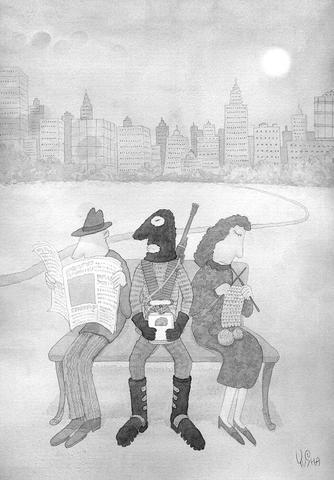
ILLUSTRATION: YU SHA
Months after the first-orange alert sent terrified Americans out to buy duct tape in February as protection against chemical attack and local governments began to bemoan the cost of extra security, experts say they see little or no chance of a lower alert level any time soon.
That will require years of success in fighting terror groups and huge improvements in domestic security, they said.
"I think for the foreseeable future, literally nothing can happen that can take us to green [the lowest risk]," said Michael O'Hanlon, an analyst at the Brookings Institution in Washington and expert on security issues.
"In terms of getting to blue [guarded risk], there's obviously some arbitrariness, and some politics in all of this, but blue is not even on the radar screen."
For a lower alert, O'Hanlon said "You would need major improvements in homeland security, further neutralization of al-Qaeda with no sign that it is being reconstituted, and also a period of years during which there isn't an attack," such as bombings in Riyadh that killed 35 people, or in Casablanca that killed 44, both in May.
In other words, a lower alert would need a significant US victory in the "war on terror," declared after the Sept. 11, 2001 attacks, including the capture of Osama bin Laden and Ayman al-Zawahiri, his deputy, but also much more, experts said.
On Tuesday, the Department of Homeland Security said it had warned the airline industry of possible suicide hijackings and bombings by al-Qaeda for the rest of the summer but said no change was anticipated in the alert level, which was yellow.
According to the Department of Homeland Security, which inaugurated the alert system in March 2002, "an Elevated [Orange] Condition is declared when there is a significant risk of terrorist attacks."
A blue alert would be declared only for a "general risk of terrorist attacks," it said. Green reflects a low risk. Red, the highest level, would be declared only if an attack on US soil were imminent or taking place, experts said.
WAR WITHOUT FRONTIER
Homeland Security chief Tom Ridge said in May that al-Qaeda was still the main danger, but threats could also come from other anti-US groups or "disgruntled individuals."
John Parachini, a terrorism expert at the Rand Corp, said the threat to the US was reduced by the removal of the Taliban government in Afghanistan, which had made that country a sanctuary for al-Qaeda.
Tightened security within the US since Sept. 11, has also helped, he said.
"Even since Sept. 12, our vigilance has greatly increased. Certainly here in the United States, we've closed many gaps in our system. However, many gaps still remain, and this is a long-term effort," Parachini said.
But like the "war on drugs," declared by then president Richard Nixon in 1971 and on which the US has spent hundreds of billions of dollars with no end in sight, the war on terror lacks a specific enemy or frontier.
And it would be even more difficult to declare won.
Some 10,000 to 70,000 people are said to have trained at al-Qaeda camps, and only a fraction have been killed or captured to date. Bin Laden and Taliban leader Mullah Omar have not been found.
In Iraq, months after US-led forces removed former Iraqi president Saddam Hussein in a pre-emptive strike justified partly by the "war on terror," many waging guerrilla attacks on US troops are Islamic fighters from other countries.
Analysts said this showed that an organized, anti-US Islamist movement remained a potent international force.
"One of the disconcerting things about the ongoing troubles in Iraq is the large number of `jihadists' from different countries who have flowed into Iraq, and essentially it's a place where people who have a long animosity to the United States want to go and fight the United States on what they perceive as Arab soil," Parachini said.
In the meantime, critics say the constant elevated alert has become meaningless and the added security it requires so expensive it could bankrupt strapped states and cities.
Financial analysts say the constant terror threat has hurt the US dollar on foreign exchange markets. Before the July 4 holiday weekend, some warned the currency could slip if the alert were raised again from yellow to orange.
Brian Roehrkasse, a spokesman for the Department of Homeland Security, said the department is trying to refine the alert system to target specific industries or areas.
"The National Homeland Security Advisory System is an evolving system that improves with each day," he said. "... At some point in time, we may actually see a blue or even a green, but we just don't have a sense of when that would be."

Could Asia be on the verge of a new wave of nuclear proliferation? A look back at the early history of the North Atlantic Treaty Organization (NATO), which recently celebrated its 75th anniversary, illuminates some reasons for concern in the Indo-Pacific today. US Secretary of Defense Lloyd Austin recently described NATO as “the most powerful and successful alliance in history,” but the organization’s early years were not without challenges. At its inception, the signing of the North Atlantic Treaty marked a sea change in American strategic thinking. The United States had been intent on withdrawing from Europe in the years following
For fans of the aesthetic, Taiwan is hailed as a pilgrimage destination for all things cute. Not just Hello Kitty, but cutesy characters of all kinds are just as common in the alleys of Taipei’s trendy Ximending (西門町) area as on the desk of a bank employee. Visitors are sometimes taken aback by its ubiquity, especially in the hallowed halls of business or government, but the cognitive dissonance resonant in the minds of many Westerners appears to be absent in Taiwan. The aesthetic of cuteness seems entwined into the nation’s very fabric. The trend is by no means exclusive to Taiwan. Neighbor
My wife and I spent the week in the interior of Taiwan where Shuyuan spent her childhood. In that town there is a street that functions as an open farmer’s market. Walk along that street, as Shuyuan did yesterday, and it is next to impossible to come home empty-handed. Some mangoes that looked vaguely like others we had seen around here ended up on our table. Shuyuan told how she had bought them from a little old farmer woman from the countryside who said the mangoes were from a very old tree she had on her property. The big surprise
Ursula K. le Guin in The Ones Who Walked Away from Omelas proposed a thought experiment of a utopian city whose existence depended on one child held captive in a dungeon. When taken to extremes, Le Guin suggests, utilitarian logic violates some of our deepest moral intuitions. Even the greatest social goods — peace, harmony and prosperity — are not worth the sacrifice of an innocent person. Former president Chen Shui-bian (陳水扁), since leaving office, has lived an odyssey that has brought him to lows like Le Guin’s dungeon. From late 2008 to 2015 he was imprisoned, much of this


 RSS
RSS