


A close inspection of China reveals a lot of revolting things. However, this observation is not so much conditions that would give an impression of revulsion to the viewer as it reflects the continuing signs of unrest as China undergoes the wrenching exercise of encountering modernization.
Beijing has always asserted that foreigners refrain from interfering with its internal affairs. However, China's opening to the outside world makes it hard for others to turn a blind eye to its domestic events. Whether the Communist leadership likes it or not, a variety of conditions in the Middle Kingdom will influence how outsiders view Beijing's current Olympic bid or its discussions over WTO membership.
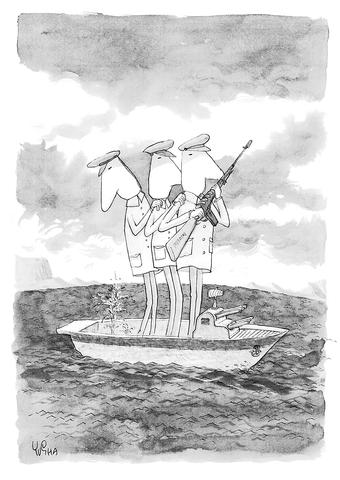
ILLUSTRATION: YU SHA
On the economic front, restructuring and downsizing of its ailing state industry are taking place in a backdrop of declining rural incomes. On the social and political front, Beijing is locked in an often-brutal struggle with separatists in its Central Asian provinces as well as with practitioners of Falun Gong (
As usual, demands for greater autonomy or independence from non-Han minorities in the far-flung provinces are met with denunciations of "splitists"whose selfish acts threaten the motherland. Such threats are not taken mildly and considerable force is being used to suppress them.
Roman Catholics have long been targets of vitriolic bile with Beijing setting up its own patriotic version of the church. It appears that some unofficial Christian churches have been disbanded and their premises destroyed.
More recently, shrill and scolding attacks on Falun Gong are being mounted in a thinly veiled ruse that is one of the oldest tricks of Chinese despots. This is to portray any opposition to their heavenly mandate as an attack on the Chinese people. Thus, criticisms of the Chinese Communist Party are reduced to a fatuous equation of the expressions of an anti-Chinese conspiracy. It is hardly worth one's breath to denounce this as rubbish.
What is more is that there is a strong anti-foreign content in attacks on Falun Gong with the Legal Daily condemning Falun Gong practitioners as "running dogs of foreign anti-Chinese forces." Ironically, Beijing seems incapable of grasping that these childish attacks are counter-productive in its quest to serve as host for the 2008 Olympic Games and to join the WTO.
Even the most cursory examination of events in China reveals that the problems of social unrest that so vex the masters of Beijing as homegrown in nature. In short, China's revolting masses are responding to the revolting messes cooked up by the communist leadership that seems incapable of reining in its cadres or filling the spiritual vacuums that are being filled by a growth in sects and religious conversions. Perhaps more troubling, there are also signs of an inability to address the insecurities arising from industrial restructuring.
For example, groups of rural peasants and urban workers who are becoming conscious of their rights are confronting opportunistic and abusive bureaucrats. Most of the protests are in response to corruption, elitism and hypocrisy. It appears that Beijing's political and legal institutions are incapable of avoiding these conflicts. Much worse is that there is little success in managing or resolving them short of using force.Perhaps the most egregious sins are those of corrupt local Communist Party cadres who have been fleecing peasants by assessing excessive fees or levying taxes in a capricious manner.
In August of last year, 20,000 angry peasants near Fengcheng City in Jiangxi Province rampaged for five-days and attacked government offices in protest over high and arbitrary taxation.
Apparently the riots followed the discovery of a pamphlet that contained guidelines for maximum taxation levels that had been exceeded by a wide margin.Coal miners in Liaoning had staged an uprising earlier last year. Then in December, hundreds of laid-off workers demonstrated outside a garment factory in Nanjing to oppose the sale of the enterprise.
In many of these instances, the complaints were based upon Communist Party documents that contain pledges guaranteeing that collectivist interests will be promoted. Yet these citations are no more likely to reflect the commitment of peasants to communism than the Tiananmen "Incident" was a statement about promoting democracy. In both instance, these actions are simple statements of disaffection with inept leadership that no longer acts in the interests of the protesting groups.
The nature of these grievances is varied but with real substance. In a report by the central government, it was revealed that rural residents face over 50 different fees. Levies imposed by the central government has been limited to no more than 5 percent of rural incomes, provincial and township governments are reported to impose fees and taxes that absorb as much as 50 percent of rural income.
These actions of unrest are occurring with the backdrop of impending losses of jobs and social welfare benefits as economic restructuring moves forward. Estimates published by the World Bank indicate that 35 percent of the 140 million workers employed by state-owned enterprise could lose their jobs. These cutbacks would push urban unemployment rate up towards 20 percent so that about 80 million out of 350 million in the urban labor force would be without jobs.
At the same time, township and village enterprises (TVEs) have seen their profits shrink due to excess capacity and employment in the rural industrial is declining. According to official estimates, a "floating population" of around 100 million migrant peasants who have been displaced by rising agricultural productivity will be joined by as many as 160 million underemployed peasants.
And so, it can be expected that the brutality of force being used against Falun Gong and other dissident groups will rise. So far, hundreds of the leaders and thousands of its followers of this "evil sect" have been detained or sent to labor camps. Monitors of human rights abuse in China estimate that over 100 Falun Gong members have perished while under arrest over the past year and a half.
Beijing finds itself skewered on the horns of an irreconcilable dilemma. Despite a highly publicized anti-corruption campaign that has netted some big fish, the misdeeds of the small fries continue to undermine its authority. With the loss of a credible claim to leadership, there will be increasing internal pressures for political reform to avert an increasing spiral of internal revolt.
With the loss of support from the masses slipping away, the illusion of acting as a dictatorship on behalf of the proletariat will soon be lost. With so many unanswered grievances, China could soon see a new peasant's revolution that will truly liberate its people from despotic oppression.
Christopher Lingle is Global Strategist for eConoLytics.com and author of The Rise and Decline of the Asian Century.
When I visited Taiwan last summer, I called on the nation to use its status as a technology superpower to build superweapons. It is obvious to me as I return a year later that Taiwan is now answering that call. By 2030, Taiwan envisions a domestic drone hub, capable of producing large quantities of drones per year. The nation continues to tighten cooperation across the private sector, scientific researchers and the elected government, on creating new and innovative production avenues for defense, while efforts to become central to the “democratic supply chain” are only increasing. Anduril is seeing all of these positive
Singaporean former Prime Minister and current senior minister Lee Hsien- Loong(李顯龍) last month stood on Chinese soil and told Beijing that Singapore cooperates because of “shared interests”, not because of common “ethnic descent,” a significant statement that has upended China’s cognitive warfare tactics of “ethnic nationalism.” Along with using its military buildup and economic growth to expand its international dominance, China has long deployed ethnic politics to promote the idea that all ethnic Chinese around the world, regardless of citizenship, share a tight bond with the Chinese motherland, by which it means the regime of the People’s Republic of China (PRC)
Chinese Nationalist Party (KMT) Chairwoman Cheng Li-wun (鄭麗文) in San Francisco on Tuesday last week said if she had not met with Chinese President Xi Jinping (習近平), she would have been “just a plain” and “even negligible” KMT chairperson, bluntly signaling the role she is playing in her visit to the US — Beijing’s messenger from Taiwan. Cheng and her delegation arrived in the US on Monday last week for a two-week visit across five major cities. Her party said the group is scheduled to meet with US lawmakers, officials, policy experts and businesspeople. Before departing, Cheng said her trip
In 1935, the German Reich led by the National Socialist Party officially created the Nuremberg Race Laws, a “legal cage”, for German Jews, stripping them of citizenship, criminalizing their personal relationships, barring them from public life, and transforming them into stateless subjects and isolating them from the rest of society. Similarly, in March 2026, the People’s Republic of China (PRC) National People’s Congress adopted the “Promoting Ethnic Unity and Progress” law, which represents the most significant shift in Chinese domestic governance since the era of Mao Zedong (毛澤東). Ostensibly designed as domestic legislation to manage China’s 56 officially recognized ethnic groups,


 RSS
RSS