


For decades, stories abounded in the Philippines of how military officers became millionaires by bilking funds intended for soldiers on the frontlines of the country's fight against communist and Muslim insurgents.
Allegations of irregularities in the armed forces' allocation of financial resources flourished, with foot soldiers often suffering from a lack of equipment and supplies, as well as poor benefits.
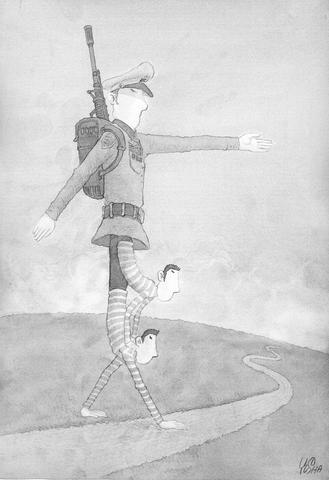
ILLUSTRATION: YU SHA
While corruption in the military is an open secret in the Philippines, a failed mutiny by hundreds of soldiers last month has finally thrust the issue into the spotlight.
More than 300 officers and soldiers -- who laid siege to a shopping center in Manila's financial district of Makati on July 27 -- said the unsuccessful coup d'etat was a last stand, after military leaders failed to investigate numerous corruption complaints in the past.
"The whole world has no idea of the gravity of corruption in the armed forces," said Navy Lieutenant Senior Grade Antonio Trillanes, one of the leaders of the aborted mutiny.
Among other accusations, the rebellious soldiers alleged the chief of the Philippines Intelligence Service, Victor Corpus, and defense secretary, Angelo Reyes, were behind a series of bomb attacks in the southern city of Davao earlier in the year.
The bombings in the troubled region of Mindanao were carried out by government-directed "special operations teams," in a bid to get more financial aid from the US to fight terrorism, the soldiers alleged.
Corpus resigned two days after the failed mutiny, calling the allegations against him "without basis."
"I feel that the restiveness will not calm down with my continued presence," Corpus said in his resignation letter.
Also highlighted after the failed putsch were off-the-book sales of military weaponry to groups in the restive southern Philippines.
Marine Captain Danilo Luna, who was not among the mutineers, came forward after the failed uprising and testified at a senate inquiry he personally escorted two trucks that delivered guns and ammunition to former Muslim rebels on the southern island of Jolo.
Luna said on Dec. 27, 1997, he escorted two military trucks loaded with 81mm mortar cartridges, 57mm rocket launchers, thousands of 50-calibre machine gun rounds, and a variety of small arms to a former mayor in the town of Panamao.
Luna said he reported the incident to the marine intelligence department in the area, but nothing came of his complaint.
According to the Commission on Audit, it has uncovered at least 77.8 million pesos (US$1.4 million) worth of missing inventory during a recent check of the supplies of the Government Arsenal (GA).
The GA, a bureau attached to the defense department, produces the basic weapons and ammunition for use of the country's military and police forces.
Lieutenant Trillanes -- one the mutineers -- said the rebellious soldiers are documenting evidence of military corruption for investigators to look at.
"My companions are preparing hundreds of affidavits of their personal knowledge regarding the irregularities in the armed forces," he told a hearing of a fact-finding commission formed to investigate the July 27 siege.
Trillanes pointed out, however, previous attempts to report anomalies have been futile, and sometimes resulted in the deaths of complainants.
He cited a case of a navy officer who was recommended for "psychiatric evaluation" after complaining about the illegal sale of fuel on the naval vessel he was assigned.
Trillanes said at least two navy officers turned up dead after allegedly discovering irregularities in their units. While their deaths were declared "suicides," their families and peers still today question the circumstances.
Trillanes said navy patrol boats were also being used to escort smugglers -- ensuring the safe travel of contraband, including guns and ammunition -- on the seas of the war-torn southern region of Mindanao.
Other forms of corruption included "ghost employees," and the diversion of budget funds allotted for the purchase of supplies, he said.
Another of the rebellious soldiers, Army Captain Milo Maestrecampo -- a bemedalled scout ranger who battled communist and Muslim guerrillas in Mindanao for eight years before joining the mutiny -- lamented the perks enjoyed by senior officers.
"I cannot see the point why here, at the [armed forces] general headquarters, there's so many staff cars. Some of them are not being used, but out there in the field our men die because there is no adequate communication equipment," he said.
Maestrecampo narrated before a fact-finding commission how these problems have been reflected in all after-encounter reports sent to the armed forces headquarters, but until now, the situation has not been taken seriously by military investigators.
"I just hope they fill in the gaps in the frontline because people there are dying," he said. "They [senior officers] are benefiting from the scores of those soldiers in the frontline. These are the reasons they became colonels and generals."
President Gloria Macapagal Arroyo has vowed to get to the bottom of the soldiers' accusations.
"The secretary of defense and the armed forces chief of staff are committed to a relentless clean-up under the principles of discipline and due process," she said.
But Senator Sergio Osmena Junior was less certain.
"We have in the past exposed several anomalies in the armed forces of the Philippines, but not one person has gone to jail," Osmena said.
Osmena warned if the government does not seriously address corruption in the armed forces -- one of the main causes of the disillusionment among young officers -- "military adventurism" will continue.
"If we do not address the causes for which the soldiers mutinied, then I believe it [the mutiny] will happen again," Osmena said.
Could Asia be on the verge of a new wave of nuclear proliferation? A look back at the early history of the North Atlantic Treaty Organization (NATO), which recently celebrated its 75th anniversary, illuminates some reasons for concern in the Indo-Pacific today. US Secretary of Defense Lloyd Austin recently described NATO as “the most powerful and successful alliance in history,” but the organization’s early years were not without challenges. At its inception, the signing of the North Atlantic Treaty marked a sea change in American strategic thinking. The United States had been intent on withdrawing from Europe in the years following
My wife and I spent the week in the interior of Taiwan where Shuyuan spent her childhood. In that town there is a street that functions as an open farmer’s market. Walk along that street, as Shuyuan did yesterday, and it is next to impossible to come home empty-handed. Some mangoes that looked vaguely like others we had seen around here ended up on our table. Shuyuan told how she had bought them from a little old farmer woman from the countryside who said the mangoes were from a very old tree she had on her property. The big surprise
The issue of China’s overcapacity has drawn greater global attention recently, with US Secretary of the Treasury Janet Yellen urging Beijing to address its excess production in key industries during her visit to China last week. Meanwhile in Brussels, European Commission President Ursula von der Leyen last week said that Europe must have a tough talk with China on its perceived overcapacity and unfair trade practices. The remarks by Yellen and Von der Leyen come as China’s economy is undergoing a painful transition. Beijing is trying to steer the world’s second-largest economy out of a COVID-19 slump, the property crisis and
Former president Ma Ying-jeou’s (馬英九) trip to China provides a pertinent reminder of why Taiwanese protested so vociferously against attempts to force through the cross-strait service trade agreement in 2014 and why, since Ma’s presidential election win in 2012, they have not voted in another Chinese Nationalist Party (KMT) candidate. While the nation narrowly avoided tragedy — the treaty would have put Taiwan on the path toward the demobilization of its democracy, which Courtney Donovan Smith wrote about in the Taipei Times in “With the Sunflower movement Taiwan dodged a bullet” — Ma’s political swansong in China, which included fawning dithyrambs


 RSS
RSS