


It’s a rare day when a mayor balks at proposals that his town be entered on the World Heritage List next to such illustrious sites as the Taj Mahal, but Mayor Eugen Furdui of Rosia Montana — a picturesque Carpathian mountain village with rich gold deposits and ancient galleries that tell the story of mining back to Roman times — is adamant.
Mining is still his priority, but the modern sort — a Canadian open-cast gold mine project that is backed by officials, but has split the town of 3,000 and drawn criticism from environmentalists, archeologists, historians and some high-profile activists, like British actress Vanessa Redgrave.
“If Rosia Montana were added to the UNESCO World Heritage List, that would automatically mean that mining cannot go through and we want this mining project to be carried on,” Furdui said.
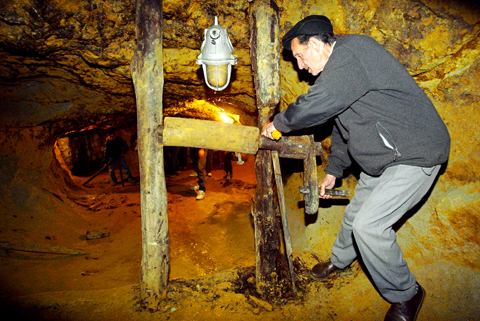
PHOTO: AFP
Ahead of a January deadline that could tip the balance, the “pros” and “cons” have mobilized anew at headquarters long set up in the town’s Old Square.
Rosia Montana’s green hills are said to hold more than 300 tonnes of gold, one of the biggest deposits in Europe, all the more attractive now that gold prices are hovering at record highs and Romania is battling a severe economic crisis.
For Furdui, the lucrative mine deal far outweighs the boost to tourism brought by a World Heritage listing.
In 1999, the Rosia Montana Gold Corp (RMGC), the daughter company of Canadian firm Gabriel Resources — which holds 80 percent of RMGC, while state mining company Minvest Deva holds nearly 20 percent — obtained a concession licence to exploit the local gold. More than a decade later, the firm has still not been granted all the required environmental and archeological permits.
Eager to push things along, Romanian Economy Minister Adriean Videanu said last year he wanted the mine, which will use a cyanide-based extraction process, to start work as soon as possible, but the opposition won’t back down, not only locals, but groups like the WWF and environmental watchdog Greenpeace, neighboring Hungary and even the Orthodox and the Unitarian churches.
In 2002, archeologists and historians from around the world joined in, saying the mine would damage one of the most extensive remaining networks of Roman mining tunnels — an allegation rejected by RMGC.
“Rosia Montana concentrates an exceptional cultural heritage when we talk about the history of mining,” said Virgil Apostol, architect at the National History Museum in Bucharest.
Traces also exist of gold mining from the medieval, Renaissance and Austro-Hungarian periods and mining brought development, so “many houses in the center of the village are listed as historical monuments in Romania because of their classical and baroque architecture,” Apostol said.
He and the Romanian group Architecture, Restoration, Archeology, want the Culture Ministry to include Rosia Montana on a “tentative UNESCO list,” a first step in the long process toward a World Heritage listing.
The International Council for Monuments and Sites, one of the three formal advisory bodies to the World Heritage Committee, supports the move, but the Culture Ministry has until January to decide.
“Rosia Montana obviously is an important site for Romania,” said Csilla Hegedus, an advisor at the ministry. “Our specialists are currently analyzing the issue.”
Irked by the maneuver, Furdui, a member of the ruling Liberal Democrat Party, shot off a letter this summer saying the ministry had no right to propose his town as a heritage site.
A rare move, according to UNESCO, which said some 90 percent of mayors of proposed sites are keen for a heritage listing.
Furdui maintains that his “community as a whole supports the mining project” and does not want the UNESCO listing, but banners displayed in the Old Square show differently, with one saying “We Want Mining,” while another proclaims “Save Rosia Montana.”
“I am against the gold mine. It feels like we are occupied by the Canadians,” said Sorin Jurca, the owner of a grocery store on Old Square.
He pointed to several historical houses bought by RMCG that now display signboards with the company’s logo, promising: “This house will be renovated when the mining project starts.”
“I agree to preserve history, but we cannot block such a colossal gold reserve,” said Valentin Rus, director of the state mining company.
To woo support, RMGC has touted job creation, last year saying 1,200 people would be employed in an initial, two-year construction phase, though the figure has now risen to 2,300. After that, 880 jobs would be created to work the mine, set to last 16 years.
“Everybody used to work in the mine here. We are not trained to do anything else. We desperately need jobs,” said resident Eusebiu Cosa, 37-year-old former miner. “The Gold Corporation project is the best solution.”
Eugen David, 45, a farmer who heads a local non-governmental organization opposed to the mine, however, feels the mine will cause “irreversible environmental damage.”
“I do not believe the company will use explosives on top of four mountains surrounding the village without causing any damage to the Roman galleries and the historical center,” David said.
“We could promote ecotourism and sustainable agriculture instead,” he said, accusing local authorities of “blocking any alternative to the mine” — a charge the mayor denies.
Andrei Gruber, a 26-year-old miner’s son, said he and his girlfriend now make a living from a hostel they opened two years ago despite “the total lack of cooperation from the municipality.”
“We are getting tourists from all around the world, from the US to Korea,” Gruber said. “I think a UNESCO listing would be very good to protect the Roman galleries.”
Even if the mayor wins, the battle may continue. RMGC says that 651 households already “chose resettlement or relocation” out of what local sources close to the project say are a total 750 to 900 households that would need to move, but villagers like David and Ovidiu Plic vow they will never leave their homes or sell their land.
“Even if I am the only one, I will not sell because I want to live here and I believe what I am doing is right,” David said.
RETHINK? The defense ministry and Navy Command Headquarters could take over the indigenous submarine project and change its production timeline, a source said Admiral Huang Shu-kuang’s (黃曙光) resignation as head of the Indigenous Submarine Program and as a member of the National Security Council could affect the production of submarines, a source said yesterday. Huang in a statement last night said he had decided to resign due to national security concerns while expressing the hope that it would put a stop to political wrangling that only undermines the advancement of the nation’s defense capabilities. Taiwan People’s Party Legislator Vivian Huang (黃珊珊) yesterday said that the admiral, her older brother, felt it was time for him to step down and that he had completed what he

Taiwan has experienced its most significant improvement in the QS World University Rankings by Subject, data provided on Sunday by international higher education analyst Quacquarelli Symonds (QS) showed. Compared with last year’s edition of the rankings, which measure academic excellence and influence, Taiwanese universities made great improvements in the H Index metric, which evaluates research productivity and its impact, with a notable 30 percent increase overall, QS said. Taiwanese universities also made notable progress in the Citations per Paper metric, which measures the impact of research, achieving a 13 percent increase. Taiwanese universities gained 10 percent in Academic Reputation, but declined 18 percent

UNDER DISCUSSION: The combatant command would integrate fast attack boat and anti-ship missile groups to defend waters closest to the coastline, a source said The military could establish a new combatant command as early as 2026, which would be tasked with defending Taiwan’s territorial waters 24 nautical miles (44.4km) from the nation’s coastline, a source familiar with the matter said yesterday. The new command, which would fall under the Naval Command Headquarters, would be led by a vice admiral and integrate existing fast attack boat and anti-ship missile groups, along with the Naval Maritime Surveillance and Reconnaissance Command, said the source, who asked to remain anonymous. It could be launched by 2026, but details are being discussed and no final timetable has been announced, the source

CHINA REACTS: The patrol and reconnaissance plane ‘transited the Taiwan Strait in international airspace,’ the 7th Fleet said, while Taipei said it saw nothing unusual The US 7th Fleet yesterday said that a US Navy P-8A Poseidon flew through the Taiwan Strait, a day after US and Chinese defense heads held their first talks since November 2022 in an effort to reduce regional tensions. The patrol and reconnaissance plane “transited the Taiwan Strait in international airspace,” the 7th Fleet said in a news release. “By operating within the Taiwan Strait in accordance with international law, the United States upholds the navigational rights and freedoms of all nations.” In a separate statement, the Ministry of National Defense said that it monitored nearby waters and airspace as the aircraft


 RSS
RSS