


The rhythmic clickety-clack of 19th-century hand looms will soon be silenced when what is thought to be the last Jacquard workshop in Europe closes in a few weeks and another traditional art disappears.
Film makers, theaters and interior designers have been keeping the LAD Jacquard fabric workshop in Warsaw alive but the economic crisis has hit all of them very hard.
“We’re in a very difficult economic situation and in a few weeks this, the oldest working Jacquard manufacturer in Europe, will become history,” said Dariusz Makowski, owner of the workshop.

PHOTO: AFP
Makowski is pessimistic that public subsidies can be found.
Invented by Frenchman Joseph Marie Jacquard in the French city of Lyon around 1800, the Jacquard loom was the first to weave complicated patterns. It revolutionized textile manufacturing and paved the way for the mechanized modern textile industry.
“It allowed fabrics with beautiful, intricate designs to be produced much faster and at a much lower cost,” Makowski said.
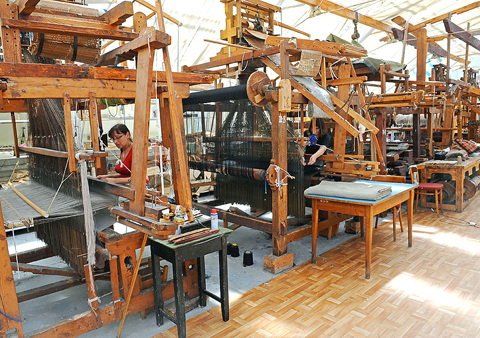
PHOTO: AFP
“In fact in the 1820s it sparked a labor movement by weavers in Lyon, a great social revolution and the rise of the weavers’ Solidarity union in 1823 to 1825 — much, much sooner than in Poland,” he remarked of the rise of Poland’s historic Solidarity union led by Nobel Prize winner Lech Walesa in 1980.
The Jacquard technique spread across Europe in the 1800s and by the 1840s large manufacturing facilities weaving Jacquard fabrics and rare laces were set up in Poland. But soon machine-operated Jacquard looms replaced their hand-operated ancestors.
“In 1926 they [the hand looms] became the property of the Warsaw Fine Arts academy and later the LAD artists’ co-operative was created. We are their successors,” Makowski said.
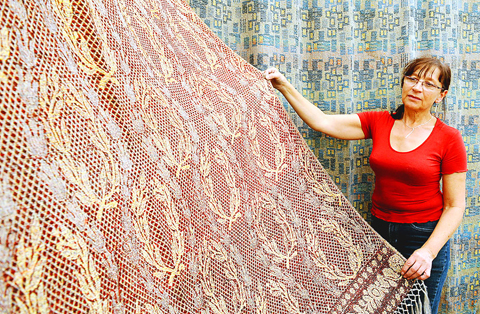
PHOTO: AFP
“This is the only remaining working cooperative of the famous ones such as Bauhaus in Germany or the Arts and Crafts Society in London,” he said.
Fifteen years ago he bought 12 19th-century wooden Jacquard looms and an inventory of 509 antique Jacquard patterns from the LAD cooperative which folded in post-communist Poland’s difficult adaptation to the market economy.
Today, the workshop is located in a ramshackle greenhouse in Warsaw’s sprawling Royal Lazienki park.
The revolutionary Jacquard loom was the first to use special punch-hole cards using a binary code to make fabric patterns using a steering mechanism on the top of the loom.
“The machine on top of the loom can be likened to a computer while the punch-card is like a kind of primitive computer program or disc,” said veteran weaver Mariola Nowakowska, 54, who has been working on looms for 30 years.
“The machine reads the punch-card and really you could say it’s a kind of a proto-computer,” she said.
A weaver on a Jacquard hand loom must be physically fit to pump its heavy wooden pedal day in, day out and have the patience of a saint to make sure each of several thousand fine threads is in its rightful place, Nowakowska said.
But the effort is rewarded by the special quality of the product.
“On hand looms fabrics are naturally more supple and light than mechanically made ones as we compact the weave by hand and we don’t have as much strength as the motor running a machine,” Nowakowska said.
An experienced weaver can produce up to 2m of Jacquard cloth per day, but Nowakowska is one of the last possessing the skill to deftly operate a Jacquard loom.
“Essentially, this craft has disappeared. We are just two weavers here and young people just aren’t interested in learning. It’s hard, complicated work. Perhaps there will be someone willing to learn, if not, it will become a museum,” Nowakowska said with a hint of sadness.

ROLLER-COASTER RIDE: More than five earthquakes ranging from magnitude 4.4 to 5.5 on the Richter scale shook eastern Taiwan in rapid succession yesterday afternoon Back-to-back weather fronts are forecast to hit Taiwan this week, resulting in rain across the nation in the coming days, the Central Weather Administration said yesterday, as it also warned residents in mountainous regions to be wary of landslides and rockfalls. As the first front approached, sporadic rainfall began in central and northern parts of Taiwan yesterday, the agency said, adding that rain is forecast to intensify in those regions today, while brief showers would also affect other parts of the nation. A second weather system is forecast to arrive on Thursday, bringing additional rain to the whole nation until Sunday, it

CONDITIONAL: The PRC imposes secret requirements that the funding it provides cannot be spent in states with diplomatic relations with Taiwan, Emma Reilly said China has been bribing UN officials to obtain “special benefits” and to block funding from countries that have diplomatic ties with Taiwan, a former UN employee told the British House of Commons on Tuesday. At a House of Commons Foreign Affairs Committee hearing into “international relations within the multilateral system,” former Office of the UN High Commissioner for Human Rights (OHCHR) employee Emma Reilly said in a written statement that “Beijing paid bribes to the two successive Presidents of the [UN] General Assembly” during the two-year negotiation of the Sustainable Development Goals. Another way China exercises influence within the UN Secretariat is

LANDSLIDES POSSIBLE: The agency advised the public to avoid visiting mountainous regions due to more expected aftershocks and rainfall from a series of weather fronts A series of earthquakes over the past few days were likely aftershocks of the April 3 earthquake in Hualien County, with further aftershocks to be expected for up to a year, the Central Weather Administration (CWA) said yesterday. Based on the nation’s experience after the quake on Sept. 21, 1999, more aftershocks are possible over the next six months to a year, the agency said. A total of 103 earthquakes of magnitude 4 on the local magnitude scale or higher hit Hualien County from 5:08pm on Monday to 10:27am yesterday, with 27 of them exceeding magnitude 5. They included two, of magnitude

Taiwan’s first drag queen to compete on the internationally acclaimed RuPaul’s Drag Race, Nymphia Wind (妮妃雅), was on Friday crowned the “Next Drag Superstar.” Dressed in a sparkling banana dress, Nymphia Wind swept onto the stage for the final, and stole the show. “Taiwan this is for you,” she said right after show host RuPaul announced her as the winner. “To those who feel like they don’t belong, just remember to live fearlessly and to live their truth,” she said on stage. One of the frontrunners for the past 15 episodes, the 28-year-old breezed through to the final after weeks of showcasing her unique


 RSS
RSS