


With its pink-hued medieval churches, tree-lined city walls and a famously excellent regional cuisine, Lucca seems the perfect Tuscan city. But that charm is precisely what has made it the latest battleground in a tug of war between the romantic Italy of the popular imagination and the more complex reality.
Lucca’s center-right city council recently stirred much contention and accusations of racism by prohibiting new ethnic food restaurants from opening within its gorgeous historical center.
This is, after all, a walled city. Many shops have been in the same families for generations. Some locals proudly trace their lineage, or imagined lineage, back to the Etruscans, who founded Lucca before the Romans took over about 180BC. With so much history, change comes hard.
Lucca is “very closed,” said Rogda Gok, a native of Turkey and the co-owner of Mesopotamia, a kebab restaurant, in the heart of the historical center.
“In Istanbul there’s other food, like German and Italian; it’s no problem,” she said. “But here in Lucca, they only want Luccan food.”
In this deeply conservative city, where even Sicilian food is considered ethnic, there are already four kebab houses, testaments to Italy’s growing immigrant population and the fact that many Italians, especially young ones, like eating non-Italian food. Offering kebabs for the equivalent of US$5, the restaurants are also a bargain in difficult times.
Under the new law, these four can stay, but the banning of new ethnic and fast-food restaurants within the city walls has struck many here as contrary to the rules of free-market capitalism and the notion that Italy can offer more than visions of its long-dead past.
Yet those dreamy visions of Tuscany — rolling hills, olive groves, the bicycle paths on Lucca’s tree-lined Renaissance-era city walls — are exactly what draw the half-million tourists a year that the city relies on to survive. Lucca is not the only city caught in this struggle. Siena and other Tuscan cities have also banned fast food in their historical centers.
This month, Venice dropped a controversial plan to allow Coca-Cola to place vending machines throughout the city, one of many corporate sponsorships that help support its infrastructure from the crushing weight of the tourism that today is its lifeblood.
In Lucca, the kebab ban has also struck a chord.
“It’s shameful,” said Renata Barbonchielli, a Lucca resident, as she stood outside a bakery downtown. “Of course there should be kebabs. We have to have openness here.”
Lucca allowed the kebab shops to open in the first place only because city officials did not know what they were, Filippo Candelise, a Lucca City Council member who handles economic development, said in a recent interview in the medieval palazzo that houses city government.
Candelise defended the new regulation as essential for Lucca’s future.
“We absolutely reject the ‘racist’ label,” he said. “We simply want to preserve our cultural and historical identity.”
Indeed, visitors from countries that pride themselves on openness do not necessarily bring the same perspective to Lucca.
“An American wants to find a typical ‘osteria,’ not a Chinese restaurant,” Candelise said.
Barbara Di Cesare, a spokeswoman for the city, showed e-mail messages from around the world, lauding the new norm.
“You are right to keep Lucca’s charm,” one German tourist wrote. “We come to Lucca every year because we want to see and live Italy, not New York.”
The ban applies only to new businesses within the walls of Lucca’s historical center.
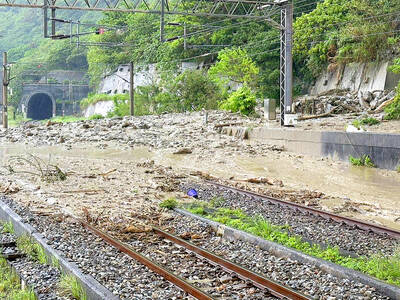
ROLLER-COASTER RIDE: More than five earthquakes ranging from magnitude 4.4 to 5.5 on the Richter scale shook eastern Taiwan in rapid succession yesterday afternoon Back-to-back weather fronts are forecast to hit Taiwan this week, resulting in rain across the nation in the coming days, the Central Weather Administration said yesterday, as it also warned residents in mountainous regions to be wary of landslides and rockfalls. As the first front approached, sporadic rainfall began in central and northern parts of Taiwan yesterday, the agency said, adding that rain is forecast to intensify in those regions today, while brief showers would also affect other parts of the nation. A second weather system is forecast to arrive on Thursday, bringing additional rain to the whole nation until Sunday, it

CONDITIONAL: The PRC imposes secret requirements that the funding it provides cannot be spent in states with diplomatic relations with Taiwan, Emma Reilly said China has been bribing UN officials to obtain “special benefits” and to block funding from countries that have diplomatic ties with Taiwan, a former UN employee told the British House of Commons on Tuesday. At a House of Commons Foreign Affairs Committee hearing into “international relations within the multilateral system,” former Office of the UN High Commissioner for Human Rights (OHCHR) employee Emma Reilly said in a written statement that “Beijing paid bribes to the two successive Presidents of the [UN] General Assembly” during the two-year negotiation of the Sustainable Development Goals. Another way China exercises influence within the UN Secretariat is
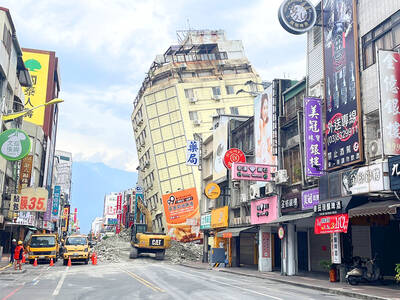
LANDSLIDES POSSIBLE: The agency advised the public to avoid visiting mountainous regions due to more expected aftershocks and rainfall from a series of weather fronts A series of earthquakes over the past few days were likely aftershocks of the April 3 earthquake in Hualien County, with further aftershocks to be expected for up to a year, the Central Weather Administration (CWA) said yesterday. Based on the nation’s experience after the quake on Sept. 21, 1999, more aftershocks are possible over the next six months to a year, the agency said. A total of 103 earthquakes of magnitude 4 on the local magnitude scale or higher hit Hualien County from 5:08pm on Monday to 10:27am yesterday, with 27 of them exceeding magnitude 5. They included two, of magnitude
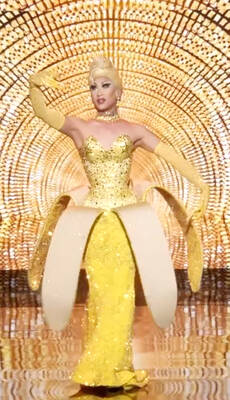
Taiwan’s first drag queen to compete on the internationally acclaimed RuPaul’s Drag Race, Nymphia Wind (妮妃雅), was on Friday crowned the “Next Drag Superstar.” Dressed in a sparkling banana dress, Nymphia Wind swept onto the stage for the final, and stole the show. “Taiwan this is for you,” she said right after show host RuPaul announced her as the winner. “To those who feel like they don’t belong, just remember to live fearlessly and to live their truth,” she said on stage. One of the frontrunners for the past 15 episodes, the 28-year-old breezed through to the final after weeks of showcasing her unique


 RSS
RSS