


Ever since this once-impoverished communist country’s economy began taking off in the 1990s, the motorbike has been an icon of wealth and modernization. To trade in your bicycle for a motorbike was to show that you were making it, and by last year, more than two-thirds of Vietnam’s households owned one.
But since Vietnam’s government abruptly raised gasoline prices 31 percent on June 21, to 19,000 dong (US$1.10) per liter, the symbolic status of the motorbike has taken a bit of a hit.
With inflation running at 27 percent and gas costs taking a big bite out of the average Vietnamese wage, some have begun leaving their Hondas at home, in favor of buses, electric scooters —and, yes — bicycles.
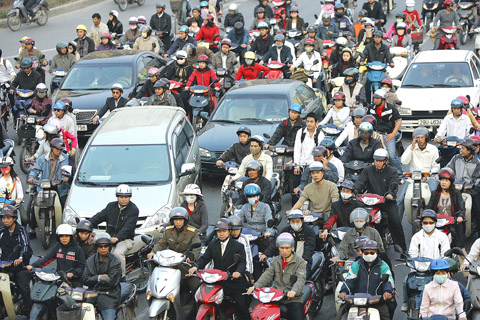
PHOTO: AP
“The number of people using buses and bicycles has increased significantly since the gasoline price was raised,” said Than Van Thanh, director of the Ministry of Transportation’s Transit Department.
Thanh said with the price hikes, a motorbike commuter might spend nearly US$20 a month on fuel. “Someone who earns 1.5 million dong [US$90] a month cannot afford to travel by motorbike anymore.”
The impact has shown up most clearly at shops selling electric bicycles and scooters. Once mainly limited to the elderly, electric bicycles have seen sales take off in the past month, and are selling to a broader demographic.
“We’re selling five or six units a day, compared with two a day before the gasoline price was raised,” said Huynh Thi Nhung, a salesperson at Robo Electric Bicycle Shop in Hanoi.
Nhung said she was selling many of the electric bikes to young people and workers with low salaries. She estimated that the electricity for a 90km trip on an electric bike would cost about US$0.30, while the same trip on a gasoline-powered motorbike might cost US$3.50.
The combination of high gasoline prices and inflation was also leading to a slight rise in bicycle sales, Hanoi bike shop owner Nguyen Trung Hiep said.
Hiep said families that might once have flaunted their wealth by buying motorbikes for school-aged children were now economizing by buying them new bicycles.
A shift away from motorbikes would be a healthy twist for Hanoi’s atmosphere. Over the past five years, it has become as polluted as the air in more prosperous Asian cities like Bangkok, said pollution researcher Pham Duy Hien, who recently concluded a study of Hanoi’s air quality sponsored by the Swiss Agency for Development and Cooperation.
“There are very few motorbikes in developed countries,” Hien said.
It is not necessary to look to the West for countries without gas-fueled motorbikes.
The closest major Chinese city, Kunming, allows only electric scooters, and boasts air quality far superior to Hanoi’s.
But Hien said any shift away from motorbikes in Vietnam was still too small and too new to quantify. He called for a “general movement of the people” to turn from motorbikes to bicycles and buses.
There was a time when bicycles ruled the road in Vietnam. Images from the 1960s and 1970s feature young women in the flowing pantsuits, called ao dai, cycling along city streets. North Vietnamese wartime propaganda movies show soldiers bicycling through mountainous jungle on the Ho Chi Minh Trail, pedaling enormous loads of shells and ammunition over bamboo and rope bridges.
As recently as the mid-1990s, Westerners who visited Hanoi were struck by the quietness of the city, the sound of traffic limited to the swish of bicycle wheels and the tingling of bells. One visitor at the time estimated the ratio of bicycles to motorbikes at 10 to one.
Today, Hanoi’s traffic is a cacophonous riot. Poor peasants bicycling in from the countryside with fruits or vegetables piled on the backs of their bikes must dodge and weave between herds of honking motorbikes.
The chaotic traffic is in itself a disincentive for bicyclists. They may not be emitting any fumes themselves, but they must still breathe everyone else’s.
And for those prosperous Vietnamese who can afford gasoline, the motorbike habit may prove a hard one to kick.
Pham Van Khai, 45, a customer at Nhung’s Robo Electric Bicycle Shop, said he didn’t plan to switch to an electric motorbike himself. He was looking for one for his granddaughter.
“It’s a lot cheaper and safer for her to use an electric bike,” Khai said. “But I have to travel a lot, so I will stick to my motorbike.”
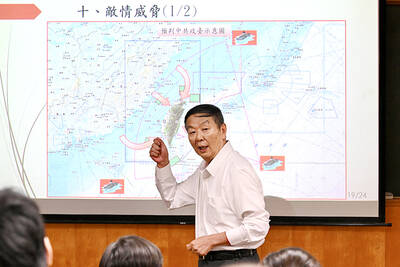
RETHINK? The defense ministry and Navy Command Headquarters could take over the indigenous submarine project and change its production timeline, a source said Admiral Huang Shu-kuang’s (黃曙光) resignation as head of the Indigenous Submarine Program and as a member of the National Security Council could affect the production of submarines, a source said yesterday. Huang in a statement last night said he had decided to resign due to national security concerns while expressing the hope that it would put a stop to political wrangling that only undermines the advancement of the nation’s defense capabilities. Taiwan People’s Party Legislator Vivian Huang (黃珊珊) yesterday said that the admiral, her older brother, felt it was time for him to step down and that he had completed what he

Taiwan has experienced its most significant improvement in the QS World University Rankings by Subject, data provided on Sunday by international higher education analyst Quacquarelli Symonds (QS) showed. Compared with last year’s edition of the rankings, which measure academic excellence and influence, Taiwanese universities made great improvements in the H Index metric, which evaluates research productivity and its impact, with a notable 30 percent increase overall, QS said. Taiwanese universities also made notable progress in the Citations per Paper metric, which measures the impact of research, achieving a 13 percent increase. Taiwanese universities gained 10 percent in Academic Reputation, but declined 18 percent
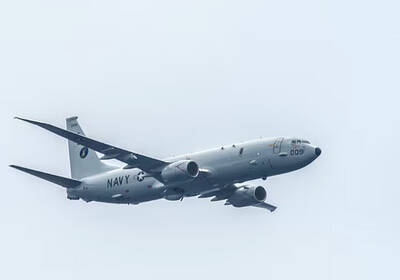
CHINA REACTS: The patrol and reconnaissance plane ‘transited the Taiwan Strait in international airspace,’ the 7th Fleet said, while Taipei said it saw nothing unusual The US 7th Fleet yesterday said that a US Navy P-8A Poseidon flew through the Taiwan Strait, a day after US and Chinese defense heads held their first talks since November 2022 in an effort to reduce regional tensions. The patrol and reconnaissance plane “transited the Taiwan Strait in international airspace,” the 7th Fleet said in a news release. “By operating within the Taiwan Strait in accordance with international law, the United States upholds the navigational rights and freedoms of all nations.” In a separate statement, the Ministry of National Defense said that it monitored nearby waters and airspace as the aircraft

UNDER DISCUSSION: The combatant command would integrate fast attack boat and anti-ship missile groups to defend waters closest to the coastline, a source said The military could establish a new combatant command as early as 2026, which would be tasked with defending Taiwan’s territorial waters 24 nautical miles (44.4km) from the nation’s coastline, a source familiar with the matter said yesterday. The new command, which would fall under the Naval Command Headquarters, would be led by a vice admiral and integrate existing fast attack boat and anti-ship missile groups, along with the Naval Maritime Surveillance and Reconnaissance Command, said the source, who asked to remain anonymous. It could be launched by 2026, but details are being discussed and no final timetable has been announced, the source


 RSS
RSS