


If innovation has a heart, it's probably a semiconductor, beating to the pace of Moore's Law. Under this principle, named for the Intel cofounder Gordon Moore, the chip industry in the last four decades has doubled the number of transistors it crams onto a chip about every 18 months.
That's a big reason that chips are now in our offices, homes, cars and toys -- and often implanted in our pets and occasionally in our own bodies. Chips are almost ubiquitous, and where they're not, they probably will be soon.
But keeping the heart of innovation beating is becoming ever harder and more expensive. Making chips is an improbable blend of farming, photography and baking: Think of your standard 300mm silicon wafer as a field where mostly metallic substances are"grown" according to patterns put in place by photolithography and then "baked" at extremely high temperatures.
This agri-photo-baking takes big money: It costs US$3 billion to US$5 billion to build a single semiconductor fabrication plant, or "fab."
In the near future, that figure is likely to rise to US$12 billion, VLSI Research said.
In the boom-and-bust cycle of the chip industry, it has become harder and harder to get a return on fab investments.
The remarkable progression of Moore's Law, meanwhile, involves continually shrinking almost everything to do with the chips. Today, the transistors in a high-end chip are no wider than the nucleus of a smallish bacterium -- that's far smaller than the smallest light wave.
Until now, as chips became smaller, they also became faster in about the same proportion. It's still true for transistors, but it's no longer true for the wires used to connect transistors -- and that slows performance gains.
"We're running out of steam," says Daniel Edelstein, a program manager at IBM Research.
Edelstein is leading a team of researchers from inside and outside IBM in developing a new way to solve the problem by using "self assembling" nanotechnology to make better insulators, raising performance.
In this case, self-assembly involves creating so-called airgaps, vacuums a few nanometers wide that keep the tiny copper wires in a chip from touching one another, instead of putting down a layer of insulating material and trying to align it effectively at the nanoscale. It's more efficient and it would save IBM US$50 million in photolithographic equipment.
A few weeks ago, Edelstein took me on a tour of the fab in East Fishkill, NY, that will be the first to use the self-assembly technique. While the technique is not quite done being tested, IBM senior vice president for research John Kelly is confident.
"There is no question in our minds this is going to work," Kelly says, adding that IBM will move to it by 2009, first for an existing high-end processor or a next-generation chip, then across its fabs.
Kelly says Edelstein has a "unique" ability to solve problems and work across the company to commercialize new technologies. In the last decade, he has led two other important breakthroughs, most notably the use of copper for the wires inside chips, replacing aluminum.
Each time, Edelstein has done it by working with a small group of two or three scientists to explore out-of-the-mainstream approaches to problems. He also goes beyond research, getting to know the manufacturing team to help him understand what it takes to get a novel technique into IBM's existing manufacturing process.
With the self-assembling nanotechnology, he also had to go beyond IBM's walls, in part because IBM in the 1990s decided for a number of reasons -- including costs and the desire to help create a doctorate feeder program -- to work with a public-private consortium to develop a modern research fab run by the College of Nanoscience and Electronics at the State University of New York at Albany.
This fab features one-of-a-kind equipment and it is where Edelstein's team developed its techniques before moving them to IBM's fab in East Fishkill.
Kelly says IBM is developing a number of ways to use self-assembly in other parts of the chipmaking process.
And other companies are also racing to adopt the techniques. Steve Jurvetson, a co-founder of the venture capital firm Draper Fisher Jurvetson, says self-assembling technology holds huge promise for all types of semiconductors.
He says two start-ups that his firm has backed, ZettaCore, which is developing memory chips, and Konarka Technologies, which makes solar power technology, are close to reaching commercial production, thanks in part to nanoscale self-assembly.
Richard Doherty, director of the engineering consultant group Envisioneering, says self-assembly techniques should also greatly reduce the number of defective chips.
The techniques could lead to more dramatic advances. Alain Kaloyeros, professor of nanoelectronics at the State University of New York at Albany, says self-assembling nanotechnology will make it possible to etch a computer onto a pair of glasses or create "nanobots" that can float in our bloodstreams, searching for cancerous cells that the bots will eliminate.
For now, the technique will help keep Moore's Law pumping -- and with it a huge amount of innovation.

ROLLER-COASTER RIDE: More than five earthquakes ranging from magnitude 4.4 to 5.5 on the Richter scale shook eastern Taiwan in rapid succession yesterday afternoon Back-to-back weather fronts are forecast to hit Taiwan this week, resulting in rain across the nation in the coming days, the Central Weather Administration said yesterday, as it also warned residents in mountainous regions to be wary of landslides and rockfalls. As the first front approached, sporadic rainfall began in central and northern parts of Taiwan yesterday, the agency said, adding that rain is forecast to intensify in those regions today, while brief showers would also affect other parts of the nation. A second weather system is forecast to arrive on Thursday, bringing additional rain to the whole nation until Sunday, it
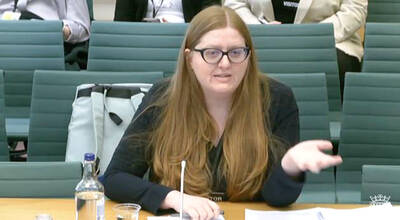
CONDITIONAL: The PRC imposes secret requirements that the funding it provides cannot be spent in states with diplomatic relations with Taiwan, Emma Reilly said China has been bribing UN officials to obtain “special benefits” and to block funding from countries that have diplomatic ties with Taiwan, a former UN employee told the British House of Commons on Tuesday. At a House of Commons Foreign Affairs Committee hearing into “international relations within the multilateral system,” former Office of the UN High Commissioner for Human Rights (OHCHR) employee Emma Reilly said in a written statement that “Beijing paid bribes to the two successive Presidents of the [UN] General Assembly” during the two-year negotiation of the Sustainable Development Goals. Another way China exercises influence within the UN Secretariat is

LANDSLIDES POSSIBLE: The agency advised the public to avoid visiting mountainous regions due to more expected aftershocks and rainfall from a series of weather fronts A series of earthquakes over the past few days were likely aftershocks of the April 3 earthquake in Hualien County, with further aftershocks to be expected for up to a year, the Central Weather Administration (CWA) said yesterday. Based on the nation’s experience after the quake on Sept. 21, 1999, more aftershocks are possible over the next six months to a year, the agency said. A total of 103 earthquakes of magnitude 4 on the local magnitude scale or higher hit Hualien County from 5:08pm on Monday to 10:27am yesterday, with 27 of them exceeding magnitude 5. They included two, of magnitude

Taiwan’s first drag queen to compete on the internationally acclaimed RuPaul’s Drag Race, Nymphia Wind (妮妃雅), was on Friday crowned the “Next Drag Superstar.” Dressed in a sparkling banana dress, Nymphia Wind swept onto the stage for the final, and stole the show. “Taiwan this is for you,” she said right after show host RuPaul announced her as the winner. “To those who feel like they don’t belong, just remember to live fearlessly and to live their truth,” she said on stage. One of the frontrunners for the past 15 episodes, the 28-year-old breezed through to the final after weeks of showcasing her unique


 RSS
RSS