


Above the din of children playing, tourists chatting and dogs barking, a muffled clang echoes through the alleyways. It's 70-year-old Pranee Sutdis who, as she has for most of the last 58 years, is hammering steel into bowls with a small mallet.
"It used to be that every house did this all day, and you would wake up to endless `ping, ping, ping.' Now, there are only a few and it's not so noisy," she said.
Pranee is part of Bangkok's shrinking community of traditional Buddhist alms bowl makers, in the last such enclave in Thailand. Most monks in Thailand now buy factory-made goods. So these artisans rely on tourism to keep their tradition alive.
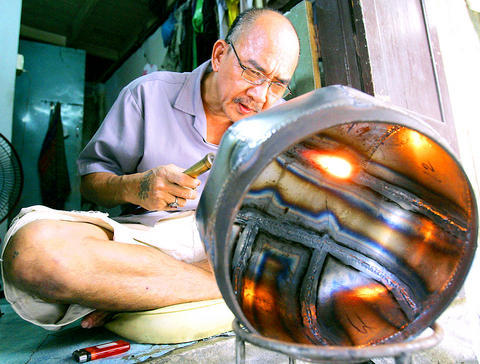
PHOTO: AP
The narrow alleys in Rattanakosin, the city's old quarter, are known as Ban Baht, or House of Bowls. Approximately 60 people, including five families, work there. The community is believed to have started in the 1700s as a settlement of refugees fleeing war with neighboring Myanmar.
The art of making handmade alms bowls for Buddhist monks goes back thousands of years.
The bowl is one of the most important objects in the daily life of the monks. It is primarily used to collect money and food from lay supporters. But it also has deep symbolic significance. In Buddhism, giving of alms is the beginning of one's journey to Nirvana, the state of perfect bliss.
Sunee Serseeserm, 59, spends his days fitting cross-shaped sheets of metal to a round mold, part of the beginning of the bowl-making process. Like Pranee, he has performed the same job for most of his life, he said.
Sunee said he still gets orders from veteran monks, who often buy bowls rubbed in oil rather than lacquer, so the golden seams from its handmade manufacture are visible. Medium-size handmade bowls cost around 1,000 baht, about US$32. Factory-made ones can be as little as one-tenth of that price.
"If they have been monks for a long time, they know they need to buy a handmade bowl. In some temples, they don't accept factory-made ones," Sunee said.
He added that business from monks had been especially good this year with Thai King Bhumibol Adulyadej's upcoming 80th birthday. More people are becoming monks and they want special bowls for the occasion.
Somsak Batchart, 51, owns one of four retail shops in the neighborhood, where he was born. He says the shop has been in his family for hundreds of years. While business slumped a few years ago, it has since boomed because of an influx of tourists.
"My customers are Westerners, so I always have business," he says, smiling. "Sometimes I can't even get everything done on time, and as it's handmade, there's no way to speed up the process."
He credits part of the growth in tourist business to a program run by Bangkok's city government promoting Ban Baht as a "conservation community" important to Thailand's heritage. Somsak received a government certificate for excellence, which he photocopied and hands out to visitors.
Sunait Chutintaranond, who teaches a course on modernization and traditional society at Bangkok's Chulalongkorn University, said it's not surprising that tourists are replacing Thais as Ban Baht's customer base.
"When the Thai people think of quality, they now look to the West, wanting brands like Gucci and Dolce and Gabbana,'' he said, adding that they gain a sense of cultural cachet from imported items.
He said that many traditional industries survive because of tourist interest, but this has altered their forms in some cases.
"If you look at Thai silk nowadays, it's still the same fabric, but the patterns have changed. Now you'll see patterns that are appealing to tourists and not the traditional Thai designs,'' he said.
Pranee said she was worried that the tradition may continue to fade over time. Her whole family used to work in Ban Baht, but now it is only she and her daughter, who paints designs on finished bowls in gold paint. After her husband died 10 years ago, she was forced to merge her business with another shop.
But Somsak is more hopeful. Out of his five children, two work in his shop.
If fewer people learn the craft, it's OK, he said.
"I can at least teach some of the younger generation to do it, and it'll be here," he said.
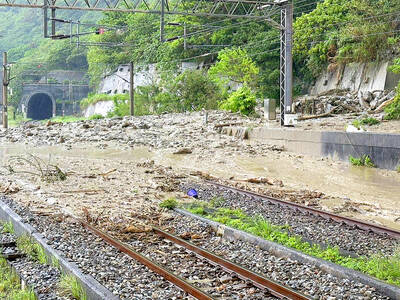
ROLLER-COASTER RIDE: More than five earthquakes ranging from magnitude 4.4 to 5.5 on the Richter scale shook eastern Taiwan in rapid succession yesterday afternoon Back-to-back weather fronts are forecast to hit Taiwan this week, resulting in rain across the nation in the coming days, the Central Weather Administration said yesterday, as it also warned residents in mountainous regions to be wary of landslides and rockfalls. As the first front approached, sporadic rainfall began in central and northern parts of Taiwan yesterday, the agency said, adding that rain is forecast to intensify in those regions today, while brief showers would also affect other parts of the nation. A second weather system is forecast to arrive on Thursday, bringing additional rain to the whole nation until Sunday, it

CONDITIONAL: The PRC imposes secret requirements that the funding it provides cannot be spent in states with diplomatic relations with Taiwan, Emma Reilly said China has been bribing UN officials to obtain “special benefits” and to block funding from countries that have diplomatic ties with Taiwan, a former UN employee told the British House of Commons on Tuesday. At a House of Commons Foreign Affairs Committee hearing into “international relations within the multilateral system,” former Office of the UN High Commissioner for Human Rights (OHCHR) employee Emma Reilly said in a written statement that “Beijing paid bribes to the two successive Presidents of the [UN] General Assembly” during the two-year negotiation of the Sustainable Development Goals. Another way China exercises influence within the UN Secretariat is
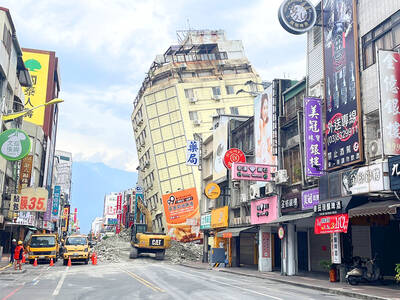
LANDSLIDES POSSIBLE: The agency advised the public to avoid visiting mountainous regions due to more expected aftershocks and rainfall from a series of weather fronts A series of earthquakes over the past few days were likely aftershocks of the April 3 earthquake in Hualien County, with further aftershocks to be expected for up to a year, the Central Weather Administration (CWA) said yesterday. Based on the nation’s experience after the quake on Sept. 21, 1999, more aftershocks are possible over the next six months to a year, the agency said. A total of 103 earthquakes of magnitude 4 on the local magnitude scale or higher hit Hualien County from 5:08pm on Monday to 10:27am yesterday, with 27 of them exceeding magnitude 5. They included two, of magnitude

Taiwan’s first drag queen to compete on the internationally acclaimed RuPaul’s Drag Race, Nymphia Wind (妮妃雅), was on Friday crowned the “Next Drag Superstar.” Dressed in a sparkling banana dress, Nymphia Wind swept onto the stage for the final, and stole the show. “Taiwan this is for you,” she said right after show host RuPaul announced her as the winner. “To those who feel like they don’t belong, just remember to live fearlessly and to live their truth,” she said on stage. One of the frontrunners for the past 15 episodes, the 28-year-old breezed through to the final after weeks of showcasing her unique


 RSS
RSS