


No country has prospered more than China by opening up to trade and investment, so a nationalist hum for protection on the sidelines of the Chinese Communist Party (CCP) Congress that ended yesterday was all the more striking.
China's manufacturing juggernaut might seem unstoppable to hard-pressed US and European firms, but some in China see things quite differently: They worry about the inroads foreigners are making into the world's fourth-largest economy.
They might not be a majority but grumbling from a number of businesses, from airlines to equipment makers, contrasted sharply with Chinse President Hu Jintao's (胡錦濤) vow to keep opening the economy and seek "win-win" cooperation between Chinese and foreign firms.
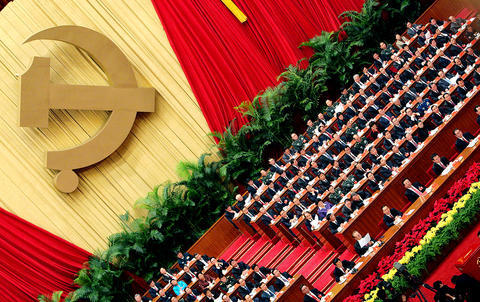
PHOTO: AFP
"Why is the Chinese dairy industry in the state it's in now?" asked Pan Gang (
"Because many of the foreign firms are only looking for short-term gain when they come here," Pan said. "When the foreign companies come in, they just take away the milk."
To be sure, the overwhelming majority of policy makers argued that China cannot backtrack on market reforms.
"Opening up brings new problems and new risks, but we cannot control the risks -- it is not possible to control them -- by shutting the door again," Hu Xiaolian (
Still, interviews with a range of corporate chiefs who are also CCP members highlighted not just their rapidly growing influence -- entrepreneurs were officially welcomed into the party only five years ago, though many had joined before -- but how emboldened they are to lobby for their own interests.
Li Jiaxiang (
"If foreign investors get control of the big domestic airlines, it will be very difficult to restructure the industry in the future," Li said in an interview.
Yang Yuanyuan (
"If our airlines want to become strong, they can only do so against the backdrop of international competition," Yang said. "If they rely on protection, they can't become strong."
The stakes of such arguments are very real for Western companies and governments -- and for the global economy.
The more the nationalist argument wins out, the more tense Beijing's trade relations with the US and EU will become, potentially sparking spiralling protectionism.
What has been clear for months is that, faced with a flood of cash from its bulging trade surplus and inflows of foreign direct investment, China is becoming increasingly picky about how it uses foreign direct investment.
Jiang Kaiwen (
"The government is tightening foreign investment in polluting industries; it needs to be environmentally friendly, and so forth," Jiang said.
Comments by Guo Shuqing (郭樹清), chairman of China Construction Bank, highlighted the tension that the open-versus-closed debate is generating among businessmen and policy makers.
Guo is tipped by insiders as a candidate to lead the central bank should its current governor, Zhou Xiaochuan (周小川), lose his job.
In one session, Guo spoke with great passion of the need to press on with industrial restructuring, despite worries about job cuts.
"This is the most critical time -- right now. I think the entire country, the entire party, from top to bottom, needs to unify their idea on this point," Guo said.
"Industrial adjustment and upgrading will decide the future of China's economy and development -- even its fate," he said.
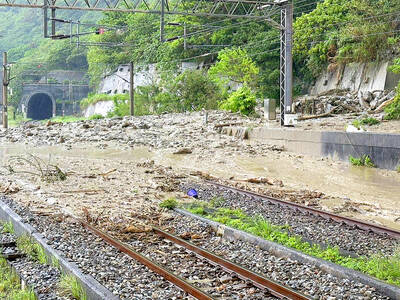
ROLLER-COASTER RIDE: More than five earthquakes ranging from magnitude 4.4 to 5.5 on the Richter scale shook eastern Taiwan in rapid succession yesterday afternoon Back-to-back weather fronts are forecast to hit Taiwan this week, resulting in rain across the nation in the coming days, the Central Weather Administration said yesterday, as it also warned residents in mountainous regions to be wary of landslides and rockfalls. As the first front approached, sporadic rainfall began in central and northern parts of Taiwan yesterday, the agency said, adding that rain is forecast to intensify in those regions today, while brief showers would also affect other parts of the nation. A second weather system is forecast to arrive on Thursday, bringing additional rain to the whole nation until Sunday, it

CONDITIONAL: The PRC imposes secret requirements that the funding it provides cannot be spent in states with diplomatic relations with Taiwan, Emma Reilly said China has been bribing UN officials to obtain “special benefits” and to block funding from countries that have diplomatic ties with Taiwan, a former UN employee told the British House of Commons on Tuesday. At a House of Commons Foreign Affairs Committee hearing into “international relations within the multilateral system,” former Office of the UN High Commissioner for Human Rights (OHCHR) employee Emma Reilly said in a written statement that “Beijing paid bribes to the two successive Presidents of the [UN] General Assembly” during the two-year negotiation of the Sustainable Development Goals. Another way China exercises influence within the UN Secretariat is
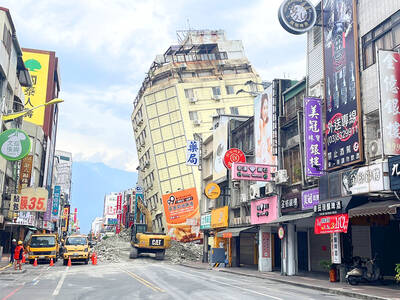
LANDSLIDES POSSIBLE: The agency advised the public to avoid visiting mountainous regions due to more expected aftershocks and rainfall from a series of weather fronts A series of earthquakes over the past few days were likely aftershocks of the April 3 earthquake in Hualien County, with further aftershocks to be expected for up to a year, the Central Weather Administration (CWA) said yesterday. Based on the nation’s experience after the quake on Sept. 21, 1999, more aftershocks are possible over the next six months to a year, the agency said. A total of 103 earthquakes of magnitude 4 on the local magnitude scale or higher hit Hualien County from 5:08pm on Monday to 10:27am yesterday, with 27 of them exceeding magnitude 5. They included two, of magnitude

Taiwan’s first drag queen to compete on the internationally acclaimed RuPaul’s Drag Race, Nymphia Wind (妮妃雅), was on Friday crowned the “Next Drag Superstar.” Dressed in a sparkling banana dress, Nymphia Wind swept onto the stage for the final, and stole the show. “Taiwan this is for you,” she said right after show host RuPaul announced her as the winner. “To those who feel like they don’t belong, just remember to live fearlessly and to live their truth,” she said on stage. One of the frontrunners for the past 15 episodes, the 28-year-old breezed through to the final after weeks of showcasing her unique


 RSS
RSS