


Mark Zuckerberg is considered the founder of Facebook, the popular social networking Web site estimated to be worth upward of US$1 billion.
Three Harvard classmates, the founders of ConnectU, have long claimed that Zuckerberg stole the idea from them, and they are suing him in federal district court in Boston.
Both parties seem to have forgotten Aaron Greenspan, yet another Harvard classmate. He says he was actually the one who created the original college social networking system, before either side in the legal dispute. And he has the e-mails to prove it.
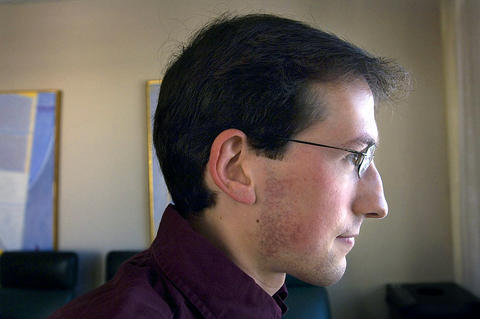
PHOTO: NY TIMES NEWS SERVICE
As a Harvard student in 2003 -- six months before Facebook was started and eight months before ConnectU went online -- Greenspan established a simple Web service that he dubbed houseSYSTEM. It was used by several thousand Harvard students for a variety of online college-related tasks. Zuckerberg was briefly an early participant.
An e-mail message, circulated widely by Greenspan to Harvard students on Sept. 19, 2003, de-scribes the newest feature of houseSYSTEM, as "the Face Book," an online system for quickly locating other students. The date was four months before Zuckerberg started his own site, originally "thefacebook.com." (Greenspan retained his college e-mail messages and provided The New York Times with copies of his communications with Zuckerberg.)
Later the two students, both of whom graduated in 2004, exchanged e-mail about their separate projects. When Greenspan asked what Zuckerberg was planning and suggested the two integrate their systems, Zuckerberg responded, a month before launching his own service: "I actually did think about integrating it into houseSYSTEM before you even suggested it, but I decided that it's probably best to keep them separated at least for now."
Despite Greenspan's entre-preneurial ambitions, Zuckerberg was the first to move to Silicon Valley, raising venture capital and eventually transforming Facebook from a social networking site for the nation's college students into one of the fastest growing Internet sites for both social and business contacts.
Indeed, Greenspan, who is now 24 and moved to Silicon Valley last year to start a company, appears to be a clear example of a truism in this high-technology region: Establishing who is first with an idea is often murky at best, and it is frequently not the inventor of an idea who is the ultimate winner.
Zuckerberg declined to be interviewed, saying through a spokeswoman that he was not sure how to respond. He did not dispute the chronology of events or the authenticity of Greenspan's e-mail messages. Zuckerberg is seeking to dismiss the ConnectU suit.
Greenspan said that Zuckerberg's lawyer had contacted him earlier this year in connection with the ConnectU lawsuit but that he had declined a request to serve as a witness, fearing that he would become embroiled in the legal battle.
In an interview at a cafe this week, Greenspan said he had mostly made peace with the fact that Zuckerberg would be the first of the Harvard '04 graduates to become a billionaire.
If Zuckerberg did borrow some of Greenspan's concepts, he may have simply been working in a grand Harvard tradition. After all, it was a young Harvard dropout, William Gates, and his classmate, Paul G. Allen, who almost three decades earlier copied a version of the BASIC programming language, designed by two Dartmouth college professors, to jump-start the company that would grow into the world's most powerful software firm.
"I've had a long time to think about this, and I'm not as bitter as I was a year ago," Greenspan said. "Things like this aren't surprising to me anymore."
He has described the original creation of houseSYSTEM, ConnectU and Facebook in Authoritas: One Student's Harvard Admissions, a 306-page unpublished autobiography about his adventures as a college student.
"This book is partly a search for justice," he wrote in the introduction. "You don't write an autobiography in your early twenties unless there's something you need to get off your chest."
Although he has yet to find a publisher, he has deployed his system as a commercial Web service for other potential authors as part of CommonRoom, a social networking and business Web site that he established last year.
Greenspan says that he has learned some important lessons since leaving school, although he is not so keen on becoming one of the serial entrepreneurs for which Silicon Valley is known.
"I've written a lot about Harvard's motto being `veritas,'" he wrote recently, "[it's] possibly the best [motto] there is, because if you wait long enough, the truth will come out."

ROLLER-COASTER RIDE: More than five earthquakes ranging from magnitude 4.4 to 5.5 on the Richter scale shook eastern Taiwan in rapid succession yesterday afternoon Back-to-back weather fronts are forecast to hit Taiwan this week, resulting in rain across the nation in the coming days, the Central Weather Administration said yesterday, as it also warned residents in mountainous regions to be wary of landslides and rockfalls. As the first front approached, sporadic rainfall began in central and northern parts of Taiwan yesterday, the agency said, adding that rain is forecast to intensify in those regions today, while brief showers would also affect other parts of the nation. A second weather system is forecast to arrive on Thursday, bringing additional rain to the whole nation until Sunday, it
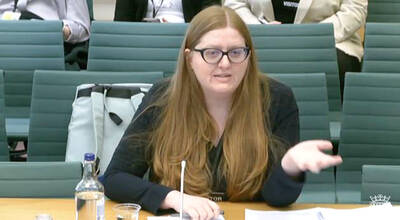
CONDITIONAL: The PRC imposes secret requirements that the funding it provides cannot be spent in states with diplomatic relations with Taiwan, Emma Reilly said China has been bribing UN officials to obtain “special benefits” and to block funding from countries that have diplomatic ties with Taiwan, a former UN employee told the British House of Commons on Tuesday. At a House of Commons Foreign Affairs Committee hearing into “international relations within the multilateral system,” former Office of the UN High Commissioner for Human Rights (OHCHR) employee Emma Reilly said in a written statement that “Beijing paid bribes to the two successive Presidents of the [UN] General Assembly” during the two-year negotiation of the Sustainable Development Goals. Another way China exercises influence within the UN Secretariat is

LANDSLIDES POSSIBLE: The agency advised the public to avoid visiting mountainous regions due to more expected aftershocks and rainfall from a series of weather fronts A series of earthquakes over the past few days were likely aftershocks of the April 3 earthquake in Hualien County, with further aftershocks to be expected for up to a year, the Central Weather Administration (CWA) said yesterday. Based on the nation’s experience after the quake on Sept. 21, 1999, more aftershocks are possible over the next six months to a year, the agency said. A total of 103 earthquakes of magnitude 4 on the local magnitude scale or higher hit Hualien County from 5:08pm on Monday to 10:27am yesterday, with 27 of them exceeding magnitude 5. They included two, of magnitude

Taiwan’s first drag queen to compete on the internationally acclaimed RuPaul’s Drag Race, Nymphia Wind (妮妃雅), was on Friday crowned the “Next Drag Superstar.” Dressed in a sparkling banana dress, Nymphia Wind swept onto the stage for the final, and stole the show. “Taiwan this is for you,” she said right after show host RuPaul announced her as the winner. “To those who feel like they don’t belong, just remember to live fearlessly and to live their truth,” she said on stage. One of the frontrunners for the past 15 episodes, the 28-year-old breezed through to the final after weeks of showcasing her unique


 RSS
RSS