


They can cost a small fortune, resemble '80s disco jewelry, and are arguably un-Buddhist, but many Thais seeking psychic insurance in troubled times are snapping up so-called Jatukam Ramathep amulets, coin-shaped talismans with supposed magical powers.
The Jatukam amulets, coveted by millions of people in Thailand -- and available on eBay for those living elsewhere -- have become big business, as believers, collectors and speculators drive a thriving market. Rare ones reportedly command prices of more than 1 million baht (US$30,000).
The amulet craze has also led to robberies and at least one death, when a crowd stampeded for the opportunity to get a limited edition.
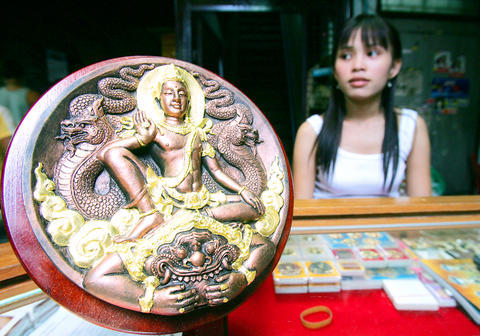
PHOTO: AP
As Thailand muddles through political insecurity and nervousness about the economy, people are more openly grasping at supernatural aids. The fad vividly illustrates how belief in astrology, the occult and animism remain a major part of a modern, industrialized Thailand.
The amulets are typically the size of a silver dollar, and come in a variety of materials, including bronze, silver and clay.
Prices depend on the materials used, the circumstances under which they were anointed -- some were recently taken aloft on a jetliner to be blessed by monks -- and how rare the model is.

PHOTO: AP
It is not unusual for them to be encased in a gold frame hanging from a heavy link chain around the neck and worn outside the shirt -- an awkward fashion statement, at best.
Many Thais carry or wear amulets, usually small ones depicting images associated with Buddhism, the religion of most Thais, though amulets are not formally part of its doctrine.
Most amulet owners are fairly discreet, wearing them under shirts and blouses. Serious believers carry more than one and as many as a dozen, though such ostentatiousness is usually associated with policemen and criminals -- who understandably seek all the protection they can get.
But Jatukam amulets are everywhere; affluent businessmen, political protesters, teachers in the insurgency-wrecked south, curbside food vendors, all wear them proudly with the shared hope that they will ward off danger and attract good fortune.
"I was in a number of car accidents before. Once I started putting these amulets in my taxis and around my neck, my car has been safe no matter how many hours I am on the road each day and how tired I am," said Surasak Mansee, a Bangkok taxi driver, who has three amulets draped on his rearview mirror and two more around his neck.
"I don't know what you think, but my wife has also won some lotteries and we are happier than ever," he said.
"People turn to superstition when they feel that religion and other social as well as judicial systems are no longer providing them the security and justice they need," said respected archeologist Srisak Vallibhotama. "It's a reflection of the kind of society we live in."
Although Buddhism promotes achieving inner peace through detachment from desires, many Thais who profess themselves adherents practice a spirituality that targets material gain as much as inner tranquility.
Different variations of the Jatukam amulet focus on the promise of wealth and prosperity, such as the "Super Rich," "Immediately Rich," "Rich Without Reason" and "Miracle Rich" models.
"The names are as important as how they are made and promoted. The producers know what the demands are and they have to match those demands. People want protection and people want wealth," said Niti Pawakapan, an anthropologist at Bangkok's Chulalongkorn University.
Jatukam Ramathep amulets were named after a legendary warrior prince of an ancient southern Thai kingdom who is usually depicted on the talisman in a seated position. The original batch was made in the southern province of Nakhon Si Thammarat in 1987 to raise funds to build a new city pillar, which marks the founding site of a city.
These originals were priced at less than 50 baht (then worth US$2) each when they came out. Now, they can fetch more than 100,000 baht (US$3,200), according to vendors.
The Jatukam amulets became a true nationwide phenomenon after their original creator, Police Major General Khunphantarak Rajadej, died at the age of 104 last year -- a time which also saw political turmoil that led to the country's first coup in 15 years.
Khunphantarak, a respected law enforcement officer, was also believed to possess knowledge of the occult. Thousands of people attended his funeral in February, drawing such a crowd in part because it was an auspicious occasion to acquire the amulets.
Since then, distribution of the amulets has often been chaotic.
In April, a crowd waiting to buy the amulets in Nakhon Si Thammarat, 580km south of Bangkok, erupted into a stampede that left one woman dead and dozens of others injured. More than 10,000 people had camped overnight outside a school for the amulets.
Prudent buyers can order from mail order catalogs that otherwise offer mundane household goods such as brooms, baby food and electrical appliances.
Despite their dubious religious merit, many temples and schools have produced the amulets to raise funds for charitable causes.
But at least one well-known monk derides the fad.
Phra Payom Kalayano, a temple abbot in Nonthaburi, made chocolate cookies that resembled the amulets and called them "Four bites." Stamped on them are four of the Buddha's teachings on how to become wealthy.
"I want to remind people that becoming rich is about discipline and hard work, not magical amulets. If it is really magical, why would the monks share it with you and not keep it to themselves and make money for the temples?" he said.
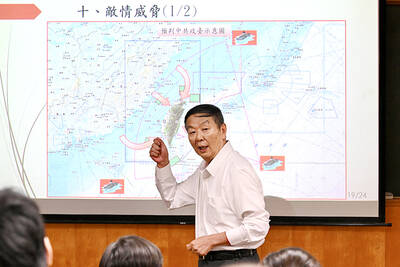
RETHINK? The defense ministry and Navy Command Headquarters could take over the indigenous submarine project and change its production timeline, a source said Admiral Huang Shu-kuang’s (黃曙光) resignation as head of the Indigenous Submarine Program and as a member of the National Security Council could affect the production of submarines, a source said yesterday. Huang in a statement last night said he had decided to resign due to national security concerns while expressing the hope that it would put a stop to political wrangling that only undermines the advancement of the nation’s defense capabilities. Taiwan People’s Party Legislator Vivian Huang (黃珊珊) yesterday said that the admiral, her older brother, felt it was time for him to step down and that he had completed what he
Taiwan has experienced its most significant improvement in the QS World University Rankings by Subject, data provided on Sunday by international higher education analyst Quacquarelli Symonds (QS) showed. Compared with last year’s edition of the rankings, which measure academic excellence and influence, Taiwanese universities made great improvements in the H Index metric, which evaluates research productivity and its impact, with a notable 30 percent increase overall, QS said. Taiwanese universities also made notable progress in the Citations per Paper metric, which measures the impact of research, achieving a 13 percent increase. Taiwanese universities gained 10 percent in Academic Reputation, but declined 18 percent

UNDER DISCUSSION: The combatant command would integrate fast attack boat and anti-ship missile groups to defend waters closest to the coastline, a source said The military could establish a new combatant command as early as 2026, which would be tasked with defending Taiwan’s territorial waters 24 nautical miles (44.4km) from the nation’s coastline, a source familiar with the matter said yesterday. The new command, which would fall under the Naval Command Headquarters, would be led by a vice admiral and integrate existing fast attack boat and anti-ship missile groups, along with the Naval Maritime Surveillance and Reconnaissance Command, said the source, who asked to remain anonymous. It could be launched by 2026, but details are being discussed and no final timetable has been announced, the source
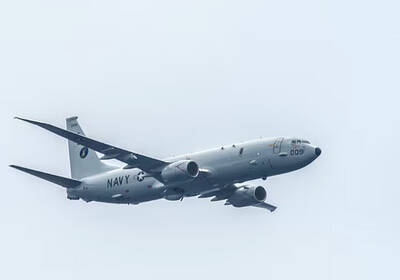
CHINA REACTS: The patrol and reconnaissance plane ‘transited the Taiwan Strait in international airspace,’ the 7th Fleet said, while Taipei said it saw nothing unusual The US 7th Fleet yesterday said that a US Navy P-8A Poseidon flew through the Taiwan Strait, a day after US and Chinese defense heads held their first talks since November 2022 in an effort to reduce regional tensions. The patrol and reconnaissance plane “transited the Taiwan Strait in international airspace,” the 7th Fleet said in a news release. “By operating within the Taiwan Strait in accordance with international law, the United States upholds the navigational rights and freedoms of all nations.” In a separate statement, the Ministry of National Defense said that it monitored nearby waters and airspace as the aircraft


 RSS
RSS