


About one in 12 families in the US do not have a bank account, and for the poor the rate is as high as one in four, according to the Federal Reserve.
As many as 28 million of the more than 300 million people in the US are forgoing traditional financial institutions because of mistrust, cultural and language barriers or a belief that by the time all the bills are paid there will be nothing left for an account.
That can be expensive and risky. People can run up big fees to cash checks, pay bills and meet their other financial needs. Walking around with large amounts of cash can make them a target for thieves.
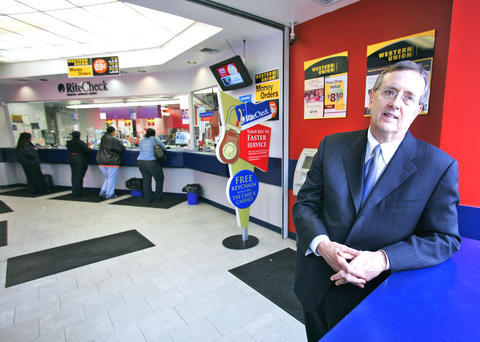
PHOTO: AP
The bankless are estimated to earn hundreds of billions of dollars a year in income. Seeing a business opportunity, banks are trying to draw in these potential customers. So, too, are check-cashing businesses and retailers.
Many people, however, still resist, preferring to remain in the financial shadows.
They tend to be minority -- Hispanic or blacks especially -- as well as low income and young.
According to the Federal Reserve, about one in 12 families -- 8.7 percent -- does not have a bank account.
The number is higher for the poorest -- nearly a quarter of families earning less than US$18,900 the US central bank said, citing 2004 data.
For some, like Rosa Alvarez, the financial choices can be bewildering.
"I don't understand about this bank stuff," said Alvarez, 54, who lives in Texas.
A nagging fear that she might make a mistake "if I don't keep up with it right or something" keeps her from opening an account. She had one once, briefly. But she had trouble keeping track of her balance. She thinks that when the account closed, she owed the bank US$12.
Carlos Maren, 25, a cook, is afraid that if he opens a bank account in the US, he will get hit with fees for not keeping in enough money or for taking out more money than he has.
"My uncle sometimes says that it's expensive ... because if you don't have money in the account, [the bank] is going to be charging you," Maren said.
He does his financial transactions at a check-cashing outlet in Washington. He said it is convenient and he likes knowing upfront what he will be charged to cash his paychecks, buy money orders and wire money to his native Mexico. He has a bank account there.
"It's not real expensive," Maren said.
Yet those charges can add up.
A Consumer Federation of America survey of check-cashing outlets, found that on average it cost US$24.45 to cash a US$1,002 government check last year. A blue-collar worker pays an average US$19.66 every week to cash a US$478.41 handwritten paper check.
Having a bank account can be expensive, too, if it is not managed wisely.
Failure to keep track of an account balance can incur a penalty of US$20 to US$35 each time a check is bounced or an account is overdrawn.
"It can be costly to be outside the banking system. The poor pay more," said John Caskey, economics professor at Swarthmore College.
"On the other hand, if all you did is take that low-income person, living paycheck to paycheck and moved them into the banking system and they are bouncing checks and incurring fees, you haven't done much and you may not have done them a favor," Caskey said.
The share of families without bank accounts decreased gradually from 1989 to 2001, then leveled off, the Fed said.
Banks have an economic interest in reeling in people outside the banking system -- 10 million to 28 million individuals who earn US$510 billion a year -- and turn them into customers who eventually may need loans to buy homes, cars and other items.
Banks are working through community groups to ease fears, build trust and to educate people about financial options. It is a challenge that can take years, bank officials say. Moreover, what may work in Houston does not necessarily prove fruitful in Fresno, California.
Federal Reserve research found that the most common reason families gave for not having checking accounts was that they did not write enough checks to make it worthwhile. Many people said they did not like dealing with banks.
Some -- regulators could not provide a percentage -- are in the country illegally. Without some proof of identification such as a driver's license or a passport, they cannot set up a bank account.
Over the years, technological innovations have spurred a range of products for people without bank accounts.
Some employers, not wanting to deal with the expense of paper checks, load employees' paychecks onto electronic cards that can be swiped at stores and restaurants or used to pay bills. These cards have federal protections, such as liability limits for unauthorized use, said Jean Ann Fox, director of consumer protection at the Consumer Federation of America.
Check-cashing outlets also sell electronic cards on which money from paychecks or a tax refund can be loaded. Fox said some of these cards can carry usage fees and may not have the same protections as bank-issued debit cards.
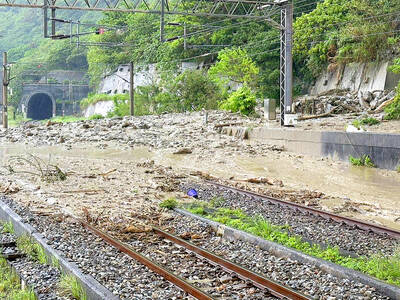
ROLLER-COASTER RIDE: More than five earthquakes ranging from magnitude 4.4 to 5.5 on the Richter scale shook eastern Taiwan in rapid succession yesterday afternoon Back-to-back weather fronts are forecast to hit Taiwan this week, resulting in rain across the nation in the coming days, the Central Weather Administration said yesterday, as it also warned residents in mountainous regions to be wary of landslides and rockfalls. As the first front approached, sporadic rainfall began in central and northern parts of Taiwan yesterday, the agency said, adding that rain is forecast to intensify in those regions today, while brief showers would also affect other parts of the nation. A second weather system is forecast to arrive on Thursday, bringing additional rain to the whole nation until Sunday, it
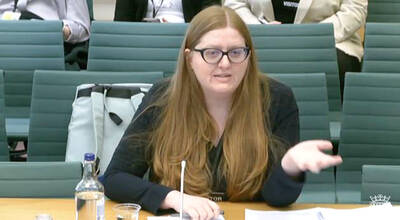
CONDITIONAL: The PRC imposes secret requirements that the funding it provides cannot be spent in states with diplomatic relations with Taiwan, Emma Reilly said China has been bribing UN officials to obtain “special benefits” and to block funding from countries that have diplomatic ties with Taiwan, a former UN employee told the British House of Commons on Tuesday. At a House of Commons Foreign Affairs Committee hearing into “international relations within the multilateral system,” former Office of the UN High Commissioner for Human Rights (OHCHR) employee Emma Reilly said in a written statement that “Beijing paid bribes to the two successive Presidents of the [UN] General Assembly” during the two-year negotiation of the Sustainable Development Goals. Another way China exercises influence within the UN Secretariat is
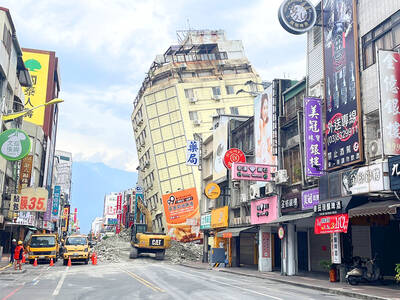
LANDSLIDES POSSIBLE: The agency advised the public to avoid visiting mountainous regions due to more expected aftershocks and rainfall from a series of weather fronts A series of earthquakes over the past few days were likely aftershocks of the April 3 earthquake in Hualien County, with further aftershocks to be expected for up to a year, the Central Weather Administration (CWA) said yesterday. Based on the nation’s experience after the quake on Sept. 21, 1999, more aftershocks are possible over the next six months to a year, the agency said. A total of 103 earthquakes of magnitude 4 on the local magnitude scale or higher hit Hualien County from 5:08pm on Monday to 10:27am yesterday, with 27 of them exceeding magnitude 5. They included two, of magnitude
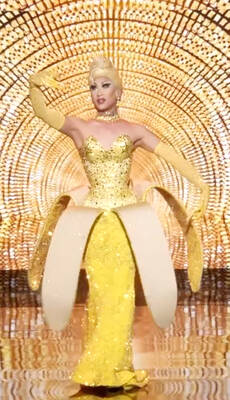
Taiwan’s first drag queen to compete on the internationally acclaimed RuPaul’s Drag Race, Nymphia Wind (妮妃雅), was on Friday crowned the “Next Drag Superstar.” Dressed in a sparkling banana dress, Nymphia Wind swept onto the stage for the final, and stole the show. “Taiwan this is for you,” she said right after show host RuPaul announced her as the winner. “To those who feel like they don’t belong, just remember to live fearlessly and to live their truth,” she said on stage. One of the frontrunners for the past 15 episodes, the 28-year-old breezed through to the final after weeks of showcasing her unique


 RSS
RSS