


Rogue companies. Secret profits. Legal threats. Allegations of "evil deeds" and "tyranny."
It may sound like an overwrought corporate thriller, but all are elements in a dispute between French firm Danone and its Chinese partner which has underlined the lingering risks of doing business in China.
The case has seen a successful Sino-foreign joint venture devolve into a catfight of charges and recriminations. For many, it's a cautionary tale about getting into bed with a Chinese partner.
"In my mind, there is no reason to have a [Chinese] partner anymore," said Mic Mittasch, an Australian who was involved in joint ventures but now runs a wholly foreign-owned business here creating production lines for manufacturing firms.
"A lot of firms that have them are now looking to cut down on the partner's influence," he said.
The French firm, maker of Danone yogurt and Evian water, is now trying to do just that with its estranged partner Hangzhou Wahaha Group Co (
Since joining forces in 1996, Danone has injected tens of millions of dollars to gain access to Wahaha's China distribution network in a venture run by Zong Qinghou (
But Danone this month filed a suit in the US accusing Zong of setting up dozens of rogue companies that sold the joint venture's drinks, but with none of those profits going to the French firm.
Danone said the underhand dealings have cost it US$100 million.
Zong has since resigned, but not without fighting back with accusations that Danone was attempting a "hostile takeover" of their various joint-venture companies.
His loyalists in the company vowed to resist Danone's control with increasingly angry rhetoric, including allegations of "evil deeds," quotes from Chinese revolutionary leader Mao Zedong (毛澤東) and protests from Chinese staff.
The case seems ripped from the pages of the 2002 book Mr. China, a frequently hilarious real-life business memoir by Tim Clissold, a representative in 1990s China for the Wall Street investment fund Asimco.
The book recounts Clissold's battles with a long list of duplicitous Chinese partners who used Asimco's money to build rogue factories making competing products or to pay off debts.
Clissold and his team eventually lost hundreds of millions of dollars. But other Western companies in China today continue to experience such problems.
"With our Chinese partner, if you gave them a finger, they would take the whole arm," said Anders Maltesen, general manager of Tianjin Alstom Hydro Co, which makes turbines for China's massive Three Gorges hydroelectric project.
Alstom, the French engineering group, has steadily bought out its Chinese partner since the venture was formed in 1995 due to repeated squabbling, he said.
"In China, a signature on a contract is often viewed as merely the start of negotiations," he said.
Zong threatened on Thursday to pull out of the venture and sue his estranged partner, while the new Danone-appointed chairman has vowed to stand firm while leaving the door open to a settlement.
Whatever the outcome, experts say the affair underlines the risks of joint ventures.
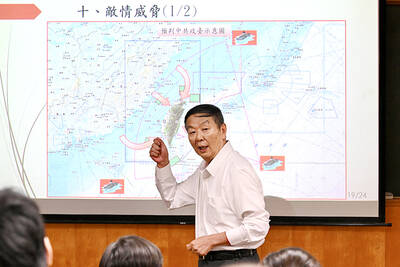
RETHINK? The defense ministry and Navy Command Headquarters could take over the indigenous submarine project and change its production timeline, a source said Admiral Huang Shu-kuang’s (黃曙光) resignation as head of the Indigenous Submarine Program and as a member of the National Security Council could affect the production of submarines, a source said yesterday. Huang in a statement last night said he had decided to resign due to national security concerns while expressing the hope that it would put a stop to political wrangling that only undermines the advancement of the nation’s defense capabilities. Taiwan People’s Party Legislator Vivian Huang (黃珊珊) yesterday said that the admiral, her older brother, felt it was time for him to step down and that he had completed what he

Taiwan has experienced its most significant improvement in the QS World University Rankings by Subject, data provided on Sunday by international higher education analyst Quacquarelli Symonds (QS) showed. Compared with last year’s edition of the rankings, which measure academic excellence and influence, Taiwanese universities made great improvements in the H Index metric, which evaluates research productivity and its impact, with a notable 30 percent increase overall, QS said. Taiwanese universities also made notable progress in the Citations per Paper metric, which measures the impact of research, achieving a 13 percent increase. Taiwanese universities gained 10 percent in Academic Reputation, but declined 18 percent
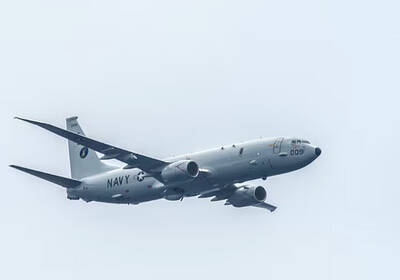
CHINA REACTS: The patrol and reconnaissance plane ‘transited the Taiwan Strait in international airspace,’ the 7th Fleet said, while Taipei said it saw nothing unusual The US 7th Fleet yesterday said that a US Navy P-8A Poseidon flew through the Taiwan Strait, a day after US and Chinese defense heads held their first talks since November 2022 in an effort to reduce regional tensions. The patrol and reconnaissance plane “transited the Taiwan Strait in international airspace,” the 7th Fleet said in a news release. “By operating within the Taiwan Strait in accordance with international law, the United States upholds the navigational rights and freedoms of all nations.” In a separate statement, the Ministry of National Defense said that it monitored nearby waters and airspace as the aircraft

UNDER DISCUSSION: The combatant command would integrate fast attack boat and anti-ship missile groups to defend waters closest to the coastline, a source said The military could establish a new combatant command as early as 2026, which would be tasked with defending Taiwan’s territorial waters 24 nautical miles (44.4km) from the nation’s coastline, a source familiar with the matter said yesterday. The new command, which would fall under the Naval Command Headquarters, would be led by a vice admiral and integrate existing fast attack boat and anti-ship missile groups, along with the Naval Maritime Surveillance and Reconnaissance Command, said the source, who asked to remain anonymous. It could be launched by 2026, but details are being discussed and no final timetable has been announced, the source


 RSS
RSS