


More than two dozen huge white satellite dishes surround ESPN's 40-hectare campus, each transmitting and plucking electronic signals from the skies. Tucked inside that digital fence are 10 buildings, all devoted to producing and broadcasting ESPN's cable sports programs. Deeper inside the campus sits another building, largely occupied by a team of 20-somethings and a few middle-aged managers, that produces sports content for just one device: the cellphone.
After some hits and misses in creating content for cellphones, ESPN thinks it knows how to keep up with its fans as they go about their days. cellphones and other mobile devices, says ESPN, are natural platforms for its content. Consumers waiting in line, riding a bus or sitting in a cafeteria will use their phones to watch sports commentary or to check scores just as often as they glance at their wristwatches -- or so the thinking goes. In ESPN's view, it is only a matter of time, and mobile technology upgrades, until "phone watching" is as common as phone calling.
"People talk about it being the third screen," says John Zehr, senior vice president for digital video and mobile products at ESPN. "I talk about it being the first screen because it's the closest to you."
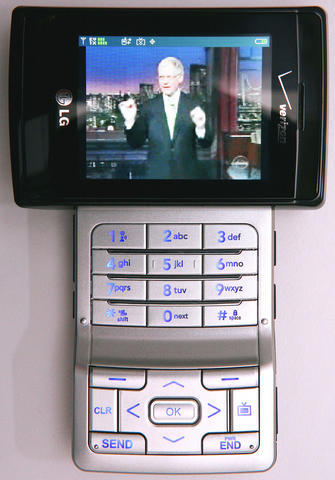
PHOTO: NY TIMES NEWS SERVICE
ESPN isn't alone. Other companies, like CBS and MTV, as well as news organizations like The Associated Press and magazine concerns like the Hearst Corp, are investing in original cellphone content. After all, there is no other medium that most people carry with them everywhere, and some media executives are wagering that consumers will fill their empty moments -- however fleeting -- with mobile media content.
Apple Inc, meanwhile, is just weeks away from introducing the iPhone, a product that some analysts speculate may reshape how people use their cellphones and increase demand for content on mobile devices. "It may start driving people's mind-set to think, `Oh, I can do this mobilely,'" Zehr says.
But the mobile media model is far from proven. Only 44 percent of cellphone owners use data services like video or the Internet on their phones, according to Forrester Research. Among those who use phones for more than calling, 88 percent of them use messaging, mostly text messaging, and about a quarter surf the Web, but only 7 percent watch videos. Screen size and low resolution are problems, analysts say, and many consumers seem uninterested in content on their phones.
"A lot of what is being said is being driven by what is technically possible as opposed to any real understanding of just what people are doing," says Mike Bloxham, research director at the Center for Media Design at Ball State University in Muncie, Indiana.
"Yes, it is possible to watch video on many of the cellphones people are buying," he said, "but you have to look at how many people are doing that."
But ESPN is clearly onto something. More than nine million people visit its cellphone Web site each month, a following that surpasses the audience of most computer-based Web sites. Some sports fans apparently cannot wait to reach their homes or offices to check the score of a Patriots game or to see if their favorite pitcher has tossed a no-hitter, so tens of thousands of them receive an average of 22 ESPN text messages on their phones each week.
As he finishes taping a segment for the cellphone show ESPN ReSet -- a recap of morning programs on ESPN -- Trey Wingo, the show's anchor, says mobile-content skeptics will be proved wrong. Wingo says that when ESPN made its debut as a cable channel in 1979, doubters said that "people weren't going to watch a 24-hour sports network -- it's similar to what they're saying about cellphones now."
ESPN has already weathered consumer indifference when it comes to cellphones. Early last year, it introduced its own cellphone and cell service for sports fans. Despite a flashy Super Bowl commercial and lavish marketing, the phone received a ho-hum reception, and ESPN stopped offering it last fall. Still, ESPN employees remain true believers: their phone failed, they say, because of consumers' reluctance to change phone carriers, not because of any lack of interest in mobile content. Indeed, ESPN's content is perfectly suited for the mobile world. Sports fans, after all, like to closely monitor their favorite players and teams -- timely information that fits comfortably into what media executives call "snack size" content. The News Corp, steward of the Fox Network and Fox Studios, is so fond of short cellphone videos that it has trademarked a term to describe them: "mobisodes."
Many mobile-content providers assume that consumers with more than a few minutes to spare won't be attached to their cellphone screens. Instead, they will call their mothers to chat, find a computer or a television, or maybe even read a book. Yet executives at broadcast networks like ABC say that this assumption is worth challenging, and they are betting that consumers will also watch longer-form content on their phones. Last month, ABC began showing full-hour episodes of shows like Lost and Grey's Anatomy on Sprint's network.
"We're creating another opportunity for content consumption where there wasn't one at all," says Albert Cheng, executive vice president for digital media at ABC.
Cheng says people may think that short-form content works best on cellphones simply because that is the bulk of what has been developed.
"We're all experimenting," he says. "I don't think any of us really knows what people want on mobile."
For its part, ESPN is not holding back. It already tracks what computer users read on its Web site to determine what like-minded sports fans want to view on their phones, and is pursuing a patent to protect the technologies underlying its multiscreen effort. The goal is to monitor individuals' interests on the Web site and then use the information to match cellphone content to their tastes. If someone is watching a football game on ESPN.com and has to hit the road, Zehr says, chances are that they would like the game to appear on their cellphone 20 minutes later.
Some of ESPN's most avid phone users do not sit in front of a PC in an office all day; instead they may work as chefs, store clerks, and construction workers. ESPN also thinks that live events will be popular on cellphones; it is showing live clips from the US Open golf tournament, for example. Zehr says he believes that for many viewers, ESPN's mobile content will become more important than its Web content.
"You start to learn more and more about your fan as they migrate from platform to platform," he says. "What we're really doing now is customer relationship management."
Despite ESPN's ardor for mobility, some critics say media companies cannot get around the chief hurdle facing the cellphone: its tiny screen. Consumers are buying larger and larger television screens for their living rooms, and many may not like squinting at a 2.5-inch picture. ESPN, for example, is addressing that by offering video content with more close-ups and customizing graphics for the small screen.
Still, some analysts are skeptical.
"The experience of content on your phone is worse than almost any other venue you could think of," says Charles Golvin, a senior analyst at Forrester Research. "If you have a choice between a phone and any other outlet for content, you'll almost always choose the other outlet because it's a better experience. The phone is the device of last resort."
Mobile-content advocates counter that people may be reaching the point of last resort much more often than they did in the past -- especially as commutes grow longer and as people generally travel more.
The popularity of DVDs has shown that people will view films on smaller screens than those at movie theaters because it is more convenient to stay home. If they can be induced to settle for even smaller screens, cellphone viewing at home may rise.
One mobile content network, Go2, which runs mobile sites about golf, travel and other topics, found that 44 percent of its users visit Go2 on their phones while they are at home. And MTV Networks has noticed that its Nickelodeon video clips do well on cellphones, possibly because parents in their cars pass their phones to bored children in the backseat.
Underlying the interest in cellphones as the Next Big Media Platform is a generation gap: younger people use cellphones more than their baby-boomer parents do -- and for a lot more than chatting. More than three-quarters of 18 to 26-year-olds use some type of data services -- compared with 44 percent of the general population -- and their time spent messaging, downloading content, watching video and surfing around the mobile slipstream is also higher, according to Forrester.
"For the younger generation, the mobile phone is their most relevant device," says Dan Novak, an executive at MediaFLO USA, a cellphone video network. "They don't want just clips. They want long-form programming, they want shows that are simulcast, they basically want a TV-like experience."
In the end, the younger crowd is what gives hope to mobility zealots like Zehr at ESPN.
"I have a five-year-old, and he doesn't know that there are phones you can't watch TV on," he says. "People are more mobile than ever. They commute more, they travel more, they are out of the house. They are going to want mobile content."

ROLLER-COASTER RIDE: More than five earthquakes ranging from magnitude 4.4 to 5.5 on the Richter scale shook eastern Taiwan in rapid succession yesterday afternoon Back-to-back weather fronts are forecast to hit Taiwan this week, resulting in rain across the nation in the coming days, the Central Weather Administration said yesterday, as it also warned residents in mountainous regions to be wary of landslides and rockfalls. As the first front approached, sporadic rainfall began in central and northern parts of Taiwan yesterday, the agency said, adding that rain is forecast to intensify in those regions today, while brief showers would also affect other parts of the nation. A second weather system is forecast to arrive on Thursday, bringing additional rain to the whole nation until Sunday, it
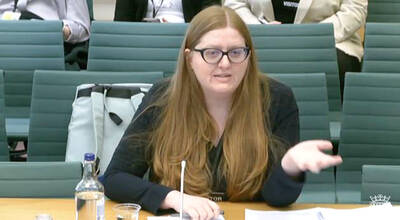
CONDITIONAL: The PRC imposes secret requirements that the funding it provides cannot be spent in states with diplomatic relations with Taiwan, Emma Reilly said China has been bribing UN officials to obtain “special benefits” and to block funding from countries that have diplomatic ties with Taiwan, a former UN employee told the British House of Commons on Tuesday. At a House of Commons Foreign Affairs Committee hearing into “international relations within the multilateral system,” former Office of the UN High Commissioner for Human Rights (OHCHR) employee Emma Reilly said in a written statement that “Beijing paid bribes to the two successive Presidents of the [UN] General Assembly” during the two-year negotiation of the Sustainable Development Goals. Another way China exercises influence within the UN Secretariat is

LANDSLIDES POSSIBLE: The agency advised the public to avoid visiting mountainous regions due to more expected aftershocks and rainfall from a series of weather fronts A series of earthquakes over the past few days were likely aftershocks of the April 3 earthquake in Hualien County, with further aftershocks to be expected for up to a year, the Central Weather Administration (CWA) said yesterday. Based on the nation’s experience after the quake on Sept. 21, 1999, more aftershocks are possible over the next six months to a year, the agency said. A total of 103 earthquakes of magnitude 4 on the local magnitude scale or higher hit Hualien County from 5:08pm on Monday to 10:27am yesterday, with 27 of them exceeding magnitude 5. They included two, of magnitude

Taiwan’s first drag queen to compete on the internationally acclaimed RuPaul’s Drag Race, Nymphia Wind (妮妃雅), was on Friday crowned the “Next Drag Superstar.” Dressed in a sparkling banana dress, Nymphia Wind swept onto the stage for the final, and stole the show. “Taiwan this is for you,” she said right after show host RuPaul announced her as the winner. “To those who feel like they don’t belong, just remember to live fearlessly and to live their truth,” she said on stage. One of the frontrunners for the past 15 episodes, the 28-year-old breezed through to the final after weeks of showcasing her unique


 RSS
RSS