


To get around the chronic labor shortages hampering the traditional textile center and in other industries across Romania, Sorin Nicolescu, who runs a clothing factory, came up with an original solution -- import 800 workers from China.
"The explanation is very simple," said Nicolescu, general manager of a Swiss concern, the Wear Co. "We don't have any Romanian workers because they have all left to work" in Western and Central Europe.
Foreign investors have been attracted to Romania, a poor Balkan country, because of its low wages and, since Jan. 1, its membership of the EU. At the same time, those low wages and freedom of movement through Europe, which is now easier, have been fueling a wave of emigration that threatens to slow an economic boom in recent years in Romania.
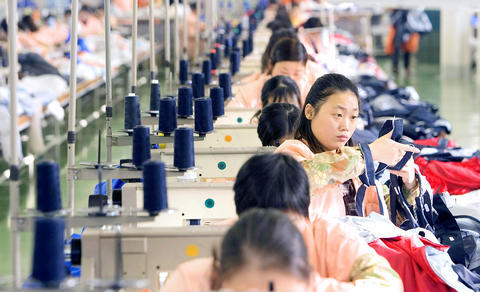
PHOTO: NY TIMES NEWS SERVICE
"This was happening before we joined the EU," said Ana Murariu, a production manager at Wear. "Now it's even worse."
Romania, a nation of 21.6 million (and declining 0.2 percent annually), received US$12 billion in foreign direct investment last year. That helped the economy grow as much as 7 percent, with an unemployment rate in January of 5.4 percent -- below the EU average.
But with monthly wages averaging around US$375 after taxes, roughly 2 million people, or more than 8 percent of the population, have left since the Stalinist government of former president Nicolae Ceausescu fell in 1989, according to analysts' estimates.
Italy and Spain are the most popular destinations for Romanian workers, where they usually perform manual labor, legally and illegally, and generally for lower wages than local people.
Nicolescu said he decided to look for workers in China because he had contracts there, and those companies had put him in touch with an employment agency. Those who are hired pay about US$2,000 for transportation and the employment agency's fee, according to one worker.
Once they reach Bacau, a drab industrial city of 181,000, 240km northeast of Bucharest, they go to work in a large, inconspicuous warehouse on the outskirts of town.
Inside, about 170 Chinese women operate sewing machines attached to tables stacked with finished and unfinished garments. Most of the tables, arranged in long rows, are empty. The plant expects 500 more Chinese workers by the end of next month.
The factory is clean, freshly painted and well lighted. The only sound is the rapid, repetitive thud of the sewing machines as the workers stitch together previously tailored pieces of garments. They make mostly sportswear for a range of brands including Prada and Carrefour. All the production is for export.
Nicolescu said he paid the women about US$347 a month after taxes. The legal minimum wage is 132 euros a month (US$176) after taxes.
The company operated with Romanian workers until 2003, when operations were suspended because the work force had dwindled to 200. Nicolescu said the company had posted hundreds of job offers at a local agency, but they had gone unanswered.
"It's very difficult work, and it's not well paid," Nicolescu said.
He said the industry found it hard to attract young workers to replace the current ones, most of whom are nearing retirement.
"I'm not very pleased about working with foreign workers because I have to provide them food and housing" on top of their salaries, Nicolescu said.
That amounts to an additional US$130 a month for each employee, he said, in addition to the US$500,000 he spent building worker dormitories.
Critics say the company would find Romanian workers if it offered better wages. But Nicolescu replied that higher wages would make his products uncompetitive internationally, pointing out that textile manufacturers had already left much of Europe in search of lower costs in regions like China.
Cornelia Barbu, deputy director of the Bacau County employment agency, said inspectors had thoroughly inspected conditions for the Chinese workers.
"They are treated very well," she said. "They have a social club and a kitchen. They live much better than most of the Romanians living abroad."
Xiu Xian Hong, from Fujian Province, who came here last July, described life as better than in China.
"It is quiet here, and the air is much cleaner," she said through a translator who worked at the plant. "The work is the same, but the pay is more."
But she said she missed her three-year-old daughter and her husband back home.
Xiu said she had come to Romania because it was the only place offered when she sought work at an agency in China. She said she planned to stay at least three years, hoping to save enough money to start a business, perhaps a shop, when she returned.
Although the city center is easily accessible by public transportation, the workers spend most of their free time in five-bed dormitory rooms in the factory complex, playing cards, reading books and watching Chinese satellite TV.
Few local residents have actually seen the workers in town. People in a city park said they learned about their new neighbors from newspapers and television.
"Our people have gone to the West and all over the world, so we need others to replace them," said Dumitru Padure, a retired aircraft factory technician.
Andrea Grigoras, a translator, sitting with her toddler daughter, expressed the view that the Chinese workers received better pay than Romanians and would probably be more focused than Romanian workers.
"I know a lot of Romanians who would do the work for less," she said. "I'm not worried. But I'd get worried if there were many foreign workers coming here."
A variety of intra-European transportation links here illustrates the scale of emigration. A discount Romanian-based airline, Blue Air, offers six direct flights a week from Bacau to Italy -- two to Turin and four to Rome. A bus company, Atlassib, one of many, runs 10 buses daily to Italy from Bacau.
The population of Romania is projected to fall by 29 percent, below 15.5 million, by 2050, according to the US Population Reference Bureau in Washington. Villages and towns outside Bucharest, have been hit especially hard.
Barbu suggested that wages would need to reach levels about three-quarters of those in the West for Romanian workers to return.
"We have to get used to it because the EU means greater mobility," she said. "Just as we have left, others will come here."

ROLLER-COASTER RIDE: More than five earthquakes ranging from magnitude 4.4 to 5.5 on the Richter scale shook eastern Taiwan in rapid succession yesterday afternoon Back-to-back weather fronts are forecast to hit Taiwan this week, resulting in rain across the nation in the coming days, the Central Weather Administration said yesterday, as it also warned residents in mountainous regions to be wary of landslides and rockfalls. As the first front approached, sporadic rainfall began in central and northern parts of Taiwan yesterday, the agency said, adding that rain is forecast to intensify in those regions today, while brief showers would also affect other parts of the nation. A second weather system is forecast to arrive on Thursday, bringing additional rain to the whole nation until Sunday, it

CONDITIONAL: The PRC imposes secret requirements that the funding it provides cannot be spent in states with diplomatic relations with Taiwan, Emma Reilly said China has been bribing UN officials to obtain “special benefits” and to block funding from countries that have diplomatic ties with Taiwan, a former UN employee told the British House of Commons on Tuesday. At a House of Commons Foreign Affairs Committee hearing into “international relations within the multilateral system,” former Office of the UN High Commissioner for Human Rights (OHCHR) employee Emma Reilly said in a written statement that “Beijing paid bribes to the two successive Presidents of the [UN] General Assembly” during the two-year negotiation of the Sustainable Development Goals. Another way China exercises influence within the UN Secretariat is

LANDSLIDES POSSIBLE: The agency advised the public to avoid visiting mountainous regions due to more expected aftershocks and rainfall from a series of weather fronts A series of earthquakes over the past few days were likely aftershocks of the April 3 earthquake in Hualien County, with further aftershocks to be expected for up to a year, the Central Weather Administration (CWA) said yesterday. Based on the nation’s experience after the quake on Sept. 21, 1999, more aftershocks are possible over the next six months to a year, the agency said. A total of 103 earthquakes of magnitude 4 on the local magnitude scale or higher hit Hualien County from 5:08pm on Monday to 10:27am yesterday, with 27 of them exceeding magnitude 5. They included two, of magnitude

Taiwan’s first drag queen to compete on the internationally acclaimed RuPaul’s Drag Race, Nymphia Wind (妮妃雅), was on Friday crowned the “Next Drag Superstar.” Dressed in a sparkling banana dress, Nymphia Wind swept onto the stage for the final, and stole the show. “Taiwan this is for you,” she said right after show host RuPaul announced her as the winner. “To those who feel like they don’t belong, just remember to live fearlessly and to live their truth,” she said on stage. One of the frontrunners for the past 15 episodes, the 28-year-old breezed through to the final after weeks of showcasing her unique


 RSS
RSS