


The growth of the Internet has created significant challenges for intellectual property law. Virtually every day there is another story about online copyright infringement of some form or another. Music, photos, film, video, books -- all the content-producing industries are being shaken up.
The legal motivation for patents and copyright is written into the US Constitution: To promote the progress of science and useful arts. By granting innovators an exclusive right to their writings and discoveries, Congress provided a strong incentive to engage in innovation. As president Abraham Lincoln put it, the patent system added "the fuel of interest to the fire of genius."
But intellectual property right (IPR) law is not the only way to provide such incentives. Ideas, for example, cannot be patented. Yet university professors churn out hundreds of thousands of publications each year that are full of ideas, both good and bad. The social norms in academia, among them citation requirements and plagiarism taboos, seem to work pretty well.
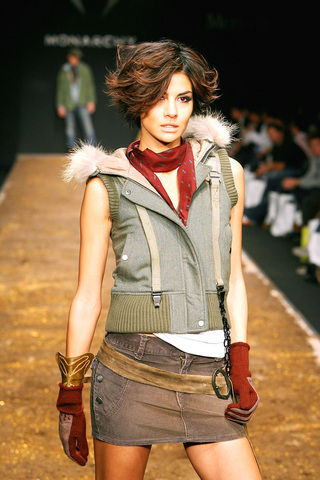
PHOTO: AFP
Another industry that seems to get along well without intellectual property protection is the fashion industry. Brand names and logos are protected by trademark, but the design of clothing is generally not protected in the US.
Recently, two law professors, Kal Raustiala of the University of California, Los Angeles, and Chris Sprigman of the University of Virginia, wrote a fascinating paper that outlines the workings of the fashion industry and how it manages to function without much IPR protection.
At one time, the fashion industry did have a self-imposed system of intellectual property protection. In the 1930s, the Fashion Originators' Guild prohibited copying among its members and urged retailers not to sell items from those who copied other designs. The guild was reasonably successful in these efforts. But in 1941, the US Supreme Court held that its practices violated antitrust laws, and since then the fashion industry in the US has had no intellectual property protection for designs.
A result has been that "piracy" of designs is common in the fashion industry. Designers constantly experiment with new shapes and colors. If a particular style catches on, it is quickly copied. Skinny jeans have been fashionable for the last few years, but there are signs that the trends are now moving toward straight-leg jean designs. If the tide changes, pretty soon everybody will be selling straight-leg jeans.
According to Raustiala and Sprigman, the fashion industry can survive without intellectual property protection because of two interacting factors that they refer to as "induced obsolescence" and "anchoring."
The first factor means that clothes become unfashionable before they wear out, so trendy people have to keep buying new clothes every year. When you are wearing the same thing as your cool friends, that's great. But when you start seeing that style on decidedly uncool people, it's time for something new -- which the fashion industry is happy to provide.
But how do the fashionable decide what the next big thing is? Or perhaps more to the point: How does the fashion industry convey to their consumers what they should be wearing? How does the industry "anchor" the consumers in this season's fashions? This is where copying comes in. If all the designers are showing baby doll dresses in the spring, then there's a good chance that is what everybody will be wearing by the summer.
Raustiala and Sprigman argue that the lack of intellectual property protection actually promotes the functioning of the industry. If the extension of copyright to fashion prevented clothes manufacturers from copying each other, the industry would be ceding a major role to the lawyers and become much less creative. We'd see the same thing year after year. In other words, women's fashion would look much more like men's fashions -- boring, boring, boring.
Since I have the same fashion sense that most economists have -- that is, none whatsoever -- I cannot attest to the accuracy of the law professors' description of the fashion industry. But it is consistent with other examples of what happens when there is no intellectual property protection.
The US did not protect copyrights of foreign authors until 1891, since it was just too tempting to ride free on the production of those great 19th-century British authors. Clipper ships used to carry copies of Charles Dickens' latest book to the US, where it was quickly rushed into print by dozens of printers and sold for next to nothing.
Critics complained that these hastily produced books were poorly printed and cheaply manufactured. That may have been bad for books, but it is not such a big deal for that cheap, but fashionable hoodie sweatshirt your teenage son bought a few months ago, since he isn't going to wear it much after this season anyway.
The US started to recognize international copyright in 1891 partly to protect US writers from cheap foreign competition like the Dickens volumes. This was almost certainly the right thing to do, particularly since copyrights held by US authors received reciprocal recognition abroad.
But not every industry necessarily benefits from strong intellectual property protection. In some cases, it appears that lack of protection can lead to a more vibrant and dynamic industry.

ROLLER-COASTER RIDE: More than five earthquakes ranging from magnitude 4.4 to 5.5 on the Richter scale shook eastern Taiwan in rapid succession yesterday afternoon Back-to-back weather fronts are forecast to hit Taiwan this week, resulting in rain across the nation in the coming days, the Central Weather Administration said yesterday, as it also warned residents in mountainous regions to be wary of landslides and rockfalls. As the first front approached, sporadic rainfall began in central and northern parts of Taiwan yesterday, the agency said, adding that rain is forecast to intensify in those regions today, while brief showers would also affect other parts of the nation. A second weather system is forecast to arrive on Thursday, bringing additional rain to the whole nation until Sunday, it

LANDSLIDES POSSIBLE: The agency advised the public to avoid visiting mountainous regions due to more expected aftershocks and rainfall from a series of weather fronts A series of earthquakes over the past few days were likely aftershocks of the April 3 earthquake in Hualien County, with further aftershocks to be expected for up to a year, the Central Weather Administration (CWA) said yesterday. Based on the nation’s experience after the quake on Sept. 21, 1999, more aftershocks are possible over the next six months to a year, the agency said. A total of 103 earthquakes of magnitude 4 on the local magnitude scale or higher hit Hualien County from 5:08pm on Monday to 10:27am yesterday, with 27 of them exceeding magnitude 5. They included two, of magnitude

CONDITIONAL: The PRC imposes secret requirements that the funding it provides cannot be spent in states with diplomatic relations with Taiwan, Emma Reilly said China has been bribing UN officials to obtain “special benefits” and to block funding from countries that have diplomatic ties with Taiwan, a former UN employee told the British House of Commons on Tuesday. At a House of Commons Foreign Affairs Committee hearing into “international relations within the multilateral system,” former Office of the UN High Commissioner for Human Rights (OHCHR) employee Emma Reilly said in a written statement that “Beijing paid bribes to the two successive Presidents of the [UN] General Assembly” during the two-year negotiation of the Sustainable Development Goals. Another way China exercises influence within the UN Secretariat is

Taiwan’s first drag queen to compete on the internationally acclaimed RuPaul’s Drag Race, Nymphia Wind (妮妃雅), was on Friday crowned the “Next Drag Superstar.” Dressed in a sparkling banana dress, Nymphia Wind swept onto the stage for the final, and stole the show. “Taiwan this is for you,” she said right after show host RuPaul announced her as the winner. “To those who feel like they don’t belong, just remember to live fearlessly and to live their truth,” she said on stage. One of the frontrunners for the past 15 episodes, the 28-year-old breezed through to the final after weeks of showcasing her unique


 RSS
RSS