


China will send ripples through the financial world when it unleashes an investment company with more money under management than any mutual fund in existence, analysts said.
The State Foreign Exchange Investment Co (
"A company like that will definitely have an impact on global markets," said Zhang Ming (
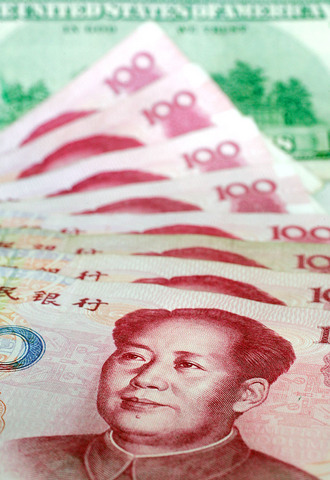
PHOTO: AFP
"Other investors will be following it closely and try and guess its next move. They'll buy assets that the company is likely to buy, and withdraw from markets if that's what they believe the company will do," he said.
The State Foreign Exchange Investment Co is expected to spend its money on a wide array of investment targets at home and abroad, from oil and gas to financial assets and entire companies, analysts said.
It will get its huge bag of money as part of a plan to divide China's US$1.07 trillion of reserves into three portions, the Southern Weekly paper said recently.
Another US$100 billion from the reserves will be allocated to Central Huijin Investment Co (
That arrangement will put the State Foreign Exchange Investment Co in charge of more money than the approximately US$160 billion of assets controlled by the Growth Fund of America, the world's largest mutual fund.
"In the long term, the company should become a national reserve asset management company, which should be able to earn returns higher than those from US Treasury bonds," said Zhou Jiangong, a Shanghai-based economic analyst.
In finance, the ideal portfolio offers high yields combined with low risk, but the problem is China's forex portfolio increasingly looks like the exact opposite.
"The government is concerned about the prospect of a steep depreciation of the US dollar," said Wang Qing (王慶), the Hong Kong-based chief economist with Bank of America.
"Most of China's forex reserves are in US-dollar assets, and it's possible that the government wishes to diversify towards more assets in other currencies to reduce the potential loss from a falling dollar," he said.
Some observers argue China has already been quietly trying to extricate itself from this risk.
They cite estimates that the share of US-dollar Treasury bonds is now 60 percent of China's forex reserves, down from 70 percent five years ago.
But for a more radical approach to the problem, the fresh perspective that a whole new company can offer is a good idea, analysts said.
But a cautious attitude is called for, due to the sheer weight China now possesses in global finance because of its huge reserves.
It is an amount of money that could rattle global financial markets if allowed to flow out of China in a reckless manner.
"The outflow will be carefully managed since a stable asset market is in the interest of China," Zhou said.
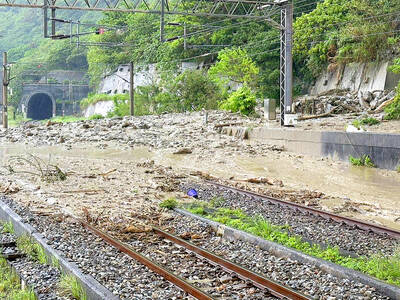
ROLLER-COASTER RIDE: More than five earthquakes ranging from magnitude 4.4 to 5.5 on the Richter scale shook eastern Taiwan in rapid succession yesterday afternoon Back-to-back weather fronts are forecast to hit Taiwan this week, resulting in rain across the nation in the coming days, the Central Weather Administration said yesterday, as it also warned residents in mountainous regions to be wary of landslides and rockfalls. As the first front approached, sporadic rainfall began in central and northern parts of Taiwan yesterday, the agency said, adding that rain is forecast to intensify in those regions today, while brief showers would also affect other parts of the nation. A second weather system is forecast to arrive on Thursday, bringing additional rain to the whole nation until Sunday, it
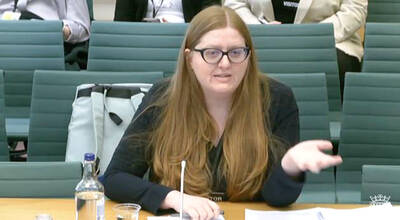
CONDITIONAL: The PRC imposes secret requirements that the funding it provides cannot be spent in states with diplomatic relations with Taiwan, Emma Reilly said China has been bribing UN officials to obtain “special benefits” and to block funding from countries that have diplomatic ties with Taiwan, a former UN employee told the British House of Commons on Tuesday. At a House of Commons Foreign Affairs Committee hearing into “international relations within the multilateral system,” former Office of the UN High Commissioner for Human Rights (OHCHR) employee Emma Reilly said in a written statement that “Beijing paid bribes to the two successive Presidents of the [UN] General Assembly” during the two-year negotiation of the Sustainable Development Goals. Another way China exercises influence within the UN Secretariat is
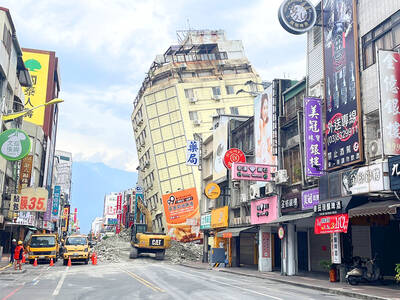
LANDSLIDES POSSIBLE: The agency advised the public to avoid visiting mountainous regions due to more expected aftershocks and rainfall from a series of weather fronts A series of earthquakes over the past few days were likely aftershocks of the April 3 earthquake in Hualien County, with further aftershocks to be expected for up to a year, the Central Weather Administration (CWA) said yesterday. Based on the nation’s experience after the quake on Sept. 21, 1999, more aftershocks are possible over the next six months to a year, the agency said. A total of 103 earthquakes of magnitude 4 on the local magnitude scale or higher hit Hualien County from 5:08pm on Monday to 10:27am yesterday, with 27 of them exceeding magnitude 5. They included two, of magnitude

Taiwan’s first drag queen to compete on the internationally acclaimed RuPaul’s Drag Race, Nymphia Wind (妮妃雅), was on Friday crowned the “Next Drag Superstar.” Dressed in a sparkling banana dress, Nymphia Wind swept onto the stage for the final, and stole the show. “Taiwan this is for you,” she said right after show host RuPaul announced her as the winner. “To those who feel like they don’t belong, just remember to live fearlessly and to live their truth,” she said on stage. One of the frontrunners for the past 15 episodes, the 28-year-old breezed through to the final after weeks of showcasing her unique


 RSS
RSS