


Taipei Times: Holding large-scale exhibitions has always been a major task for the Taiwan External Trade Development Council (TAITRA, 外貿協會). Last year alone, we saw new expositions including AutoTronics Taipei and this year it will hold new shows such as the Taiwan radio frequency identification (RFID) and the Photovoltaic Forum & Exhibition Taiwan. How important are these expos in lifting Taiwan's image?
Hsu Chih-jen (
Before 2000, traditional industries -- including toys, gifts and stationery -- were the major shows that we held, but land and labor costs have pushed these companies offshore to China or Southeast Asia.

PHOTO: SUNG CHIH-HSIUNG, TAIPEI TIMES
This has given way to service and high-tech industries. TAITRA has to stay abreast of these trends and hold related shows to showcase the nation's competitiveness.
As long as there are companies striving to do business in Taiwan, we will continue to hold such exhibits in which they can participate. That's why we decided to revive the Taipei International Furniture Show last March and will do so again next month.
TAITRA's overseas branches have been tasked to encourage domestic buyers to visit and take part in our exhibitions.
When they come, they will have to find accommodation, eat and get to know local culture, so this is not only an expo business per se but also an activity that also benefits the tourism and services industries.
While some traditional industries are slowing down, rising fields such as RFID are very popular. Issues such as renewable energy and solar energy are hot and their presence on the stock market, through companies like Motech Industries Inc (
These will be the first shows we hold this year and if we do it properly we will be able to position Taiwan as the most important base in Asia.
TT: The new Nangang Exhibition Hall is expected to open its doors for the first expo in March next year. How would TAITRA -- the hall operator -- position it, given that exhibitors might favor the exhibition halls at the Taipei World Trade Center (TWTC) in the bustling Xinyi District? [Editor's note: The Nangang Hall was originally scheduled for completion last June but has been delayed until April. Located in Nangang District, it will have seven floors and two underground levels with a total floor space of 47,000m2 that can accommodate more than 2,600 booths.]
Hsu: We started to set up TWTC Exhibition Hall I in 1983, followed by halls II and III later. These halls used to be the most superb in the region, as they boasted four-in-one functions -- exhibition, hotel, office and conference.
But the floor space has become limited and transportation in the area became congested after the economy picked up. For instance, we could only offer 2,500 booths to accommodate exhibitors at the Computex Taipei in all three TWTC halls. This meant that we had to turn down requests for an additional 2,500 booths.
Shanghai, Shenzhen, Suzhou, Hong Kong, as well as South Korea, Japan and Singapore are all now holding competitive exhibits. We have entered a period where we have to compete in terms of infrastructure.
We are now pushing for "second-generation" exhibition halls. Nangang Hall still isn't what we have in mind when we think of a top-notch exhibit hall. But it will still be complementary to the TWTC halls, as most exhibitors will still prefer TWTC in terms of location, proximity and familiarity.
But starting next year, TAITRA will move some exhibitors from the nine major expositions to Nangang, which should relieve some of the congestion.
This is what we have in mind for a "second-generation" hall: a great amount of land surrounds Nangang Hall. The hall only occupies one-third of the land; the remaining two-thirds are to be developed into hotels, shopping malls and offices. We hope to persuade the developer to work with us to turn some of that land into exhibition halls as well. This would help us make a reality of our "second-generation exhibition hall" and help turn Taiwan into a world-class expo location.
TT: You have been aggressively promoting local agriculture products since you came on board in 2003. How do you view Taiwan's competitiveness in this sector?
Hsu: Taiwan is blessed with rich agriculture, a plentiful ecosystem and fine weather and temperature. But the government and even farmers long neglected its competitiveness. Agriculture is not a sunset industry. We all know Sunkist is a specialty from California; the Netherlands is famous for its dairy products and that the Kiwi fruit is from New Zealand.
These products offer higher profit margins than the production of computers, something which Taiwan is strong at.
Agriculture products must put hygiene as the first priority and if we can produce safe and clean food, we will attract big spenders even though our products are more expensive.
If we produce good organic rice, its price will be NT$90 per kg, compared to NT$30 per kg for the more common rice. In Ilan and Changhwa, "koshihikari rice" (越光米) -- a fine rice that originated in Japan -- can sell for as much as NT$150 per kg.
TAITRA's role in all this is to push these products overseas. Over the years, we have set up export offices in Tokyo, Osaka, Hong Kong, Beijing, Shanghai and Indonesia. We also brought delegations to attend food fairs in Tokyo, Shanghai, Paris, Frankfurt and Australia.
TT: TAITRA has helped local firms exploit business opportunities in overseas markets. What are the major target markets you will focus on this year?
Hsu: To gain a successful foothold, we will need to see what these markets need and what we can offer them. First will be the energy-rich markets. Due to their strong oil reserves, the higher fuel prices we have experienced recently have made countries such as Dubai, Nigeria and Russia prosperous. Their real-estate segment is booming and will need new properties such as hotels and resorts -- areas we plan to focus on.
We will continue to delegate local companies to visit these countries to explore potential business opportunities.
The second would be the emerging markets, such as China, Vietnam, India and Africa. We cannot deny their rising economic power and TAITRA has annual development plans laid out for each of these markets.
TT: You were based overseas for a great number of years. Based on this experience, how do you think Taiwanese companies could further market themselves at the international level?
Hsu: Taiwanese firms have always been ready to explore overseas markets on their own. They are especially well acquainted with the US, Japanese and Chinese markets.
I recently visited the Middle East and found out that Japanese, South Korean and even Chinese goods have taken this market by storm. This constitutes a new territory for Taiwanese companies and they should consider gaining a stronger foothold.
In order to market their products successfully, local companies need to focus on strong products and promote them at the international level.
Each market has its own sets of demands and types of behavior and companies will need to find ways to cater to the idiosyncrasies of these markets.
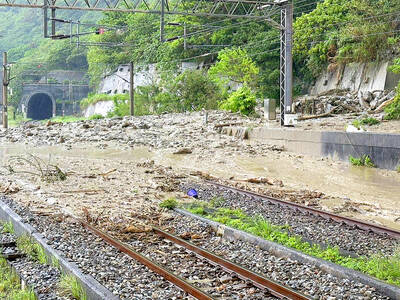
ROLLER-COASTER RIDE: More than five earthquakes ranging from magnitude 4.4 to 5.5 on the Richter scale shook eastern Taiwan in rapid succession yesterday afternoon Back-to-back weather fronts are forecast to hit Taiwan this week, resulting in rain across the nation in the coming days, the Central Weather Administration said yesterday, as it also warned residents in mountainous regions to be wary of landslides and rockfalls. As the first front approached, sporadic rainfall began in central and northern parts of Taiwan yesterday, the agency said, adding that rain is forecast to intensify in those regions today, while brief showers would also affect other parts of the nation. A second weather system is forecast to arrive on Thursday, bringing additional rain to the whole nation until Sunday, it

CONDITIONAL: The PRC imposes secret requirements that the funding it provides cannot be spent in states with diplomatic relations with Taiwan, Emma Reilly said China has been bribing UN officials to obtain “special benefits” and to block funding from countries that have diplomatic ties with Taiwan, a former UN employee told the British House of Commons on Tuesday. At a House of Commons Foreign Affairs Committee hearing into “international relations within the multilateral system,” former Office of the UN High Commissioner for Human Rights (OHCHR) employee Emma Reilly said in a written statement that “Beijing paid bribes to the two successive Presidents of the [UN] General Assembly” during the two-year negotiation of the Sustainable Development Goals. Another way China exercises influence within the UN Secretariat is
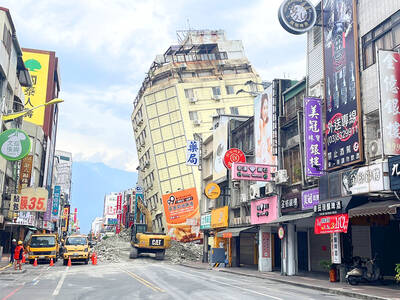
LANDSLIDES POSSIBLE: The agency advised the public to avoid visiting mountainous regions due to more expected aftershocks and rainfall from a series of weather fronts A series of earthquakes over the past few days were likely aftershocks of the April 3 earthquake in Hualien County, with further aftershocks to be expected for up to a year, the Central Weather Administration (CWA) said yesterday. Based on the nation’s experience after the quake on Sept. 21, 1999, more aftershocks are possible over the next six months to a year, the agency said. A total of 103 earthquakes of magnitude 4 on the local magnitude scale or higher hit Hualien County from 5:08pm on Monday to 10:27am yesterday, with 27 of them exceeding magnitude 5. They included two, of magnitude

Taiwan’s first drag queen to compete on the internationally acclaimed RuPaul’s Drag Race, Nymphia Wind (妮妃雅), was on Friday crowned the “Next Drag Superstar.” Dressed in a sparkling banana dress, Nymphia Wind swept onto the stage for the final, and stole the show. “Taiwan this is for you,” she said right after show host RuPaul announced her as the winner. “To those who feel like they don’t belong, just remember to live fearlessly and to live their truth,” she said on stage. One of the frontrunners for the past 15 episodes, the 28-year-old breezed through to the final after weeks of showcasing her unique


 RSS
RSS