


Over the past five years, Microsoft Corp promised its most advanced operating system ever and then yanked key features to meet deadlines that were then missed anyway. Details of what would later be known as Windows Vista sounded suspiciously like Apple's Mac OS X.
Yet Vista, which finally will appear on store shelves and new PCs on Tuesday, manages to largely overcome its long, tortured prelude. Though it duplicates some of the feel and functions of Mac software, Vista includes its own improvements that take security, reliability and usability to new heights.
Vista is by far the most robust and visually appealing version of Windows yet. It is similar enough to its predecessor, Windows XP, to make the switch easy, but different enough to make the price almost bearable.
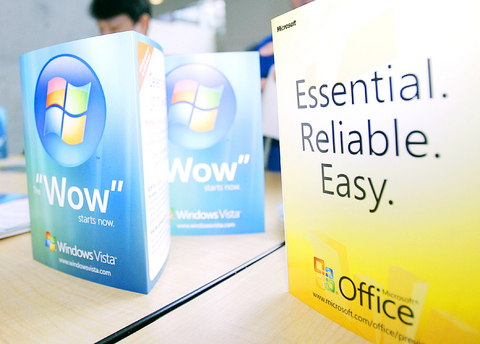
PHOTO: AP
That's not to suggest Vista is perfect or even as polished as Mac OS X. In more than a month of testing on multiple PCs, I've run into a number of rough patches. Then again, I was able to run my systems longer between restarts, experienced fewer crashes and generally found the new operating system more informative than its predecessor.
Overall, Vista is a worthy upgrade, though one that most users will probably want to delay until the kinks are worked out.
Be forewarned: The hardware requirements for the best features are high.
Though a low-end version is offered -- the Home Basic Edition, US$199 for the full version or US$99 if the user is upgrading from XP -- it lacks high-end graphics and multimedia functions.
Most consumers will likely want the Home Premium Edition -- US$239 or $159 if upgrading from XP -- that includes the visuals and entertainment tools and requires a heftier PC with at least a 1 gigahertz processor and 1 gigabyte of memory.
The visuals, for obvious reasons, are the most noticeable improvement, though the software doesn't hesitate to downgrade the experience if your PC is too weak. Programs appear in semi-transparent frames that pop open and close with an animated swoosh. Icons can be instantly resized with a slider.
The flourishes aren't just eye candy. They also help get the job done, particularly if you're a multitasker.
In previous Windows versions, minimized programs were something of a mystery: You knew they were there but it wasn't easy to find them. In Vista, live mini-previews of each window pop open when the cursor is moved along the task bar.
Switching between programs using the Alt-Tab key combination is easier as the live previews appear there, too. A new key combination -- Tab-Windows -- flips through all your programs like a 3-D stack of playing cards.
The start menu, which has wisely lost the word "Start," has also been renovated. It now sports a search box that returns results instantly as you type. No more dancing dogs or grinding hard drives.
In fact, the improved search -- which had been available for Windows XP users through add-on programs -- is fully integrated throughout Vista, much like the latest version of Mac OS X released in April 2005.
Windows that display the contents of hard drive folders, for instance, all have a search box that can filter whatever is inside.
Search results also can be saved into folders that get populated by future files that meet the original search criteria, though the feature isn't easy to find.
By default, the right side of the screen is filled with small programs known as gadgets, displaying headlines, weather, microprocessor loads and memory utilization. The idea is not new: Mac OS X has "Widgets," and other companies have offered similar lightweight application layers for years.
The default gadgets in Vista look great but aren't terribly useful. The Really Simple Syndication gadget, which pulls headlines from news sites and blogs, only displays four items at a time.
Hundreds of additional gadgets are available from Microsoft's Web site. Some maintain the slick Vista visuals. Others don't seem to try.
Vista also includes considerable security improvements, including a firewall that blocks network traffic in both directions and an anti-spyware program. You still need to get your own anti-virus software.
Vista adopts "user authenti-cation," which prompts you before the installation of anything that might muck up the system. Oddly, unlike Mac OS X and Linux, the authentication doesn't require a username or password. The prompt, which darkens and deactivates everything in the background, is also jarring and decidedly un-Vista-like.
Vista also has tools for monitoring and controlling your kids' computer and Internet usage, as well as new "features" that Hollywood can use to control what you do with its movies. If you ever update to HD DVD or Blu-ray, for instance, the quality of those crisp videos may be downgraded.
There are finer controls to adjust for power consumption and excellent notification and monitoring tools to figure out how the system is operating and what has gone wrong. Like a judge at a diving competition, Vista will rate a computer's performance, although it doesn't explain the scale very well.
Vista sports new multimedia capabilities, including a photo management program and improvements on XP's moviemaking software.
The premium editions also include Windows Media Center, which is a shell that makes playing music and video easy, even with a remote control. The program adds some of Vista's visual pizazz to a package that bundles a digital video recorder for capturing live standard and high-definition TV.
How long does it take to give a PC running Windows XP this facelift and, arguably, heart and brain transplant? Surprisingly little, at least on a high-end PC with 2 gigabytes of memory. The anesthesia takes considerably longer to wear off.
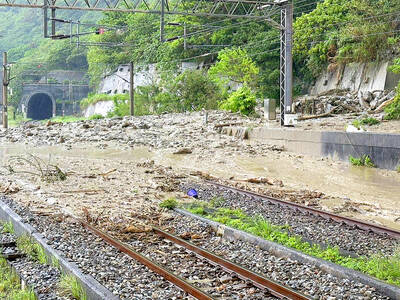
ROLLER-COASTER RIDE: More than five earthquakes ranging from magnitude 4.4 to 5.5 on the Richter scale shook eastern Taiwan in rapid succession yesterday afternoon Back-to-back weather fronts are forecast to hit Taiwan this week, resulting in rain across the nation in the coming days, the Central Weather Administration said yesterday, as it also warned residents in mountainous regions to be wary of landslides and rockfalls. As the first front approached, sporadic rainfall began in central and northern parts of Taiwan yesterday, the agency said, adding that rain is forecast to intensify in those regions today, while brief showers would also affect other parts of the nation. A second weather system is forecast to arrive on Thursday, bringing additional rain to the whole nation until Sunday, it
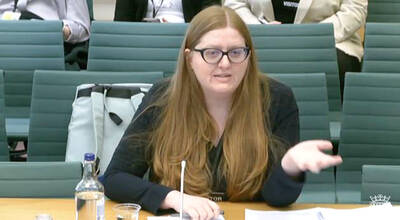
CONDITIONAL: The PRC imposes secret requirements that the funding it provides cannot be spent in states with diplomatic relations with Taiwan, Emma Reilly said China has been bribing UN officials to obtain “special benefits” and to block funding from countries that have diplomatic ties with Taiwan, a former UN employee told the British House of Commons on Tuesday. At a House of Commons Foreign Affairs Committee hearing into “international relations within the multilateral system,” former Office of the UN High Commissioner for Human Rights (OHCHR) employee Emma Reilly said in a written statement that “Beijing paid bribes to the two successive Presidents of the [UN] General Assembly” during the two-year negotiation of the Sustainable Development Goals. Another way China exercises influence within the UN Secretariat is
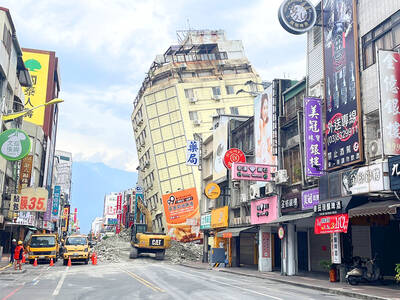
LANDSLIDES POSSIBLE: The agency advised the public to avoid visiting mountainous regions due to more expected aftershocks and rainfall from a series of weather fronts A series of earthquakes over the past few days were likely aftershocks of the April 3 earthquake in Hualien County, with further aftershocks to be expected for up to a year, the Central Weather Administration (CWA) said yesterday. Based on the nation’s experience after the quake on Sept. 21, 1999, more aftershocks are possible over the next six months to a year, the agency said. A total of 103 earthquakes of magnitude 4 on the local magnitude scale or higher hit Hualien County from 5:08pm on Monday to 10:27am yesterday, with 27 of them exceeding magnitude 5. They included two, of magnitude
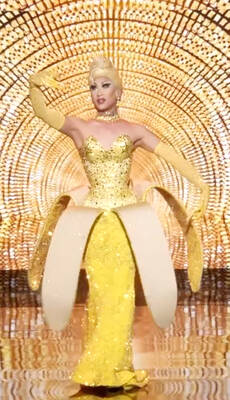
Taiwan’s first drag queen to compete on the internationally acclaimed RuPaul’s Drag Race, Nymphia Wind (妮妃雅), was on Friday crowned the “Next Drag Superstar.” Dressed in a sparkling banana dress, Nymphia Wind swept onto the stage for the final, and stole the show. “Taiwan this is for you,” she said right after show host RuPaul announced her as the winner. “To those who feel like they don’t belong, just remember to live fearlessly and to live their truth,” she said on stage. One of the frontrunners for the past 15 episodes, the 28-year-old breezed through to the final after weeks of showcasing her unique


 RSS
RSS