


In an upmarket gallery near Hollywood Road in Hong Kong, a middle-aged Swiss woman unfurls a crumpled piece of paper from her handbag and squints at the unfamiliar words written down.
As she struggles to articulate them, the gallery owner is forced to politely correct her pronunciation of the unfamiliar Chinese names on her shopping list.
Within a few minutes, the gallery owner is e-mailing images of the artist's work to the woman's husband, another potential buyer desperate to catch a piece of the booming Chinese market.
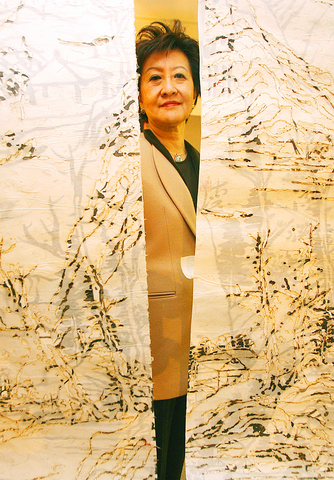
PHOTO: AFP
The name belongs to one of the new superstars of Chinese art, part of an elite group whose works can fetch prices at auction unequalled by almost any living artist in the world.
But the boom has raised serious concerns about the quality of the art now being churned out -- and what the exploding market says about China itself.
Nicole Schoeni, whose family has run a gallery in Hong Kong since the early 1990s, says wealthy investors trying to get in on the art action have become an almost daily phenomenon. Recently one first-time customer bought nearly US$400,000 in art from her gallery.
"I call them the top 10 wish lists," Schoeni said. "The majority come in for investment rather than any passion for art. They used to buy property but now if they put the piece in auction they can sell it for five times the price straight away."
Schoeni said many of her long-term collectors have been priced out of the market.
Hong Kong is awash with new galleries, many of them peddling the stylized paintings that will attract investors: bright colors, obvious references to the Cultural Revolution, big wide faces and an often overt sexuality.
"A lot of it is total crap," said Johnson Chang (
"[The booming market] is both good and bad for new artists. The danger is everyone starts to copy the successful model. There is a blueprint for how to succeed, and a lot of people get misled into that creative model," he said.
In the past three years, records for Chinese paintings have tumbled at every new auction, but the most staggering prices have been for contemporary artists.
In November, an oil painting by Liu Xiaodong (
The painting, which depicts the controversial Three Gorges Dam, in Hubei Province, was sold for more than three times its expected price to a Chinese businesswoman.
For John Batten, who for nine years ran a gallery in Hong Kong selling contemporary Chinese paintings, the influx of investors with little interest in art is "obscene," but he said it is simply a reflection of China's booming economy.
"In many ways it [the art boom] was inevitable. Culture has always been a partner of trade, especially when the country in question is essentially a dictatorship," he said.
"It is a bit like the ping pong diplomacy of the 1970s, a way of broaching subjects that cannot be discussed," he said, referring to the table tennis matches between China and the US which preceded president Richard Nixon's historic visit to China.
The huge demand has also raised questions about the authenticity of the work that is being sold. Rumors are rife that some work by well-known painters is now mass produced, and many galleries do not recommend that collectors buy pieces that have been painted since 2000.
"The market is definitely `buyer beware' now," Batten says. "There is a strong market for fakes and I know of cases of fakes being sold. But these things, and the lack of provenance, will only become apparent when the market crashes."
Despite the downsides, the boom has undoubtedly provided a huge boost to the artistic community. For the first time in a generation artists believe they can make a proper living from producing art, Chang added.
It has also led to more international shows, and more exposure for many Chinese artists, as well as an increase in the number of galleries showing contemporary Chinese art, rather than the traditional antiquities.
Karen Smith, an art historian based in Beijing, is curating a British show at the Tate Liverpool, entitled "The Real Thing," in an effort to show work outside the circle of superstar artists.
"Even three years ago, something like [the exhibition] would have been unimaginable," she said.
Smith believes it is not surprising that some artists are tempted to simply follow the example of their more successful contemporaries in style and subject.
"Chinese museums are so underfunded and there is no real critical culture, so for young artists the price tags are the often the best indicators of how they are doing. It becomes a benchmark to strive for," she said.
Despite the dollar signs being waved in front of them, exciting work is being produced. Ignored by some galleries, young artists in Hong Kong, Shanghai and Beijing are using every nook and cranny to show work that does not conform to the marketable model.
There is also a movement to ensure that contemporary art retains qualities that mark it as specifically Chinese.
Ink painting, often regarded as a staid, traditional form, is being taken up by new artists. The best work is challenging and cutting-edge, blending calligraphy with unusual techniques, but retaining its essential "Chineseness."
A group of like-minded members of the Hong Kong art establishment, including long-time gallery owner Alice King (
"We want to educate the public that it is not a dead art. We do not want to look at the commercial stuff over and over again and for people to think this is what is coming out of China," Ho said. "A lot of the work we are promoting does not have the shock value, but we are looking beyond the first response to something that will last."
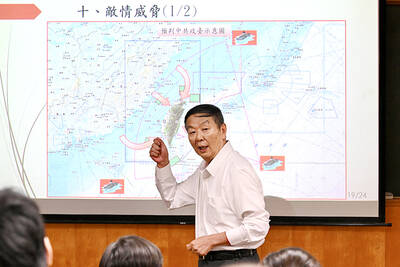
RETHINK? The defense ministry and Navy Command Headquarters could take over the indigenous submarine project and change its production timeline, a source said Admiral Huang Shu-kuang’s (黃曙光) resignation as head of the Indigenous Submarine Program and as a member of the National Security Council could affect the production of submarines, a source said yesterday. Huang in a statement last night said he had decided to resign due to national security concerns while expressing the hope that it would put a stop to political wrangling that only undermines the advancement of the nation’s defense capabilities. Taiwan People’s Party Legislator Vivian Huang (黃珊珊) yesterday said that the admiral, her older brother, felt it was time for him to step down and that he had completed what he
Taiwan has experienced its most significant improvement in the QS World University Rankings by Subject, data provided on Sunday by international higher education analyst Quacquarelli Symonds (QS) showed. Compared with last year’s edition of the rankings, which measure academic excellence and influence, Taiwanese universities made great improvements in the H Index metric, which evaluates research productivity and its impact, with a notable 30 percent increase overall, QS said. Taiwanese universities also made notable progress in the Citations per Paper metric, which measures the impact of research, achieving a 13 percent increase. Taiwanese universities gained 10 percent in Academic Reputation, but declined 18 percent

UNDER DISCUSSION: The combatant command would integrate fast attack boat and anti-ship missile groups to defend waters closest to the coastline, a source said The military could establish a new combatant command as early as 2026, which would be tasked with defending Taiwan’s territorial waters 24 nautical miles (44.4km) from the nation’s coastline, a source familiar with the matter said yesterday. The new command, which would fall under the Naval Command Headquarters, would be led by a vice admiral and integrate existing fast attack boat and anti-ship missile groups, along with the Naval Maritime Surveillance and Reconnaissance Command, said the source, who asked to remain anonymous. It could be launched by 2026, but details are being discussed and no final timetable has been announced, the source
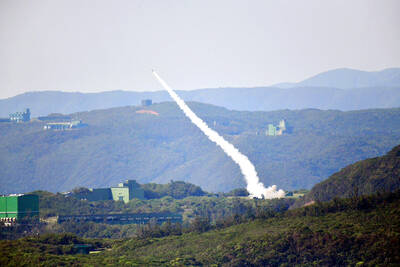
SHOT IN THE ARM: The new system can be integrated with Avenger and Stinger missiles to bolster regional air defense capabilities, a defense ministry report said Domestically developed Land Sword II (陸射劍二) missiles were successfully launched and hit target drones during a live-fire exercise at the Jiupeng Military Base in Pingtung County yesterday. The missiles, developed by the Chungshan Institute of Science and Technology (CSIST), were originally scheduled to launch on Tuesday last week, after the Tomb Sweeping Day holiday long weekend, but were postponed to yesterday due to weather conditions. Local residents and military enthusiasts gathered outside the base to watch the missile tests, with the first one launching at 9:10am. The Land Sword II system, which is derived from the Sky Sword II (天劍二) series, was turned


 RSS
RSS