


For more than half a century, residents of Hong Kong have taken pride in being more prosperous than their cousins nearby in mainland China, and have enjoyed feeling like big spenders whenever they crossed the border.
Merchants across the border in Shenzhen were happy to take Hong Kong dollars, pocketing the 6 percent premium it commanded over China's currency. Mainland tourists offering Chinese currency here were charged extra or even turned away and told to come back with Hong Kong dollars.
But the yuan is poised to become more valuable than the Hong Kong dollar by the end of the month, and could pass the traditional benchmark for the Hong Kong dollar's value as early as next week.

PHOTO: AFP
The shift has been the latest in a series of shocks for residents' confidence that they or their ancestors had made the right decision to live in Hong Kong instead of anywhere else in China.
"Nowadays, the gap between China and Hong Kong has narrowed and some people even think the standard of living in China is higher," where prices are lower and incomes are rising quickly, recalled Chan Chi Him, the second generation of a family that has sold birds' nests as a delicacy here since the end of World War II.
"It's easier for Chinese people to make money," he said.
Average incomes per person in cities like Beijing, Shanghai or Guangzhou remain a fifth or less of incomes for people in Hong Kong. But the averages in China are dragged down by very large numbers of very poor people.
People in Hong Kong are used to comparing themselves to the educated middle class on the mainland. And they are finding that a growing class of Chinese businessmen and businesswomen have become more affluent than the average resident of Hong Kong.
Millions of middle-class Chinese flock here every year, and shopkeepers are now happy to take Chinese currency, known as the yuan.
At the same time, many shopkeepers across the border in China have stopped taking Hong Kong dollars, or begun asking a slightly greater number of dollars than the number of yuan on price tags would suggest.
Prices are rising here in markets for everything from luxury apartments to dried bugs and the culprit is the same: the rising value of the Chinese yuan and the falling value of the Hong Kong dollar.
The winning bid in a land auction last month worked out to a price of more than US$7,000 a square foot once houses are built, making Hong Kong real estate some of the most valuable in the world. Developers are betting that multinationals and Mainlanders alike will continue to see Hong Kong as an excellent base for doing business in China.
But Hong Kong also imports much of its food and other goods from the mainland and the prices are climbing.
Sellers of traditional Chinese medicine are having to pay more for the herbs, insects and other wares they buy from the mainland. The price of dried cicadas, which are boiled in soup to improve eyesight, has risen close to 4 percent in the last year as the yuan has gradually strengthened, said Lee Chun Hung, the chairman of Lee Hoong Kee Ltd, a Chinese medicine wholesaler.
Prices have soared for herbs that are in demand across China, as increasingly affluent Mainlanders have bid up prices to levels that many people in Hong Kong cannot afford. A rare root that is boiled in soup and eaten to strengthen the lungs now sells for US$618 for a small box, four times its price two years ago.
"It's not just the rise of the renminbi," Lee said, "it's also because the standard of living is going up on the mainland."
While prices are starting to creep up here after years of deflation, rising home prices and falling unemployment have helped produce soaring confidence here in the territory's economic future, recent surveys have shown.
The yuan has been rising partly because of calls from the US and Europe for the Chinese currency to reflect China's rising trade surplus and huge intake of foreign investment. Chinese officials have also voiced concerns that maintaining a low value for the currency may eventually unleash inflation, although prices are barely rising now on the mainland.
China unified various exchange rates in 1994 and, after several years of gradual appreciation, fixed the exchange rate of the yuan at 8.28 yuan to the dollar in 1998. Beijing officials maintained that level until July 2004. They then began allowing a slow appreciation, with the yuan climbing 3.4 percent last year. It was worth slightly more than 7.81 yuan to the dollar in Friday trading in Shanghai.
The Hong Kong Monetary Authority pegged the Hong Kong dollar at HK$7.80 to the US dollar in September 1983, and maintained that policy with few changes until June 2005. It then moved to a narrow trading band of HK$7.75 to HK$7.85 to the dollar.
The Hong Kong dollar has been trading near the top of that band lately, which is why it is likely that it will take a couple more weeks for the yuan to reach parity. Ben Simpfendorfer, a currency strategist at the Royal Bank of Scotland, said that the yuan would surpass the Hong Kong dollar "definitely before the end of the month."
While some speculators have raised the idea that the Hong Kong dollar might be repegged to the yuan, the Hong Kong Monetary Authority has been opposed and most economists say that the move would be a bad idea. The weaker Hong Kong dollar improves Hong Kong's competitiveness relative to cities on the mainland, and a peg to the yuan would be difficult to maintain.

Chinese President Xi Jinping (習近平) yesterday met with former president Ma Ying-jeou (馬英九) at the Great Hall of the People in Beijing, with Xi’s opening statement once more emphasizing that people on both sides of the Taiwan Strait are Chinese and that foreign intervention cannot change their inevitable unification. Xi said that 5,000 years of history of zhonghua minzu (中華民族, ethnic Chinese group) have seen their ancestors move to Taiwan to establish new lives, while also documenting them fighting side-by-side against foreign forces and finally freeing Taiwan. “Both sides are Chinese,” and there are no issues that cannot be worked through, he
Taiwan has experienced its most significant improvement in the QS World University Rankings by Subject, data provided on Sunday by international higher education analyst Quacquarelli Symonds (QS) showed. Compared with last year’s edition of the rankings, which measure academic excellence and influence, Taiwanese universities made great improvements in the H Index metric, which evaluates research productivity and its impact, with a notable 30 percent increase overall, QS said. Taiwanese universities also made notable progress in the Citations per Paper metric, which measures the impact of research, achieving a 13 percent increase. Taiwanese universities gained 10 percent in Academic Reputation, but declined 18 percent
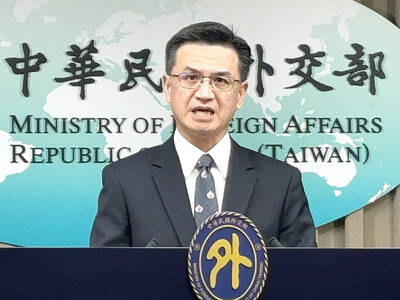
BULLY TACTICS: Beijing has continued its incursions into Taiwan’s airspace even as Xi Jinping talked about Taiwan being part of the Chinese family and nation China should stop its coercion of Taiwan and respect mainstream public opinion in Taiwan about sovereignty if its expression of goodwill is genuine, the Ministry of Foreign Affairs (MOFA) said yesterday. Ministry spokesman Jeff Liu (劉永健) made the comment in response to media queries about a meeting between former president Ma Ying-jeou (馬英九) and Chinese President Xi Jinping (習近平) the previous day. Ma voiced support for the so-called “1992 consensus,” while Xi said that although the two sides of the Taiwan Strait have “different systems,” this does not change the fact that they are “part of the same country,” and that “external

UNDER DISCUSSION: The combatant command would integrate fast attack boat and anti-ship missile groups to defend waters closest to the coastline, a source said The military could establish a new combatant command as early as 2026, which would be tasked with defending Taiwan’s territorial waters 24 nautical miles (44.4km) from the nation’s coastline, a source familiar with the matter said yesterday. The new command, which would fall under the Naval Command Headquarters, would be led by a vice admiral and integrate existing fast attack boat and anti-ship missile groups, along with the Naval Maritime Surveillance and Reconnaissance Command, said the source, who asked to remain anonymous. It could be launched by 2026, but details are being discussed and no final timetable has been announced, the source


 RSS
RSS