


It was a frigid night in January last year when Kimberly Bishop decided to quit her top-level position at First Data Corp, a global electronic commerce and payment company in Omaha, Nebraska.
She had no specific plans, no job or family hovering in the wings. All she knew was that she had lived in Nebraska her entire 37 years, had been with First Data for 16 of them, and was ready for a change. Never mind that she was an executive vice president, the youngest member of the leadership team and responsible for a US$2 billion business.
"I wanted to work for a company where I played a role in the growth of the business; I wanted to be located in a community I thought I would enjoy; and I wanted to work at a place where I felt I could make an impact," Bishop, now 39, said. "I knew I'd find the right opportunity."
As it happened, the right opportunity found her. Soon after she left First Data, she got a call from Charles Wardell, the managing director for Korn/Ferry International, the executive search and leadership development firm in New York. He had been eyeing Bishop for a while and heard she was free, she recalled. He offered her a position with his firm -- in Manhattan. Was she up for a move?
It took about 30 seconds for her reply: Why, yes, she was.
Within days, she had closed up her house, packed a suitcase, logged on to Expedia.com and booked one month at an extended-stay hotel until she found an apartment.
She said she felt both elated and petrified.
"I was leaving behind an industry, a community and a position that I knew inside and out," said Bishop, a senior partner at Korn/Ferry. "I was coming to New York alone, I was almost 40. It was a combination of exciting and terrifying."
"A lot of people didn't understand why I would want to make such big changes with work, location, making new friends," she added. "I just followed my instincts that this was the best thing for me."
For years, baby boomers and retired workers have embraced new careers, but the midcareer shift is just as prevalent among the under-40, career counselors say.
"Midcareer workers -- those 35 to 54 -- are most likely to feel dead-ended and the most likely to feel they've got too much on their plates at work," said Robert Morison, director for research at the Concours Group, a research, education and consulting firm in Kingwood, Texas.
The Bureau of Labor Statistics never tried to estimate the number of times people change careers in the course of their working lives because no consensus can be reached on what constitutes a career change. Still, a bureau report examined the number of jobs that people born in the years 1957 to 1964 held from age 18 to age 36; the answer was an average of 9.6 (in this report, a job was defined as an uninterrupted period of work with a particular employer).
Brian Kurth, the founder of VocationVacation, a firm based in Portland, Oregon, that test-drives new careers, says that 40 percent of his clients are under 40.
"They're disgruntled -- they got their law degree, their MBA, they're making plenty of money and they're dissatisfied," said Kurth, 40, who is on his fourth career. "People are saying you only live once, why be miserable?"
"There's a growing sense in the US that our destiny is our own, that we create our own paths in life," said Alan Bernstein, co-author of Your Retirement, Your Way. "This has loosened the idea that people should do what they are best at, what they most enjoy, rather than what they've been trained to do."
Lisa Mainiero, a professor of management at Fairfield University in Connecticut, said: "People are saying, I want a career that's consistent with my values. It's socially acceptable to say that, whereas 10 years ago it wasn't."
In their book The Opt-Out Revolt: Why People Are Leaving Companies to Create Kaleidoscope Careers, Mainiero and co-author Sherry Sullivan surveyed more than 3,000 professionals and executives over five years to find out how they felt about their careers.
Everyone, especially those under 40, sought authenticity, balance and challenge in their lives and careers. Both men and women were looking to share domestic responsibilities, nurture their own passions by taking on different pursuits and look for work that offered "value and an authentic living."
"They're saying, `I want it all now,'" Mainiero said.
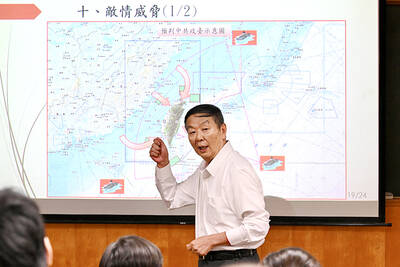
RETHINK? The defense ministry and Navy Command Headquarters could take over the indigenous submarine project and change its production timeline, a source said Admiral Huang Shu-kuang’s (黃曙光) resignation as head of the Indigenous Submarine Program and as a member of the National Security Council could affect the production of submarines, a source said yesterday. Huang in a statement last night said he had decided to resign due to national security concerns while expressing the hope that it would put a stop to political wrangling that only undermines the advancement of the nation’s defense capabilities. Taiwan People’s Party Legislator Vivian Huang (黃珊珊) yesterday said that the admiral, her older brother, felt it was time for him to step down and that he had completed what he

ROLLER-COASTER RIDE: More than five earthquakes ranging from magnitude 4.4 to 5.5 on the Richter scale shook eastern Taiwan in rapid succession yesterday afternoon Back-to-back weather fronts are forecast to hit Taiwan this week, resulting in rain across the nation in the coming days, the Central Weather Administration said yesterday, as it also warned residents in mountainous regions to be wary of landslides and rockfalls. As the first front approached, sporadic rainfall began in central and northern parts of Taiwan yesterday, the agency said, adding that rain is forecast to intensify in those regions today, while brief showers would also affect other parts of the nation. A second weather system is forecast to arrive on Thursday, bringing additional rain to the whole nation until Sunday, it

CONDITIONAL: The PRC imposes secret requirements that the funding it provides cannot be spent in states with diplomatic relations with Taiwan, Emma Reilly said China has been bribing UN officials to obtain “special benefits” and to block funding from countries that have diplomatic ties with Taiwan, a former UN employee told the British House of Commons on Tuesday. At a House of Commons Foreign Affairs Committee hearing into “international relations within the multilateral system,” former Office of the UN High Commissioner for Human Rights (OHCHR) employee Emma Reilly said in a written statement that “Beijing paid bribes to the two successive Presidents of the [UN] General Assembly” during the two-year negotiation of the Sustainable Development Goals. Another way China exercises influence within the UN Secretariat is

CHINA REACTS: The patrol and reconnaissance plane ‘transited the Taiwan Strait in international airspace,’ the 7th Fleet said, while Taipei said it saw nothing unusual The US 7th Fleet yesterday said that a US Navy P-8A Poseidon flew through the Taiwan Strait, a day after US and Chinese defense heads held their first talks since November 2022 in an effort to reduce regional tensions. The patrol and reconnaissance plane “transited the Taiwan Strait in international airspace,” the 7th Fleet said in a news release. “By operating within the Taiwan Strait in accordance with international law, the United States upholds the navigational rights and freedoms of all nations.” In a separate statement, the Ministry of National Defense said that it monitored nearby waters and airspace as the aircraft


 RSS
RSS