


It was a regular shopping trip for Yeung Hoi-kei to Shenzhen to take advantage of much cheaper mainland prices just across the Hong Kong border.
But to her surprise, when she paid for a jacket with yuan, Yeung as a visitor was given her change back in Hong Kong dollars, once the preferred currency in the Chinese city due to its higher value.
Times have changed, the shop assistant told Yeung.
"Hong Kong dollars are worth the same as the yuan now," the assistant said.
Yeung is just one of the tens of thousands of Hong Kong tourists and business people who travel to Shenzhen every day for work, shopping, dining or entertainment, getting what used to be an added bonus from a stronger Hong Kong dollar.
Now, when she changed money before making her trip, she was surprised at how much the exchange rate has dropped for the local currency.
"I used to get 106 yuan [US$13.5] for every 100 Hong Kong dollars I changed; only two months ago, I got 103 yuan. This time I only got 100 dollars and 30 cents," she complained.
The Hong Kong dollar's fortunes have been linked to the US dollar since it was pegged to the unit in 1983 when Britain sought to maintain confidence in the territory during talks with Beijing on the return of the colony to Chinese rule in 1997.
Now as the US dollar weakens steadily and the yuan rises on the back of China's booming economy, locals are finding that their mainland compatriots, who flood the city as tourists, may be getting the better deal.
Analysts are confident the yuan will continue to rise as the US economy slows, with additional pressure coming from Washington which wants Beijing to allow the unit to float freely so as to help remedy a massive trade imbalance.
The yuan and its future will he high on the agenda later this month when US Treasury Secretary Henry Paulson and Federal Reserve Chairman Ben Bernanke visit China and the currency's gains have picked up pace as a result.
"The strengthening of the yuan reflects global financial markets' interest in China's economy," said Grace Ng (吳向紅), greater China economist at JP Morgan Chase.
Although the Hong Kong Monetary Authority says a strengthening yuan will not affect monetary policy, some analysts suggest a link between the Hong Kong and mainland currencies is inevitable at some point given increasing integration of the two economies.
Other analysts see no need for Hong Kong to abandon a system that has worked well over the years despite the best efforts of speculators to break the US dollar link, most notably during the 1997-1998 Asian financial crisis.
Jun Ma (
"Politically, it is unwise for policy makers in Hong Kong to fix a well-functioning Hong Kong dollar regime and subject the financial system to unnecessary risks, especially at a time when the economy remains fairly healthy," he wrote in a report.
Should the peg be switched to the yuan, the Hong Kong currency could see a long-term appreciation against the US dollar, leading to a substantial loss in competitiveness and perhaps recession, Ma argued.
Ng also believes Hong Kong is not ready to re-peg to the yuan.
"The problem is that the yuan is not a freely convertible currency, so in the short-term it would not be practical to convert it," she said.
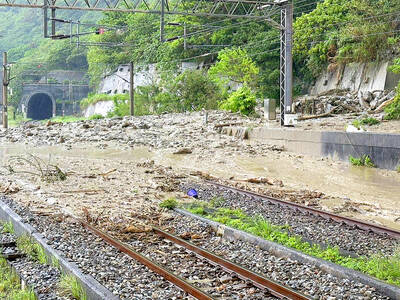
ROLLER-COASTER RIDE: More than five earthquakes ranging from magnitude 4.4 to 5.5 on the Richter scale shook eastern Taiwan in rapid succession yesterday afternoon Back-to-back weather fronts are forecast to hit Taiwan this week, resulting in rain across the nation in the coming days, the Central Weather Administration said yesterday, as it also warned residents in mountainous regions to be wary of landslides and rockfalls. As the first front approached, sporadic rainfall began in central and northern parts of Taiwan yesterday, the agency said, adding that rain is forecast to intensify in those regions today, while brief showers would also affect other parts of the nation. A second weather system is forecast to arrive on Thursday, bringing additional rain to the whole nation until Sunday, it

CONDITIONAL: The PRC imposes secret requirements that the funding it provides cannot be spent in states with diplomatic relations with Taiwan, Emma Reilly said China has been bribing UN officials to obtain “special benefits” and to block funding from countries that have diplomatic ties with Taiwan, a former UN employee told the British House of Commons on Tuesday. At a House of Commons Foreign Affairs Committee hearing into “international relations within the multilateral system,” former Office of the UN High Commissioner for Human Rights (OHCHR) employee Emma Reilly said in a written statement that “Beijing paid bribes to the two successive Presidents of the [UN] General Assembly” during the two-year negotiation of the Sustainable Development Goals. Another way China exercises influence within the UN Secretariat is

LANDSLIDES POSSIBLE: The agency advised the public to avoid visiting mountainous regions due to more expected aftershocks and rainfall from a series of weather fronts A series of earthquakes over the past few days were likely aftershocks of the April 3 earthquake in Hualien County, with further aftershocks to be expected for up to a year, the Central Weather Administration (CWA) said yesterday. Based on the nation’s experience after the quake on Sept. 21, 1999, more aftershocks are possible over the next six months to a year, the agency said. A total of 103 earthquakes of magnitude 4 on the local magnitude scale or higher hit Hualien County from 5:08pm on Monday to 10:27am yesterday, with 27 of them exceeding magnitude 5. They included two, of magnitude

Taiwan’s first drag queen to compete on the internationally acclaimed RuPaul’s Drag Race, Nymphia Wind (妮妃雅), was on Friday crowned the “Next Drag Superstar.” Dressed in a sparkling banana dress, Nymphia Wind swept onto the stage for the final, and stole the show. “Taiwan this is for you,” she said right after show host RuPaul announced her as the winner. “To those who feel like they don’t belong, just remember to live fearlessly and to live their truth,” she said on stage. One of the frontrunners for the past 15 episodes, the 28-year-old breezed through to the final after weeks of showcasing her unique


 RSS
RSS