


While many campers this summer are tying square knots, paddling canoes or weaving friendship bracelets, a growing number are instead drawing up business plans and generating personal budgets. At entrepreneur and finance camps from coast to coast, business is open.
Christian Burch, age 10, was one of 10 children sponsored by the Greater Scott County Chamber of Commerce in Indiana to attend BizCamp for nine to 11-year-olds, run by Junior Achievement in Louisville, Kentucky. The children were assigned to run a fictional business for a week and participated in a role-playing game to try to pay off a bank loan and make the company profitable.
Christian was assigned to sell ads for his own radio station. At first, he wasn't sure what he was getting into, but he said he ended up liking the program better than the basketball camp he attended the following week.

PHOTO: NY TIMES NEWS SERVICE
"I loved doing my job and seeing what it would be like when I grew up," he said. And "we learned to use our money wisely and not spend it all on candy."
His mother, Rhonda Burch, reported that Christian's first request after she picked him up from camp was to go to a bank and open a savings account.
Jeffrey Solomon, executive director of the National Camp Association, sees the rise in business camps as part of a trend toward camp diversification. While outdoors camps are still popular, more camps are appearing that focus on the arts, community service, technology, academics and other specialties.
According to the association, the total number of summer campers has risen from 5 million to more than 6.5 million over the last five years.
Some of the business and money camps focus on how to start a small venture, while others look at career exploration, global monetary markets or personal financial literacy. Most sessions last one week.
At another BizCamp session, 100 children aged 12 to 15 spent their week focused on civics, finance and business. Campers practiced job interview skills and met local business people. They were asked to create a budget for a hypothetical family. The youngsters also went on a virtual Internet shopping spree and then learned how long it would take to pay off the debt they incurred.
"When a teenager sees it will take years and years to pay off a small debt because they are making minimum payments, it really shows them what interest is all about," said Shannon Wendt, the camp's director.
Wendt said her team tried to make everything as hands-on and engaging as possible.
"We didn't want it to feel like school at all, so there were lots of games and contests, but in the end they gained a lot of financial know-how," she said. Nationally, Junior Achievement is teaming up with a variety of organizations to reach 102,000 children this summer with its programs.
Joline Godfrey, chief executive of Independent Means Inc, a financial education group in Santa Barbara, California, has seen more demand for her group's books, board games and camps each year.
"Children and teens today may be savvy shoppers, but they are less prepared to manage their own budget and create their own financial safety nets," she said. She has found that more families are using outside resources to raise financially thoughtful and competent children.
Godfrey said she thought parents also were beginning to treat their child's interest in business the same way they would treat an interest in sports and music.
"Parents seek out the best coaches and finest musical instruments for their kids," she said. "Increasingly, they give children's financial development a similar level of intention and support."
Business camps are usually priced similarly to other day camps -- which makes perfect sense as the business-minded camp directors look at the competition. The National Foundation for Teaching Entrepreneurship, however, is running 10 one-week camps this summer in the northeast for children from low-income families, who pay no tuition. Sponsors like Goldman Sachs help pay the bill.
The foundation's camps focus on teaching 11 to 18-year-olds how to start a business.
"We use the idea of running a business to get kids excited about the topic of money," said its founder, Steve Mariotti. "So when you start to teach them about personal budgeting, they see there's a reason for it, and pay more attention."
Eschewing poison ivy for ivy-covered walls, some business camps are held on college campuses. Middle schoolers at an entrepreneur camp held at the University of Wisconsin at Madison ended their week with their own business plan and a stack of laser-printed business cards.
Another program, Camp $tart-Up, is for students aged 14 to 19 and goes beyond marketing plans to the more subtle arts of professional success, including business etiquette and golf lessons. The camp, run by Independent Means, is in a different site each year, and this summer was held on the Cornell University campus, in Ithaca, New York.
For high school juniors and seniors, Bentley College, in Waltham, Massachusetts, offers a one-week summer residential program called Wall Street 101. A simulated trading room lets students try their hand buying and selling on world financial markets.
While the surfeit of new camp offerings may be enticing to children and parents, they do represent a change in what summertime means for US youngsters. Summer used to be more unstructured, and child development experts like Alvin Rosenfeld, co-author of The Over-Scheduled Child: Avoiding the Hyper-Parenting Trap, advises parents to give children plenty of free time when school is not in session.
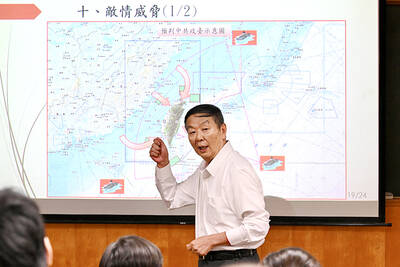
RETHINK? The defense ministry and Navy Command Headquarters could take over the indigenous submarine project and change its production timeline, a source said Admiral Huang Shu-kuang’s (黃曙光) resignation as head of the Indigenous Submarine Program and as a member of the National Security Council could affect the production of submarines, a source said yesterday. Huang in a statement last night said he had decided to resign due to national security concerns while expressing the hope that it would put a stop to political wrangling that only undermines the advancement of the nation’s defense capabilities. Taiwan People’s Party Legislator Vivian Huang (黃珊珊) yesterday said that the admiral, her older brother, felt it was time for him to step down and that he had completed what he

Taiwan has experienced its most significant improvement in the QS World University Rankings by Subject, data provided on Sunday by international higher education analyst Quacquarelli Symonds (QS) showed. Compared with last year’s edition of the rankings, which measure academic excellence and influence, Taiwanese universities made great improvements in the H Index metric, which evaluates research productivity and its impact, with a notable 30 percent increase overall, QS said. Taiwanese universities also made notable progress in the Citations per Paper metric, which measures the impact of research, achieving a 13 percent increase. Taiwanese universities gained 10 percent in Academic Reputation, but declined 18 percent

UNDER DISCUSSION: The combatant command would integrate fast attack boat and anti-ship missile groups to defend waters closest to the coastline, a source said The military could establish a new combatant command as early as 2026, which would be tasked with defending Taiwan’s territorial waters 24 nautical miles (44.4km) from the nation’s coastline, a source familiar with the matter said yesterday. The new command, which would fall under the Naval Command Headquarters, would be led by a vice admiral and integrate existing fast attack boat and anti-ship missile groups, along with the Naval Maritime Surveillance and Reconnaissance Command, said the source, who asked to remain anonymous. It could be launched by 2026, but details are being discussed and no final timetable has been announced, the source

SHOT IN THE ARM: The new system can be integrated with Avenger and Stinger missiles to bolster regional air defense capabilities, a defense ministry report said Domestically developed Land Sword II (陸射劍二) missiles were successfully launched and hit target drones during a live-fire exercise at the Jiupeng Military Base in Pingtung County yesterday. The missiles, developed by the Chungshan Institute of Science and Technology (CSIST), were originally scheduled to launch on Tuesday last week, after the Tomb Sweeping Day holiday long weekend, but were postponed to yesterday due to weather conditions. Local residents and military enthusiasts gathered outside the base to watch the missile tests, with the first one launching at 9:10am. The Land Sword II system, which is derived from the Sky Sword II (天劍二) series, was turned


 RSS
RSS