


Every couple of months, depending on his mood and the financial incentive, Nick Pagani shuts down Ace Auto, a gloriously cluttered and greasy repair shop that his grandfather opened in 1920, to resume his movie career.
Or, to be precise, the careers of about 70 old cars that Pagani, a mechanic whose shop is in New Rochelle, New York, rents to movie studios. The same studios often pay Pagani to drive those cars on camera.
That is when the true "acteur" in him comes out.
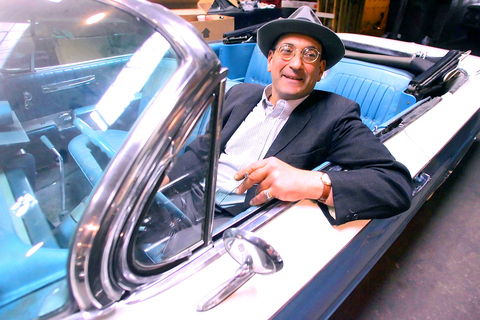
PHOTO: NY TIMES NEWS SERVICE
"You'll see an arm hanging out of the window with a cigarette," Pagani said recently, just before lighting another unfiltered Lucky Strike. "It's my signature look."
Pagani and his cars have appeared in at least 30 films by his count, including a 1952 Cadillac DeVille in A Beautiful Mind from 2001, and a 1960 Mercury Park Lane in Riding in Cars with Boys in 1986. Pagani played the driver for Roy Cohn, played by Al Pacino, in HBO's Angels in America from 2003. And he played a dead mobster in last year's Carlito's Way: Rise to Power.
"The menu comes up," he said proudly, referring to the DVD version of that film, "and it's my face."
Pagani, 47, has driven in so many films that he has a Screen Actors Guild card. He said he did not make a fortune either renting his cars to studios or appearing in the movies, but supplemented his income. More important, he has fun.
"The food is incredible," Pagani said. "It's like going to a wedding."
The business of renting old cars to studios -- or, in some cases, selling them to be burned or wrecked -- has become a minor industry. Pagani's roles are arranged through Jerry Immersi, whose business, Cars for Films, operates from a somewhat tidier garage in Newark.
Immersi's father-in-law, Sonny Abagnale, started the business in 1979. Immersi has a vast collection of his own, including police cars, taxicabs, limousines and a dry-cleaner's truck he drove in last year's The Producers.
"This business burns you out -- it's literally seven days a week," Immersi, 50, said at his shop. "Every time I ride in a car, I'm looking up and down driveways to see what's in them."
Immersi said he had hundreds of car collectors on call in the New York area.
Pagani is one of his top suppliers, mostly because the cars in his collection predate highly popular models like the Ford Mustang and the Chevrolet Camaro.
The jumbo-size Detroit classics in Pagani's shop clearly demonstrate his tastes: "The bigger it is, the more I like it."
While his high school buddies in Pelham Manor, New York, were driving newer cars in the 1970s, Pagani bought a gold 1960 Cadillac Eldorado. The car, which he drove to classes at Pace College in Westchester County, New York, is in Ace Auto's wood-frame garage.
Pagani began buying old cars, many for less than US$100, at a time when gasoline prices were rising to nearly US$1 a gallon -- an alarming event at the time. Many of those cars have since appeared in movies, he said.
"The reason you could buy them," he said, "was because nobody could put gas in them."
Before he had a contact like Immersi to line up roles for his cars, Pagani made connections at car shows, where movie studios would hand out fliers in search of four-wheel props. That is how Pagani landed his first film, Seize the Day, which starred Robin Williams and was released in 1986. Pagani supplied seven cars for the film, which was about a man in the 1950s having a midlife crisis.
"It was fun and it was nice, but there are long days, and you're basically doing nothing," Pagani said.
Supplying cars for a movie requires a considerable capacity for managing details. Besides ensuring the old cars are running well, the vehicles often have to be moved to the set for filming and then driven away at the end of the day -- a workday that often lasts 12 hours. Pagani said that directors were sometimes finicky and that the cars they had asked for were not always used.
It's not a job for everyone. Bruno Salerno, 75, an ex-marine from Bloomfield, New Jersey, said he was paid nearly US$12 an hour for the use of one of his old cars. But Salerno quit the business recently, saying: "It started to interfere with my family life."
Immersi said supplying cars to Hollywood can be a good way to make money, but agreed the business was extremely demanding. He said he sometimes got calls from the prop master of a film or the set designer for a TV show looking for a particular car for a certain date -- needs and dates that often changed.
Immersi arranges for cars for movies by contacting private collectors like Pagani; the two have worked together since 1999. Pagani has about 10 drivers for films when he is unavailable.
When that happens, Ken Bratko, the chief mechanic at Ace Auto for the last 15 or so years, may fill in.
After the cars are hired, the prop masters take over. Even if the car is only passing through a scene, they attach period-correct details like license plates, taxi medallions and even inspection stickers to make the car as historically accurate as possible.
Immersi said that when studios occasionally asked to wreck a client's car, the filmmakers were told they would first have to buy the car. He said he would burn or batter cars upon request, after removing the engine and transmission.
Immersi and Pagani would not discuss what they charge the studios, but Pagani said he did not make enough money to allow him to close his repair business. Immersi said his relationship with the studios was "pretty informal."
Drivers perform as background actors, and can qualify for membership in the actors' union by working a minimum of three days for any company that has agreed to employ workers with union cards.
Pagani stashes cars wherever he can; he has a Packard limousine in his own driveway and a 1948 Plymouth at his mother's on Long Island.
"The trick is to remember where I put all of them," Pagani said.
About 20 cars are kept at Ace Auto, including his most recent acquisition, a green 1961 Chrysler Windsor station wagon that he bought at an estate sale in Pennsylvania.
His garage, its cramped loft filled with parts, was the setting for a recent television movie, Intervention, set in 1965. The movie has not yet been broadcast.
"I have a toy box," Pagani said. "I put toys in it."
But when Hollywood beckons, he can take out one or more of those toys for a fanciful spin.

RETHINK? The defense ministry and Navy Command Headquarters could take over the indigenous submarine project and change its production timeline, a source said Admiral Huang Shu-kuang’s (黃曙光) resignation as head of the Indigenous Submarine Program and as a member of the National Security Council could affect the production of submarines, a source said yesterday. Huang in a statement last night said he had decided to resign due to national security concerns while expressing the hope that it would put a stop to political wrangling that only undermines the advancement of the nation’s defense capabilities. Taiwan People’s Party Legislator Vivian Huang (黃珊珊) yesterday said that the admiral, her older brother, felt it was time for him to step down and that he had completed what he

Taiwan has experienced its most significant improvement in the QS World University Rankings by Subject, data provided on Sunday by international higher education analyst Quacquarelli Symonds (QS) showed. Compared with last year’s edition of the rankings, which measure academic excellence and influence, Taiwanese universities made great improvements in the H Index metric, which evaluates research productivity and its impact, with a notable 30 percent increase overall, QS said. Taiwanese universities also made notable progress in the Citations per Paper metric, which measures the impact of research, achieving a 13 percent increase. Taiwanese universities gained 10 percent in Academic Reputation, but declined 18 percent

UNDER DISCUSSION: The combatant command would integrate fast attack boat and anti-ship missile groups to defend waters closest to the coastline, a source said The military could establish a new combatant command as early as 2026, which would be tasked with defending Taiwan’s territorial waters 24 nautical miles (44.4km) from the nation’s coastline, a source familiar with the matter said yesterday. The new command, which would fall under the Naval Command Headquarters, would be led by a vice admiral and integrate existing fast attack boat and anti-ship missile groups, along with the Naval Maritime Surveillance and Reconnaissance Command, said the source, who asked to remain anonymous. It could be launched by 2026, but details are being discussed and no final timetable has been announced, the source
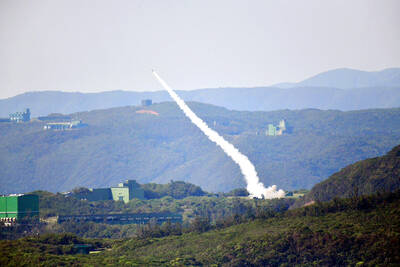
SHOT IN THE ARM: The new system can be integrated with Avenger and Stinger missiles to bolster regional air defense capabilities, a defense ministry report said Domestically developed Land Sword II (陸射劍二) missiles were successfully launched and hit target drones during a live-fire exercise at the Jiupeng Military Base in Pingtung County yesterday. The missiles, developed by the Chungshan Institute of Science and Technology (CSIST), were originally scheduled to launch on Tuesday last week, after the Tomb Sweeping Day holiday long weekend, but were postponed to yesterday due to weather conditions. Local residents and military enthusiasts gathered outside the base to watch the missile tests, with the first one launching at 9:10am. The Land Sword II system, which is derived from the Sky Sword II (天劍二) series, was turned


 RSS
RSS