


Do you find infomercials hard to resist?
Are you one of the Americans who spent more than US$8.5 billion last year on baldness cures, fitness equipment, options trading systems and other products after watching 28-minute commercials on late-night television?
Wait, there's more. If you read this article you'll discover the secrets of infomercials and how to resist the pitch for the Rotato Potato Peeler Express, the Eggstractor, the Velform Sauna Belt or John Beck's Free and Clear Real Estate System. You'll be on your way to a richer, fuller bank account.

PHOTO: NY TIMES NEWS SERVICE
Sound believable? Somehow the producers of infomercials make it work. Those trying to warn consumers about the possible pitfalls have a much harder time of it. The US Federal Trade Commission issues a stream of warnings at the site www.ftc.gov/ftc/consumer.htm against belts that twitch your abdominal muscles and no-money-down real estate seminars that promise riches. Of course, hundreds of people have to be duped before a product is cited there.
An unusual group of people, including a bodybuilder, a retired psychiatrist and an author of real estate investing and football coaching books, have created Web sites that try to educate the public.
Justin Leonard, who started Fitnessinfomercialreview.com six years ago, said, "I have more credibility because of my background as a bodybuilder."
Leonard has since started 19 other Web sites, including infomercialscams.com and infomercialratings.com, that give consumers a chance to vent or to praise the products they bought. The Wind Storm vacuum cleaner has been under attack by customers, who post anonymously.
For instance, "Cynthia," who said she paid US$282 for four machines, recently wrote in: "It is now March 2006. After numerous weekly calls to the 800 number on my bank statement, I have still not received the vacuums or a refund that was requested in January 2006. I feel so used and abused."
A spokeswoman for Igia, which sells the Wind Storm, said that it had improved customer service in recent months and that it had resolved about 95 percent of disputes.
Reading them can be an eye-opener if only because they alert you to problems besides product quality. In many instances, the refusal to make refunds or the imposition of high shipping costs is as much a concern.
Leonard has bills to pay to keep the sites going, including programmers in India who process consumer comments and pictures of infomercial products. He does something that would make the staff at Consumer Reports cringe: Leonard links to merchants who sell the products, whether they are overwhelmingly panned by his readers or given glowing reviews. He is paid a commission, averaging about 15 percent, on every sale he generates.
Leonard, a 28-year-old Arizona State University graduate student, said he was sued once by a manufacturer because of negative comments about a product, so he removed the offending comments from the site.
"That shows you how much money I don't have," he said. "I didn't want to risk it."
Stephen Barrett, a retired psychiatrist in Allentown, Pennsylvania, who has been chronicling medical frauds since the 1960s, has pretty explicit advice for consumers about infomercials making medical claims: "They should ignore all of them."
But he isn't too hopeful his advice at Quackwatch.org does much good.
"People think that if it is not true it wouldn't be allowed to be advertised," said Barrett, age 73.
"There seems to be new things everyday," he said.
Dangerous
He thinks the worst infomercials he's seen are the ones by Lorraine Day, an orthopedic surgeon who says she reversed her cancer using "natural therapies." She sells two videos for US$29.95, Cancer Doesn't Scare Me Anymore and More on Cancer, promising to outline a diet that can cure cancer, as well as mad cow disease and attention deficit disorder. Her Web site lists many more books and videos, including the latest, a way to reverse vision problems without surgery for US$21.95.
She claims bird flu is a hoax and warns her critics with biblical injunctions.
"It's the most dangerous one I have seen to date," said Barrett, who analyzes one of her infomercials at www.infomercialwatch.org/tran/day.shtml. "It resonates with people who are scared."
John Reed also gets that Sisyphian feeling. He started tracking get-rich-quick gurus back in 1986, but today his Web site, www.johntreed.com/Reedgururating.html, lists 125 names, more than ever. He recommends only 25 of them. The most frequently seen gurus, John Beck, Carleton Sheets, Russ Whitney and Robert Kiyosaki, aren't among that select group. Reed sells his own books on real estate investing on the Web site, but he says he isn't competing with them in what is their real line of work, the seminar business.
Most of this segment of the industry uses infomercials to lure people to free seminars where they are pitched training courses that cost money, naturally. After all these years, he still marvels at the contradictory psychology used.
"They tell you it's not your fault you are a failure; then they tell you it's within your power to fix it," said Reed, who gets labeled a "dream stealer" by the seminar guys. "But then if you fail, it's because you didn't try hard enough."
And you need to take another course to get it right.
Watch out
His site also includes a list of 50 techniques that are a tip-off that a wealth-creation guru is thinking only about his own wealth creation.
For instance, Reed says that testimonials that identify the speaker with only an initial for a last name is a bad sign. So is an emphasis in the infomercial on the guru's luxurious lifestyle, his religiousness or his use of the words sure-fire, foolproof or risk-free.
Why do infomercials work?
"People do respond to the hard sell," said Timothy Hawthorne, chief executive of Hawthorne Direct, one of the largest producers of infomercials with clients that include Nissan Motor and Apple Computer as well as Ronco and Ginsu. He said the classic boardwalk spiel was adaptable to all brands.
"Traditional direct response TV is like a carnie sideshow," Hawthorne tells his clients.
The infomercial tries to sidetrack an audience and pull them into the pitch.
"People like to be sold," he said.
The first thing infomercials have going for them is a self-selected audience. If you didn't have a bald spot, a spare tire, or the desire to get rich with no work, you wouldn't be watching. Half of the infomercial audience has a college education and the average household income is almost US$67,000. The best part for the marketers: There is a class of infomercial watchers. Two-thirds make multiple purchases and spend an average of about US$260 a year.
If you feel silly because you bought that Tae Bo video, remember that Americans forked more than US$600 million during the 18 months its commercials ran on television. Carleton Sheets, who advertises a system for buying real estate, has garnered revenue of US$2 billion over the last 18 years, according to figures from Hawthorne Direct.
We'll never be able to stop you from falling for an infomercial. But as you feel yourself about to get sucked in, here's what to watch for:
Repetition isn't annoying, it is key. Repeating "set it and forget it," as Ron Popeil does for his Showtime Rotisserie Oven throughout the span of the show, gives the customer time to justify the buying decision.
Stories and action
Infomercial fans, by the way, watch the average hard-sell infomercial for about 15 minutes, Hawthorne said, and they hang on to a "storymercial," a fictional tale set around a real product, for almost the entire length of the infomercial.
Hawthorne said that the successful infomercial shows a "magical transformation." Whether it is the balding guy whose hair gets thicker after just one application of Procede or the guy with no college education standing next to a Jaguar, people want to know their lives will be changed.
Testimonials are important, but not necessarily from celebrities. Hawthorne's research found that only about 1 percent of infomercial watchers are drawn in by a well-known face. Just as you probably suspected, infomercials don't use real people. They hire little-known actors who use the product and then record their reactions.
Most of all, audiences are drawn to product demonstration, so action is critical. People want to see the peeled egg erupting from the Eggstractor or the Nad's gel deforest the back of a hairy guy.
Setting the right price is also critical. It has to look like a bargain, even though infomercial products have to have fat profit margins to cover the cost of telemarketing and fulfillment. One way is to keep dropping the price, adding more things to the offer, or making it seem like the offer is good for only a limited time.
Hawthorne's research found that even slight changes in an offer creates a disproportionate lift in response. Evinrude, one of Hawthorne's clients, offered a US$1,000-off coupon on its E-TEC outboard motors and saw retail sales jump 175 percent.
Infomercial marketers are getting pinched by higher media rates as well as a fragmenting audience. The "one-step" marketers, the companies that say "call now," are finding it tougher to create a hit.
But the two-step companies, those using infomercials to generate leads, is growing, mainly because larger companies like Bank of America and Sharp Electronics are discovering that the 28-minute infomercial can cut through clutter.
Hawthorne said he saw more financial services, insurance and car companies using infomercials, which can cost as much as US$750,000 to produce, though most are less than half that.
He tells these big companies that with an infomercial they "can take some quality time to explain product benefits and features instead of using sex, humor and flash to brand a product."
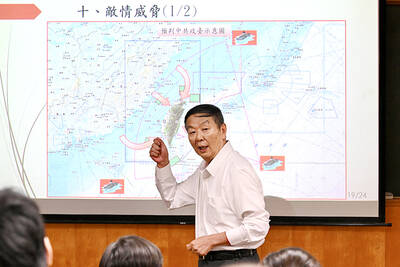
RETHINK? The defense ministry and Navy Command Headquarters could take over the indigenous submarine project and change its production timeline, a source said Admiral Huang Shu-kuang’s (黃曙光) resignation as head of the Indigenous Submarine Program and as a member of the National Security Council could affect the production of submarines, a source said yesterday. Huang in a statement last night said he had decided to resign due to national security concerns while expressing the hope that it would put a stop to political wrangling that only undermines the advancement of the nation’s defense capabilities. Taiwan People’s Party Legislator Vivian Huang (黃珊珊) yesterday said that the admiral, her older brother, felt it was time for him to step down and that he had completed what he

Taiwan has experienced its most significant improvement in the QS World University Rankings by Subject, data provided on Sunday by international higher education analyst Quacquarelli Symonds (QS) showed. Compared with last year’s edition of the rankings, which measure academic excellence and influence, Taiwanese universities made great improvements in the H Index metric, which evaluates research productivity and its impact, with a notable 30 percent increase overall, QS said. Taiwanese universities also made notable progress in the Citations per Paper metric, which measures the impact of research, achieving a 13 percent increase. Taiwanese universities gained 10 percent in Academic Reputation, but declined 18 percent

UNDER DISCUSSION: The combatant command would integrate fast attack boat and anti-ship missile groups to defend waters closest to the coastline, a source said The military could establish a new combatant command as early as 2026, which would be tasked with defending Taiwan’s territorial waters 24 nautical miles (44.4km) from the nation’s coastline, a source familiar with the matter said yesterday. The new command, which would fall under the Naval Command Headquarters, would be led by a vice admiral and integrate existing fast attack boat and anti-ship missile groups, along with the Naval Maritime Surveillance and Reconnaissance Command, said the source, who asked to remain anonymous. It could be launched by 2026, but details are being discussed and no final timetable has been announced, the source

SHOT IN THE ARM: The new system can be integrated with Avenger and Stinger missiles to bolster regional air defense capabilities, a defense ministry report said Domestically developed Land Sword II (陸射劍二) missiles were successfully launched and hit target drones during a live-fire exercise at the Jiupeng Military Base in Pingtung County yesterday. The missiles, developed by the Chungshan Institute of Science and Technology (CSIST), were originally scheduled to launch on Tuesday last week, after the Tomb Sweeping Day holiday long weekend, but were postponed to yesterday due to weather conditions. Local residents and military enthusiasts gathered outside the base to watch the missile tests, with the first one launching at 9:10am. The Land Sword II system, which is derived from the Sky Sword II (天劍二) series, was turned


 RSS
RSS