


Airbus is in the late stages of negotiations to build an assembly line for its A320 passenger plane in China, a landmark deal that would significantly lift its prospects for business there.
Producing European planes in China would open a new front in the battle between Airbus and Boeing for the world's next great aviation market, as well as underscore the growing role of state enterprises in the global economy.
Four Chinese cities are vying for the line, which would produce up to four A320's a month, in cooperation with Chinese state-owned aerospace manufacturers, industry experts said. The A320 is a short-haul jet that serves primarily domestic routes, which are booming across China.
On the short list for the project, these experts said, are Tianjin, a port near Beijing; Xian, an aircraft-manufacturing center; Shanghai, once the site of a McDonnell Douglas assembly plant, since closed; and Zhuhai, a port near Hong Kong.
While some analysts said Tianjin appeared to have an edge and Zhuhai was the dark-horse candidate, two senior executives close to Airbus said the competition was still undecided. The executives said they could speak only anonymously because of the delicacy of the negotiations. Airbus and the Chinese government are expected to make a final decision some time this summer.
The collaboration between a government-subsidized company from Europe and state-owned aircraft manufacturers in China would be a dramatic example of the new prominence of state enterprises worldwide -- a development that has worried some critics in the US.
The recent flap over a Dubai-controlled company that was blocked from acquiring the operations of six US ports illustrates the political sensitivities of such cases. The company, DP World, defused an outcry in the US Congress by agreeing to divest itself of its US holdings.
Aircraft technology has long raised security concerns in the US because of its capacity for military use. Putting an assembly line in China would aggravate those concerns, analysts said.
"Any major investment in Chinese production facilities by Airbus will be used in the US Congress to demonstrate a dangerous looseness in the sharing of sensitive technology," said Loren Thompson, a military analyst at the Lexington Institute, a policy lobbying group in Arlington, Virginia.
"No matter what they say," he added, "it is one step further down the path toward Chinese technology parity with the West."
Airbus, owned by an alliance of European aerospace companies and based in Toulouse, France, has said it is well aware of these arguments, but that a final assembly line in China would not pose a danger.
Publicly, Airbus has said only that it is considering a number of Chinese cities for a plant that would produce A320's. But it has not said which cities, nor has it committed itself to an agreement.
The plant would essentially clamp together parts of the A320, a small fraction of the manufacturing process. More than half the components, including technology-rich elements like the cockpit, would be produced in Europe and flown to China. The two senior executives close to Airbus said that the portion of work at the assembly plant would represent 4 percent to 5 percent of the value of the aircraft.
Even some traditionally sharp critics of China, like Larry Wortzel, the chairman of the US-China Economic and Security Review Commission, said the final assembly of A320's in China would be unlikely to transfer militarily important technology to the Chinese.
If anything, he said in an interview, it might teach China's aviation industry better quality control.
The transfer of secrets for the fabrication of high-grade alloys for jet engine manufacture or of certain composite materials -- not moves that Airbus has said it would consider -- would be more of an issue.
"It would not pay to transfer that technology to China, but assembly -- I don't have a problem with that," Wortzel said.
Airbus has put China at the center of its expansion plans, aiming to capture half of a market that it thinks could nearly double, to 1,790 aircraft, by 2022. Airbus has 344 planes in service in China, Hong Kong and Macao, but Boeing still dominates, with nearly two-thirds of the market.
In December, China placed an order for 150 A320's with a list price of close to US$10 billion. China and Airbus announced the order during a visit to France by Chinese Premier Wen Jiabao (溫家寶) when Airbus pledged to consider the production line.
Analysts interpreted the announcement as a quid pro quo, showing the lengths to which Airbus has had to go to break into the Chinese market, despite being active there since 1985.
For Europe, Airbus is also a potent tool to cultivate commercial ties with China. Chinese leaders and French President Jacques Chirac have celebrated visits to each other's capitals by signing aircraft deals.
Beyond the assembly line, Airbus has pledged to buy more aircraft parts from Chinese manufacturers, increasing its procurement to US$120 million a year by 2010 from US$14.5 million in 2003. Airbus and the China Aviation Industry Corp (
Analysts said, however, that Airbus might not gain much profit from assembling a plane like the A320 in China. Single-aisle planes tend to have thinner profit margins, and less advanced technology, than twin-aisle planes like the new A380 super-jumbo or Boeing's 787 and 747.
The demand for planes in China is so strong, said a person close to Airbus, that it could run its Chinese assembly line at full throttle and still have to supply A320s from its European factories.

Taiwan has experienced its most significant improvement in the QS World University Rankings by Subject, data provided on Sunday by international higher education analyst Quacquarelli Symonds (QS) showed. Compared with last year’s edition of the rankings, which measure academic excellence and influence, Taiwanese universities made great improvements in the H Index metric, which evaluates research productivity and its impact, with a notable 30 percent increase overall, QS said. Taiwanese universities also made notable progress in the Citations per Paper metric, which measures the impact of research, achieving a 13 percent increase. Taiwanese universities gained 10 percent in Academic Reputation, but declined 18 percent

Chinese President Xi Jinping (習近平) yesterday met with former president Ma Ying-jeou (馬英九) at the Great Hall of the People in Beijing, with Xi’s opening statement once more emphasizing that people on both sides of the Taiwan Strait are Chinese and that foreign intervention cannot change their inevitable unification. Xi said that 5,000 years of history of zhonghua minzu (中華民族, ethnic Chinese group) have seen their ancestors move to Taiwan to establish new lives, while also documenting them fighting side-by-side against foreign forces and finally freeing Taiwan. “Both sides are Chinese,” and there are no issues that cannot be worked through, he
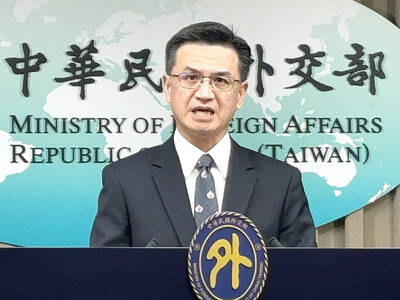
BULLY TACTICS: Beijing has continued its incursions into Taiwan’s airspace even as Xi Jinping talked about Taiwan being part of the Chinese family and nation China should stop its coercion of Taiwan and respect mainstream public opinion in Taiwan about sovereignty if its expression of goodwill is genuine, the Ministry of Foreign Affairs (MOFA) said yesterday. Ministry spokesman Jeff Liu (劉永健) made the comment in response to media queries about a meeting between former president Ma Ying-jeou (馬英九) and Chinese President Xi Jinping (習近平) the previous day. Ma voiced support for the so-called “1992 consensus,” while Xi said that although the two sides of the Taiwan Strait have “different systems,” this does not change the fact that they are “part of the same country,” and that “external
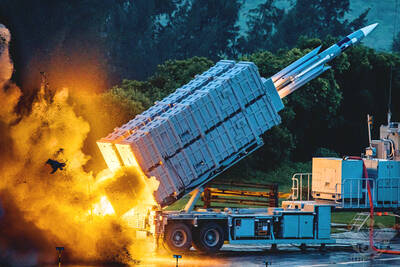
UNDER DISCUSSION: The combatant command would integrate fast attack boat and anti-ship missile groups to defend waters closest to the coastline, a source said The military could establish a new combatant command as early as 2026, which would be tasked with defending Taiwan’s territorial waters 24 nautical miles (44.4km) from the nation’s coastline, a source familiar with the matter said yesterday. The new command, which would fall under the Naval Command Headquarters, would be led by a vice admiral and integrate existing fast attack boat and anti-ship missile groups, along with the Naval Maritime Surveillance and Reconnaissance Command, said the source, who asked to remain anonymous. It could be launched by 2026, but details are being discussed and no final timetable has been announced, the source


 RSS
RSS