


The world's first mass-marketed robot, Sony's Aibo, recognizes its owners' faces and is programmed for sympathy, like a canine companion. Its eyes light up in red to show anger, green to convey happiness. It even learns its own name.
Aibo owners tend to be fiercely loyal, too. The robots have even been hacked by tinkerers seeking to add their own modifications.
But none of that prevented Sony Corp from announcing last week that it was scrapping the four-legged robot pet as part of the company's bid to reverse flagging fortunes and cut costs.

PHOTO: AP
Like so many things Sony has made over the years, the Aibo is a niche product. And since Sony is pulling the plug on robot production as part of a major restructuring, so goes the Aibo.
That isn't just disappointing Aibo fans, who bought 150,000 of the toy poodle-sized machines since they were first introduced in 1999 and now worry they won't be able to get spare parts.
It may also have robbed Sony of some of its mystique.
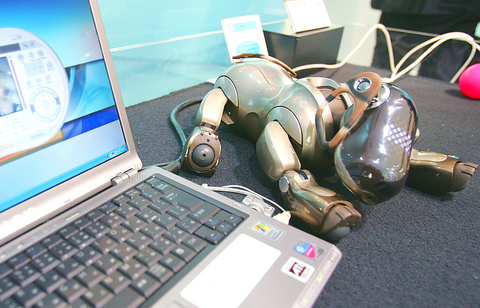
PHOTO: AP
Typical of now-dispirited Aibo owners, Hiroharu Hashimoto, a Tokyo resident and student, isn't placated by Sony's promise to provide maintenance for the robo-dogs for seven years after production ends in March.
"Aibo is so symbolic of Sony quality I'm starting to lose faith in Sony's audiovisual products," said Hashimoto, a longtime fan of the company whose every home appliance practically is a Sony.
"The robot is like a real dog. It responds when I call it," he says. "It's so cute. It sulks. And it looks sad when things don't go right."
Paul Wallingford, the owner of a Los Angeles-based Internet business, owns four Aibos. Lately, he's been keeping them turned off often so they're less likely to have problems.
"I think you do develop an attachment to them," he said by telephone.
The Aibo, which costs about US$2,000, delivers an amusing illusion of spontaneity and personality. It comes in black, white, brown and gray and is programmed to move about on its own.
It has image-recognition capabilities and a digital camera in its head that allows it to chase a special pink ball and avoid bumping into walls.
To many, the Aibo represented the tradition of innovation at Sony, which gave the world the Walkman portable music player and PlayStation video game machine.
It matters little to Aibo fans that Tokyo-based Sony -- with its sprawling entertainment business including movies, music and video games -- has opted to reorganize and focus on its core electronics business in order to better compete with the likes of Samsung Electronics Company of South Korea.
Owners have created fan clubs around the world, and some even dress up their canine robots like babies.
Some hospitals used the Aibo -- which means "pal" in Japanese and combines the first two letters of "artificial intelligence" combined with "bo" from robot -- in therapy.
The robots' charm comes in part from how their behavior somewhat reflects how they've been treated by their masters. At times, an Aibo will refuse to be toilet-trained and impudently raise a hind leg -- although, of course, it won't ever wet the rug.
An Aibo can understand 100 words and phrases and recognize three people's faces as it stores digital photos in its brain. It knows when its behavior is being praised because it has a sensor on its head that recognizes when it's being petted.
Later versions have a built-in camera so Aibos can serve as home sentinels, and e-mail their owners.
Takeshi Ohashi, a Kyushu Institute of Technology professor, considers Aibo a gem of technological finesse. He plans to appeal to Sony to bring the robots back.
Ohashi has his motives. He is an organizer of RoboCup, an annual international competition in which teams use Aibos and other robots to play soccer.
Masato Maruyama, an engineer, believes Sony isn't just hurting Aibo owners, who feel as if they're being told their pets have just seven more years to live.
"I feel the decision to withdraw from a product that's so representative of Sony heralds an end for Sony as a global leader," he said.
Richard Walkus, a Madison, New Jersey, man who has a Web site devoted to Aibo, concurs.
"They lost something," he said of Sony. "They lost stature."

ROLLER-COASTER RIDE: More than five earthquakes ranging from magnitude 4.4 to 5.5 on the Richter scale shook eastern Taiwan in rapid succession yesterday afternoon Back-to-back weather fronts are forecast to hit Taiwan this week, resulting in rain across the nation in the coming days, the Central Weather Administration said yesterday, as it also warned residents in mountainous regions to be wary of landslides and rockfalls. As the first front approached, sporadic rainfall began in central and northern parts of Taiwan yesterday, the agency said, adding that rain is forecast to intensify in those regions today, while brief showers would also affect other parts of the nation. A second weather system is forecast to arrive on Thursday, bringing additional rain to the whole nation until Sunday, it

CONDITIONAL: The PRC imposes secret requirements that the funding it provides cannot be spent in states with diplomatic relations with Taiwan, Emma Reilly said China has been bribing UN officials to obtain “special benefits” and to block funding from countries that have diplomatic ties with Taiwan, a former UN employee told the British House of Commons on Tuesday. At a House of Commons Foreign Affairs Committee hearing into “international relations within the multilateral system,” former Office of the UN High Commissioner for Human Rights (OHCHR) employee Emma Reilly said in a written statement that “Beijing paid bribes to the two successive Presidents of the [UN] General Assembly” during the two-year negotiation of the Sustainable Development Goals. Another way China exercises influence within the UN Secretariat is

CHINA REACTS: The patrol and reconnaissance plane ‘transited the Taiwan Strait in international airspace,’ the 7th Fleet said, while Taipei said it saw nothing unusual The US 7th Fleet yesterday said that a US Navy P-8A Poseidon flew through the Taiwan Strait, a day after US and Chinese defense heads held their first talks since November 2022 in an effort to reduce regional tensions. The patrol and reconnaissance plane “transited the Taiwan Strait in international airspace,” the 7th Fleet said in a news release. “By operating within the Taiwan Strait in accordance with international law, the United States upholds the navigational rights and freedoms of all nations.” In a separate statement, the Ministry of National Defense said that it monitored nearby waters and airspace as the aircraft

Taiwan’s first drag queen to compete on the internationally acclaimed RuPaul’s Drag Race, Nymphia Wind (妮妃雅), was on Friday crowned the “Next Drag Superstar.” Dressed in a sparkling banana dress, Nymphia Wind swept onto the stage for the final, and stole the show. “Taiwan this is for you,” she said right after show host RuPaul announced her as the winner. “To those who feel like they don’t belong, just remember to live fearlessly and to live their truth,” she said on stage. One of the frontrunners for the past 15 episodes, the 28-year-old breezed through to the final after weeks of showcasing her unique


 RSS
RSS