


When the Pentagon's research arm held a million-dollar race last year for autonomously controlled robot vehicles, the results were not exactly a US military success.
None of the computer-controlled vehicles made it far past the desert starting line, bumping into obstacles, breaking down or careening madly out of control.
What a difference a year makes. The US still hasn't gotten its way in Iraq, but at least DARPA's Grand Challenge looks like being a success.
In three days of qualifying rounds this week, about a dozen teams managed to nimbly navigate a four-km obstacle course inside southern California's Fontana Speedway circuit to qualify for the Saturday's prize race. Several other teams that did well in qualifying will join the final race to bring the number of contestants to 20.
"It was far better than my personal expectations," said Anthony Tether, the head of the Defence Advanced Research Projects Agency (DARPA).
The course will only be announced two hours before the race, to make sure that all navigation is conducted by the vehicles' global positioning systems.
But contestants are expected to have to travel some 250km across a desert route starting in Primm, Nevada, using only onboard sensors, navigation equipment and computers to find and follow the route and avoid obstacles. The robots also have to heed speed limits in certain zones and pass through a tunnel designed to temporarily knock out their GPS capabilities.
DARPA, which is widely credited with developing the Internet, will award US$2 million to the team whose autonomous vehicle successfully completes the route the fastest within a 10-hour time period. If no vehicle succeeds, the prize will be rolled over to next year's event, when the winner will net US$4 million.
The Pentagon hopes the competition will yield far more than merely expensive new toys.
It's part of the Pentagon's efforts to have a third of the military's ground vehicles unmanned by 2015 to fulfil a mandate by the US Congress.
Or as the military announcer at the qualifying rounds put it as the largest entrant -- a 15.25 tonne, six-wheel truck made by the Oshkosh Truck Co. and Ohio State University called TerraMax -- rumbled through the course: "That's what it's all about: a whole bunch of those things on the Baghdad highway, resupplying our troops."
Some of the other entrants look unlikely candidates for that task, especially a motorcycle named "GhostRider" which zipped off the starting line and promptly ploughed straight into a metal obstacle. Most onlookers thought the bike's bid was over, until it unfurled two metal props and quickly righted itself to complete over half the course.
The favorites were even more impressive. Stanford University's entry, Stanley, is a Volkswagen Touareg sport utility vehicle outfitted with cameras, laser guidance systems, an inertial system that functions like an inner ear to keep the vehicle oriented, and six computers. It skipped through the course perfectly in less than 11 minutes, barely slowing for the cars and obstacles parked in its path.
A team from Cornell University was just behind, using a design based on a military all-terrain vehicle. Then there was last year's most promising competitor, Red Team from Carnegie Mellon University, which is fielding two Hummer-based vehicles this year with sophisticated laser radars to help the vehicles identify obstacles and choose alternative routes.
Computer scientist William Whittaker, who heads the team, says the technology has advanced so much over the past year that the prize will definitely be won.
"There's a sea change," Whittaker told the Pittsburgh Post. "Now, it's just a matter of which team's machines will be durable enough, smart enough and, frankly, lucky enough to win the prize. There's nothing shabby about any team that's in this thing."
Whittaker believes that the implications of the technologies being developed for the race go far beyond military uses.
"It will shift the world's view of what's viable," he said. "It's not just military vehicles that will take advantage of these technologies, but a wide variety of consumer and industrial products."
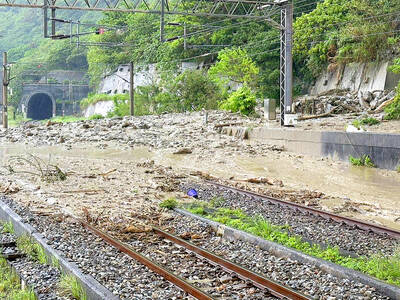
ROLLER-COASTER RIDE: More than five earthquakes ranging from magnitude 4.4 to 5.5 on the Richter scale shook eastern Taiwan in rapid succession yesterday afternoon Back-to-back weather fronts are forecast to hit Taiwan this week, resulting in rain across the nation in the coming days, the Central Weather Administration said yesterday, as it also warned residents in mountainous regions to be wary of landslides and rockfalls. As the first front approached, sporadic rainfall began in central and northern parts of Taiwan yesterday, the agency said, adding that rain is forecast to intensify in those regions today, while brief showers would also affect other parts of the nation. A second weather system is forecast to arrive on Thursday, bringing additional rain to the whole nation until Sunday, it

CONDITIONAL: The PRC imposes secret requirements that the funding it provides cannot be spent in states with diplomatic relations with Taiwan, Emma Reilly said China has been bribing UN officials to obtain “special benefits” and to block funding from countries that have diplomatic ties with Taiwan, a former UN employee told the British House of Commons on Tuesday. At a House of Commons Foreign Affairs Committee hearing into “international relations within the multilateral system,” former Office of the UN High Commissioner for Human Rights (OHCHR) employee Emma Reilly said in a written statement that “Beijing paid bribes to the two successive Presidents of the [UN] General Assembly” during the two-year negotiation of the Sustainable Development Goals. Another way China exercises influence within the UN Secretariat is
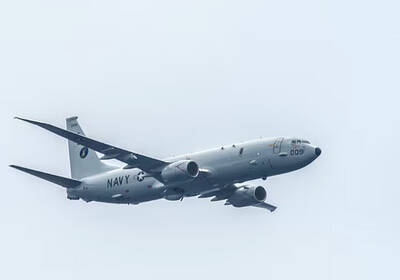
CHINA REACTS: The patrol and reconnaissance plane ‘transited the Taiwan Strait in international airspace,’ the 7th Fleet said, while Taipei said it saw nothing unusual The US 7th Fleet yesterday said that a US Navy P-8A Poseidon flew through the Taiwan Strait, a day after US and Chinese defense heads held their first talks since November 2022 in an effort to reduce regional tensions. The patrol and reconnaissance plane “transited the Taiwan Strait in international airspace,” the 7th Fleet said in a news release. “By operating within the Taiwan Strait in accordance with international law, the United States upholds the navigational rights and freedoms of all nations.” In a separate statement, the Ministry of National Defense said that it monitored nearby waters and airspace as the aircraft

Taiwan’s first drag queen to compete on the internationally acclaimed RuPaul’s Drag Race, Nymphia Wind (妮妃雅), was on Friday crowned the “Next Drag Superstar.” Dressed in a sparkling banana dress, Nymphia Wind swept onto the stage for the final, and stole the show. “Taiwan this is for you,” she said right after show host RuPaul announced her as the winner. “To those who feel like they don’t belong, just remember to live fearlessly and to live their truth,” she said on stage. One of the frontrunners for the past 15 episodes, the 28-year-old breezed through to the final after weeks of showcasing her unique


 RSS
RSS