


It looks like a Starbucks. It smells and tastes like one too. Settle into one of the comfortable Starbucks-like armchairs and it certainly feels like the real thing.
But the hottest cafe in the Ethiopian capital is not a Starbucks at all but a knockoff, the creation of a Starbucks devotee who tried to bring the real thing to Ethiopia, the birthplace of coffee, by many accounts. But she had to settle for a look-alike after the Seattle coffee giant rebuffed her partnership request.
Kaldi's has a Starbucks-like logo and Starbucks-like decor, and its workers wear Starbucks-like green aprons. At the bar, there are Starbucks-like "short" and "tall" coffee options, although Kaldi's sticks exclusively to Ethiopia's coffee varieties, while the real Starbucks includes Ethiopia's premium beans among many other offerings.
"I've always loved Starbucks, the ambiance of it," said Tseday Asrat, the proprietor of Kaldi's, fessing up to the obvious inspiration behind her year-old business. "So we created our own version of it here."
Kaldi's is by no means the only pretender around here. The latest hotel to go up near the airport is a "Marriot," another knockoff that uses only one "t" but has the exact same typeface in its sign as the JW Marriott hotel chain. There is a 7-11 convenience store here, as well, which has no connection to the 7-Elevens on so many corners back in the US.
Officials at the Starbucks Coffee Co were not thrilled when they learned of the knockoff.
"Even where it may seem playful, this type of misappropriation of a company's name (and reputation) is both derivative and dilutive of their trademark rights," a company spokeswoman, Lara Wyss, said in an e-mail message, adding that the company prefers to resolve such conflicts amicably.
The copycat cafe is not exactly cutting into the profits of the real Starbucks, though Kaldi's is popular enough that it will soon open its second cafe. And Asrat has no fear of competition from the chain, which has watched many rivals sadly hang up "out of business" signs.
"They can't compete with me," she said bluntly.
She allowed that a large company like Starbucks could theoretically try to undercut her business with lower prices. But prices here are already quite low. A Kaldi's short macchiato with a Starbucks-like chocolate muffin costs just 6.50 birr, which is under US$1 and pricey by Ethiopian standards. A similar pick-me-up at a Starbucks in the US would cost more than five times as much.
When it comes to knowing the ways of Ethiopia's finicky coffee consumers, Asrat clearly has a leg up on her rival. She points out that Ethiopians do not like to order their coffee from the counter, Starbucks style. She has a counter, complete with a Starbucks-like glass case for her baked goods, but her clients by and large sit down in their Starbucks-like chairs and issue orders to workers.
"Ethiopians like to be treated like a king when they come to a place like this," she explained. "They like to say, `Waiter, a macchiato. Waiter, come back, warm this up. Waiter, how about a muffin now?'"
They also expect parking-lot service, something not found in the business plan of a typical Starbucks. Many Ethiopians, especially young hip ones, enjoy pulling up to a cafe and ordering directly from their car windows. At a rival cafe there was far more car service than actual cafe service on a recent afternoon.
Though she is busily injecting Ethiopian culture with a bit of America, Asrat has not lived in the US. But her husband, a pilot for Ethiopian Airlines, has made regular trips there, frequently with her in tow.
She said she did not feel the least bit guilty about her imitation cafe. After all, legend has it that coffee itself originated in Ethiopia long ago when a goat herder named Kaldi noticed his goats prancing around with glee after eating some strange red berries. Yemen, just across the Red Sea, makes its own claim as the birthplace of coffee. Whatever the case may be, one thing is clear: Coffee did not originate in Seattle.
Asrat has the history of Kaldi printed on the wall of her cafe, proudly promoting the Ethiopian roots of her product. But even there Starbucks was the inspiration. Asrat acknowledges that she knew nothing about the legend of Kaldi until she read about him on the Starbucks Web site.

ROLLER-COASTER RIDE: More than five earthquakes ranging from magnitude 4.4 to 5.5 on the Richter scale shook eastern Taiwan in rapid succession yesterday afternoon Back-to-back weather fronts are forecast to hit Taiwan this week, resulting in rain across the nation in the coming days, the Central Weather Administration said yesterday, as it also warned residents in mountainous regions to be wary of landslides and rockfalls. As the first front approached, sporadic rainfall began in central and northern parts of Taiwan yesterday, the agency said, adding that rain is forecast to intensify in those regions today, while brief showers would also affect other parts of the nation. A second weather system is forecast to arrive on Thursday, bringing additional rain to the whole nation until Sunday, it
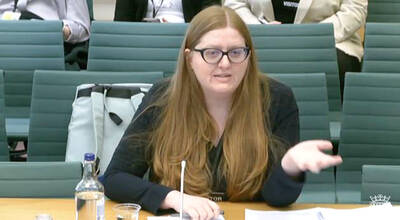
CONDITIONAL: The PRC imposes secret requirements that the funding it provides cannot be spent in states with diplomatic relations with Taiwan, Emma Reilly said China has been bribing UN officials to obtain “special benefits” and to block funding from countries that have diplomatic ties with Taiwan, a former UN employee told the British House of Commons on Tuesday. At a House of Commons Foreign Affairs Committee hearing into “international relations within the multilateral system,” former Office of the UN High Commissioner for Human Rights (OHCHR) employee Emma Reilly said in a written statement that “Beijing paid bribes to the two successive Presidents of the [UN] General Assembly” during the two-year negotiation of the Sustainable Development Goals. Another way China exercises influence within the UN Secretariat is
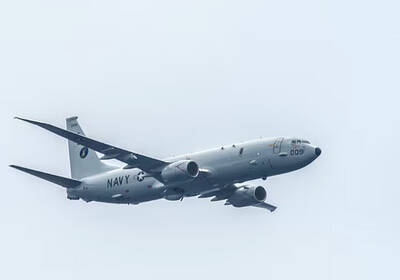
CHINA REACTS: The patrol and reconnaissance plane ‘transited the Taiwan Strait in international airspace,’ the 7th Fleet said, while Taipei said it saw nothing unusual The US 7th Fleet yesterday said that a US Navy P-8A Poseidon flew through the Taiwan Strait, a day after US and Chinese defense heads held their first talks since November 2022 in an effort to reduce regional tensions. The patrol and reconnaissance plane “transited the Taiwan Strait in international airspace,” the 7th Fleet said in a news release. “By operating within the Taiwan Strait in accordance with international law, the United States upholds the navigational rights and freedoms of all nations.” In a separate statement, the Ministry of National Defense said that it monitored nearby waters and airspace as the aircraft
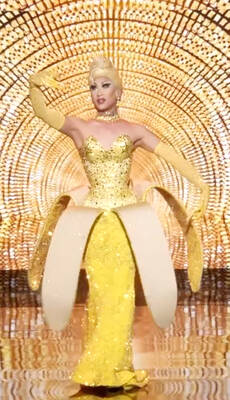
Taiwan’s first drag queen to compete on the internationally acclaimed RuPaul’s Drag Race, Nymphia Wind (妮妃雅), was on Friday crowned the “Next Drag Superstar.” Dressed in a sparkling banana dress, Nymphia Wind swept onto the stage for the final, and stole the show. “Taiwan this is for you,” she said right after show host RuPaul announced her as the winner. “To those who feel like they don’t belong, just remember to live fearlessly and to live their truth,” she said on stage. One of the frontrunners for the past 15 episodes, the 28-year-old breezed through to the final after weeks of showcasing her unique


 RSS
RSS