


A throng of foreign buyers trampled security barriers and pushed guards aside in their haste to enter the Canton Trade Fair as it opened here Friday, another sign of how companies all over the world are still rushing to do business in China.
But the downside of this torrent of money pouring into China was also apparent at the trade fair: It has fed inflation here in recent months on a scale not seen since the early 1990s, especially inflation in commodity prices.
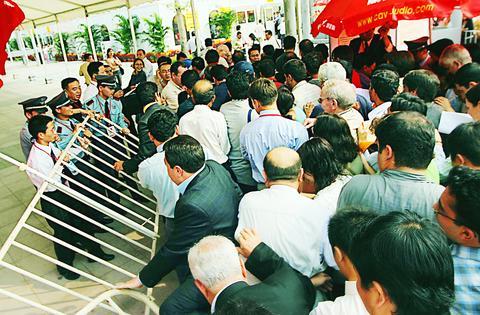
PHOTO: NY TIMES
Businesspeople from a wide range of industries all over China said in interviews at the fair that rising raw material prices in particular had been seriously crimping their profit margins. They painted a complex picture of commodities demand in particular, saying that their country's economy was still running very briskly, but that buyers were becoming resistant to paying steeply rising prices for some products and were deferring purchases.
Emerging signs that Chinese companies are balking at high commodities prices prompted near panic in the metals markets this week. On Wednesday, copper and nickel prices suffered their biggest one-day drop in London trading in more than a decade.
David Chen, the export department manager of Ningbo Jiekelong Valves Manufacturing near Shanghai, a large producer of copper valves and tubing, said that long order backlogs had disappeared in recent months. Some orders have been canceled, others have been filled and few new orders are coming in.
"The price is very high, so they're not buying, they're waiting," he said.
An executive at a manufacturer of rubber timing belts for car engines said that the price she paid for specially processed rubber had risen by nearly half in the last year, while she has not been able to raise belt prices by more than 10 percent. The executive, Fen Chen, general manager of the Fuwei Rubber Belt Manufacturing Co. in southeastern Zhejiang province, said that the company planned very little expansion in the months ahead and was turning down some belt orders because they simply were not profitable.
But not all commodities appear to be affected equally, nor is there even a consensus that copper and rubber demand are moderating. Tao Dong, a Credit Suisse First Boston economist in Hong Kong, said this week's slump in metals prices mostly appeared to reflect selling by speculators.
The overall Chinese economy is recovering from Beijing's efforts last spring to control overheating, and is now growing so robustly that the government is increasingly likely to hit the brakes again later this year, he said.
"We still have another two or three months to go for commodities before things get ugly," he added.
An executive of a battery company here said that even with high prices, crucial materials like zinc and dioxide manganese remained in short supply, with more buyers than mines can satisfy.
"Sometimes we cannot get these materials for a week or 10 days," said Chen Jia Cong, the sales manager of Shanghai Light Industrial Products. "The production line has to be stopped."
One of the biggest problems Chinese companies encounter is the power of big US retailers to resist price increases, even for products that are becoming much more expensive to manufacture.
The Tianjin Jinmao Corp. in northeastern China has raised the prices that it charges for caulking guns, shovels and stepladders by 25 percent to 30 percent over the last year for small customers, passing along the rapid rises in steel prices. But customers like Wal-Mart, Kmart and Home Depot in the US and Obi in Europe have refused to accept any increases, said Sunny Yen, the company's vice president for sales, adding that Home Depot alone accounted for a fifth of Tianjin Jinmao's sales.
"I like to say that Wal-Mart has every day a low price, Chinese steel every day has a new price," Yen said. "If I ask for a price increase, they will say, `Either you have to accept the current situation or we will take our business elsewhere.'"
Rising crude oil prices have become a preoccupation for many companies in China, which relies far more heavily on energy-intensive manufacturing than wealthy industrialized nations do.
"That leads to everything increasing in price -- the gas and the plastics -- so that makes it hard for us to keep the prices the same," said Zhou Hui, a sales representative for a local mirror manufacturer that uses plastic frames for its mirrors.
Rising prices for rice in particular, up close to 30 percent in the last year although moderating lately because of a plentiful harvest, have made the lives of migrant workers more difficult in the cities. Wages have been rising in some cities, but not others.
In some cases, wages have kept up with consumer prices, which were 5.3 percent higher in August than a year earlier despite price controls on many consumer goods. Inflation has been rising almost twice as fast on goods purchased by corporations, as tracked by the Chinese central bank.
Chinese agencies are expected to release a flood of economic statistics next week for last month and for the third quarter, and these could show some slackening in inflation because of moderating increases in rice prices.
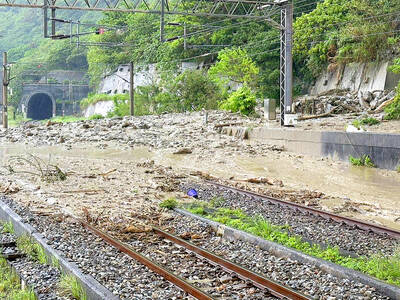
ROLLER-COASTER RIDE: More than five earthquakes ranging from magnitude 4.4 to 5.5 on the Richter scale shook eastern Taiwan in rapid succession yesterday afternoon Back-to-back weather fronts are forecast to hit Taiwan this week, resulting in rain across the nation in the coming days, the Central Weather Administration said yesterday, as it also warned residents in mountainous regions to be wary of landslides and rockfalls. As the first front approached, sporadic rainfall began in central and northern parts of Taiwan yesterday, the agency said, adding that rain is forecast to intensify in those regions today, while brief showers would also affect other parts of the nation. A second weather system is forecast to arrive on Thursday, bringing additional rain to the whole nation until Sunday, it

CONDITIONAL: The PRC imposes secret requirements that the funding it provides cannot be spent in states with diplomatic relations with Taiwan, Emma Reilly said China has been bribing UN officials to obtain “special benefits” and to block funding from countries that have diplomatic ties with Taiwan, a former UN employee told the British House of Commons on Tuesday. At a House of Commons Foreign Affairs Committee hearing into “international relations within the multilateral system,” former Office of the UN High Commissioner for Human Rights (OHCHR) employee Emma Reilly said in a written statement that “Beijing paid bribes to the two successive Presidents of the [UN] General Assembly” during the two-year negotiation of the Sustainable Development Goals. Another way China exercises influence within the UN Secretariat is
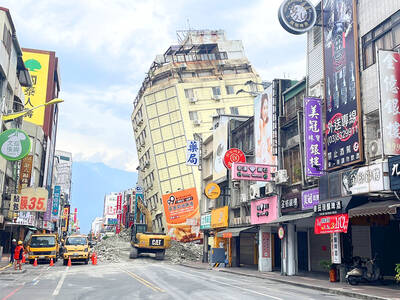
LANDSLIDES POSSIBLE: The agency advised the public to avoid visiting mountainous regions due to more expected aftershocks and rainfall from a series of weather fronts A series of earthquakes over the past few days were likely aftershocks of the April 3 earthquake in Hualien County, with further aftershocks to be expected for up to a year, the Central Weather Administration (CWA) said yesterday. Based on the nation’s experience after the quake on Sept. 21, 1999, more aftershocks are possible over the next six months to a year, the agency said. A total of 103 earthquakes of magnitude 4 on the local magnitude scale or higher hit Hualien County from 5:08pm on Monday to 10:27am yesterday, with 27 of them exceeding magnitude 5. They included two, of magnitude

Taiwan’s first drag queen to compete on the internationally acclaimed RuPaul’s Drag Race, Nymphia Wind (妮妃雅), was on Friday crowned the “Next Drag Superstar.” Dressed in a sparkling banana dress, Nymphia Wind swept onto the stage for the final, and stole the show. “Taiwan this is for you,” she said right after show host RuPaul announced her as the winner. “To those who feel like they don’t belong, just remember to live fearlessly and to live their truth,” she said on stage. One of the frontrunners for the past 15 episodes, the 28-year-old breezed through to the final after weeks of showcasing her unique


 RSS
RSS