


How big a deal will Skype turn out to be? I have no idea whether the company itself, which was founded one year ago, will someday come to epitomize and dominate a particular booming business, the way Google, eBay and Amazon now do. But I feel confident that the service it provides will be attractive to most people who give it a serious look.
Skype, a made-up term that rhymes with "tripe," is the most popular and sexiest application of VoIP, which doesn't rhyme with anything. VoIP -- sometimes pronounced letter by letter, like CIA, and at other times as a word -- stands for voice over Internet protocol. Essentially, it is a way of allowing a computer with a broadband connection to serve as a telephone.
This new form of conveying voice messages has so many advantages over traditional systems that the whole telecommunications industry is scrambling to see how fast it can shift traffic onto the Internet. AT&T, for example, is no longer recruiting new home customers, but it is offering many new VoIP services. Dozens of other companies -- including new ones like Vonage -- are selling VoIP services, too.
Skype's distinction is that, for now at least, it is the easiest, fastest and cheapest way for individual customers to begin using VoIP.
Cheap and easy
It works this way: First, you download free software from skype.com. Skype runs on most major operating systems, including Windows XP and 2000, Linux, Pocket PC for portable devices and, as of this summer, Mac OS. On three of the computers on which I installed it, it ran with no tweaking at all. On the fourth, I had to change one setting for the sound card, following easy instructions on the site.
While running, Skype sits in a little window, like an instant-messenger program, and lets you to talk with other users in two ways. If the other person has Skype installed, you can talk as long as you want, free, and with sound quality that is startlingly better than that of a normal phone connection. Over the years, I have learned to say "that's `F' as in Frank" when spelling my last name on the phone, because normal phone lines don't carry the frequencies that distinguish "F" from "S." Listening to a conversation on Skype, by contrast, is like listening to a radio program over streaming audio. The sound comes from speakers that are built into most laptop computers or attached to most desktops.
You'll need a microphone. Most laptops come with nearly invisible but quite effective tiny microphones embedded near the keyboard. (It may look odd to be talking to your laptop while using Skype, but in the cell phone age, we've all seen worse.) At either a desktop or a laptop computer, you can use a separate microphone or, less awkwardly, a phone handset or headset that plugs into a computer port. Skype sells headsets for $15 and up. I got the cheapest model, which works fine.
Calling anywhere
You can also reach people who don't use Skype, with a new service called SkypeOut. This allows you to dial nearly any cellular or land-line telephone number in any country and talk. Though it isn't free, it's really cheap. Skype's prices are in euros -- its founders are Scandinavian, the main programmers are Estonian and its headquarters are in Luxembourg -- and they average two or three US cents a minute, at any time of day. With a credit card, you buy calling time in units of 10 euros (US$12.18), which are deducted automatically as you talk.
I started with 10 euros. After my wife talked to her sister in Italy for a half-hour and I made one quick call to the Philippines and five more within the US, we still had 9.10 euros left.
Another time, I spoke from Washington simultaneously with my son in San Francisco and his business partner who was visiting Bangalore, India. (Up to five parties can participate in a Skype conference call.) All of us were at computers running Skype, so the conversation was free. The sound quality was sharp; it was about like speaking in person, and the connection had none of the satellite-bounce delay of normal transoceanic phone calls. Skype also allows file transfers and instant text messages during these computer-to-computer sessions.
Not so mobile
There is one huge drawback: Skype works best from a fully connected computer, which runs counter to the whole trend of ever more mobile communication. At the end of Skype's first year in business, I spoke with its co-founder, Niklas Zennstrom -- via SkypeOut, on his cell phone in London -- about his ambitions for the second year. High on his list were partnerships with manufacturers of cell phones and personal digital assistants, to build in compatibility with Skype. The company will also sustain its push to sign up new users. Skype says it has about 10 million users in 212 countries, with an average of more than 600,000 logged on at once.
Skype illustrates network economics in the purest form: free connections within the network become more valuable to each user as more users sign up. Because of the system's peer-to-peer design, loosely related to the Kazaa file-sharing program that Zennstrom and Skype's other co-founder, Janus Friis, invented four years ago, the system scales well -- that is, it doesn't bog down as more users join.
Risky future
Skype's own economics, including its promise that it will never impose a charge for Skype-to-Skype connections, depend on maintaining its rock-bottom cost structure and slowly adding revenue, through services like SkypeOut and future voice-mail and video-call services.
The risks make it hard to predict the company's future. The world's existing telecom companies, battered for more than a decade by technical, regulatory and marketing changes, will presumably want to answer this latest challenge.
From the individual user's point of view, there are also questions about whether this new form of instant access could become as oppressively intrusive as e-mail often seems. But at this moment, it's hard to resist.
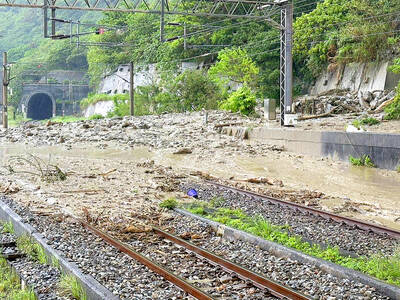
ROLLER-COASTER RIDE: More than five earthquakes ranging from magnitude 4.4 to 5.5 on the Richter scale shook eastern Taiwan in rapid succession yesterday afternoon Back-to-back weather fronts are forecast to hit Taiwan this week, resulting in rain across the nation in the coming days, the Central Weather Administration said yesterday, as it also warned residents in mountainous regions to be wary of landslides and rockfalls. As the first front approached, sporadic rainfall began in central and northern parts of Taiwan yesterday, the agency said, adding that rain is forecast to intensify in those regions today, while brief showers would also affect other parts of the nation. A second weather system is forecast to arrive on Thursday, bringing additional rain to the whole nation until Sunday, it
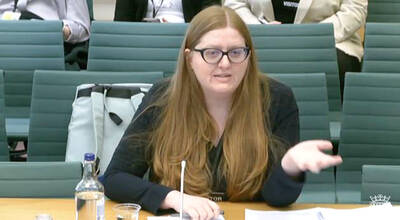
CONDITIONAL: The PRC imposes secret requirements that the funding it provides cannot be spent in states with diplomatic relations with Taiwan, Emma Reilly said China has been bribing UN officials to obtain “special benefits” and to block funding from countries that have diplomatic ties with Taiwan, a former UN employee told the British House of Commons on Tuesday. At a House of Commons Foreign Affairs Committee hearing into “international relations within the multilateral system,” former Office of the UN High Commissioner for Human Rights (OHCHR) employee Emma Reilly said in a written statement that “Beijing paid bribes to the two successive Presidents of the [UN] General Assembly” during the two-year negotiation of the Sustainable Development Goals. Another way China exercises influence within the UN Secretariat is

LANDSLIDES POSSIBLE: The agency advised the public to avoid visiting mountainous regions due to more expected aftershocks and rainfall from a series of weather fronts A series of earthquakes over the past few days were likely aftershocks of the April 3 earthquake in Hualien County, with further aftershocks to be expected for up to a year, the Central Weather Administration (CWA) said yesterday. Based on the nation’s experience after the quake on Sept. 21, 1999, more aftershocks are possible over the next six months to a year, the agency said. A total of 103 earthquakes of magnitude 4 on the local magnitude scale or higher hit Hualien County from 5:08pm on Monday to 10:27am yesterday, with 27 of them exceeding magnitude 5. They included two, of magnitude

Taiwan’s first drag queen to compete on the internationally acclaimed RuPaul’s Drag Race, Nymphia Wind (妮妃雅), was on Friday crowned the “Next Drag Superstar.” Dressed in a sparkling banana dress, Nymphia Wind swept onto the stage for the final, and stole the show. “Taiwan this is for you,” she said right after show host RuPaul announced her as the winner. “To those who feel like they don’t belong, just remember to live fearlessly and to live their truth,” she said on stage. One of the frontrunners for the past 15 episodes, the 28-year-old breezed through to the final after weeks of showcasing her unique


 RSS
RSS