


Last Sunday afternoon, Monalee and Kent Smith and 26 of their friends were out in the American wine country, exploring the vineyards and stopping for tastings at various wineries. Off in the distance, rolling hills arched above a winding river, their colors an early fall combination of amber, rust and gold. Church steeples peeked out through a canopy of trees. Along a winding two-lane highway and its tributaries were almost 50 bed-and-breakfasts, many filled for the weekend, and the antiques stores and restaurants in the quaint nearby village were doing a brisk business.
Sounds like a typical day in the fabled Napa Valley, doesn't it?
PHOTO: NY TIMES
Well, this was not Napa, or even the Sonoma Valley, but a somewhat unlikely wine region just off US Interstate 70 in Missouri. The town was Hermann, Missouri, not St. Helena, California. The river was the Missouri, not the Russian. And the grapes were Nortons, not cabernets.
"We've never been to Napa," Monalee Smith said, "but we are pretending that we are this weekend." Hermann is a three-hour drive from the couple's home in Overland Park, Kansas, and the trip, the first the couple had made to Hermann, seemed to be a success.
"We're already booked for next year," Monalee Smith said.
That's the kind of endorsement the winemakers and tourism officials of Missouri are looking for. Not to mention their counterparts in states like Virginia and Oregon, and even such unlikely wine-producing centers as Texas and North Dakota. There are now roughly 3,000 commercial vineyards in the US, and wineries in all 50 states, even Alaska. (Care for a glass of birch sap wine, anyone?) Along with producing wines for regional consumption, many of the vineyards and wineries are trying to market themselves as travel destinations.
When the people involved in promoting these wineries speak about their aspirations, it quickly becomes clear what their role model is.
"We all think of Napa, of course," said Linda Jones, the executive director of the Michigan Grape and Wine Industry Council. "They have developed a great tourist product."
While some states can apparently claim a certain wine pedigree (Missouri was the second-largest wine-producing state in the country before Prohibition, just behind New York) and lush surroundings that rival California's landscape, some have to try a little harder to attract the traveling oenophile.
Thus the snowshoe treks through the Leelanau Peninsula vineyards in northern Michigan, near Traverse City.
Started last year as a way to heighten the visibility of Michigan's wineries during the off-season, the Snowshoe Stomp consists of two races -- one for two miles, the other for four -- through vineyards that have been cleared in advance by snowmobiles. Last February, 300 people participated in the event, held on a sunny Valentine's Day weekend when the temperature hit 3 below Fahrenheit (-20?C).
"Sales do go up at the tasting rooms when we have these events," said Rick Coates, a spokesman for the Leelanau Peninsula Vintners Association, "but more importantly, it provides visitors with an experience they will take back home with them and turn them into repeat customers for Michigan wine."
Wine-related tourism brings in about US$16 million a year, according to Michigan's official tourism agency.
Bonnie Supina, a tasting-room manager at Chateau de Leelanau in Suttons Bay, Michigan, said the snowshoe trek isn't an alcohol-fueled event -- tastings are scheduled after the races are over.
"They need to stay focused while they are on their snow-shoes," she said.
Michigan isn't the only state looking for ways to increase its wine-as-tourism business. Last month, 227,623 people attended the four-day Grapefest in Grapevine, Texas, where 29 wineries offered samples and concerts; a tennis tournament and a competitive grape stomp were also on the agenda. The Grapefest organizers proudly point out that Spanish missionaries established the first North American winery in 1662 in the territory that would later become Texas.
At the Colorado Mountain Wine Fest, held in Palisade, Colorado, in September, events included a bike tour through the vineyards, ice-carving and a jazz concert. Wineries around the country offer jazz festivals, tractor rides, Halloween parties, art shows and short-story contests to attract customers.
"Tourism and wineries are soul brothers," said Bill Nelson, the vice president of WineAmerica, a trade group that has 700 members from 48 states. In 1998, the Grand Junction Visitor and Convention Bureau held a focus group in Denver trying to determine what there was about Grand Junction, in western Colorado, that would attract people looking for a weekend break.
"The No. 1 reason was the wineries," said Debbie Kovalik, the bureau's executive director.
Soon after, the town changed its tag line from "Grand Junction: A Landscape of Adventure" to "Grand Junction: Colorado's Wine Country." The move, Kovalik said, has been "significantly successful," with tourism revenues on the rise.
Kovalik added that Grand Junction had come a long way since 1990, when there were only four wineries in the area.
"The tasting rooms were modest," she said. "They were often in people's homes or in their backyards where they did production. Now, some are as nice as those you see in Napa and Sonoma."
Growing pains seem to be something of an issue in Missouri. At the turn-off to the Adam Puchta Winery in Hermann last weekend, Tim Puchta stood sentry with a walkie-talkie, letting co-workers at the parking lot know when a car was coming up the one-lane road. He has gotten more cautious about who gets through. A busload of college students came in a few years ago and pulled the toilets out of the floor and ripped the sinks out of the wall.
"They were so drunk that they couldn't get out of the bathroom, so they just kicked the doors in half," he said. After that, Puchta told himself, "That's it -- I'm not going to take another bus."
Puchta, a sixth-generation winemaker, is realistic about what he can offer the wine connoisseur.
"We can't with any real success grow cabernet, merlot, chardonnay or sauvignon blanc because of our climate," he said. "Two days ago it was 90 [32?C]; today the high will be 45 [7?C] -- if we're lucky. We have inconsistent crops. That is just farming here."
Friends in the California wine industry who come to visit are amazed by his perseverance. He says they tell him, "If I had to grow grapes in the conditions you have to grow them here, I'd just quit."
Puchta likens Missouri's position in the wine industry right now to Napa's early days.
"It took them many, many years to downplay the 'jug over the shoulder' mentality," he said.
"A lot of what we are trying to do here in Missouri is education," added Puchta, who is the chairman of the Missouri Wine and Grape Advisory Board. "We can compete on a quality issue, head to head, with California. Our port won a silver medal at the largest wine competition in California, the Los Angeles County Fair, and it beat out two of the top Portuguese port producers. It is just the ability to get it into people's mouths without them saying, `Oh, it is from Missouri.'"
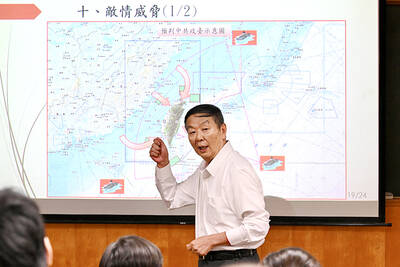
RETHINK? The defense ministry and Navy Command Headquarters could take over the indigenous submarine project and change its production timeline, a source said Admiral Huang Shu-kuang’s (黃曙光) resignation as head of the Indigenous Submarine Program and as a member of the National Security Council could affect the production of submarines, a source said yesterday. Huang in a statement last night said he had decided to resign due to national security concerns while expressing the hope that it would put a stop to political wrangling that only undermines the advancement of the nation’s defense capabilities. Taiwan People’s Party Legislator Vivian Huang (黃珊珊) yesterday said that the admiral, her older brother, felt it was time for him to step down and that he had completed what he

Taiwan has experienced its most significant improvement in the QS World University Rankings by Subject, data provided on Sunday by international higher education analyst Quacquarelli Symonds (QS) showed. Compared with last year’s edition of the rankings, which measure academic excellence and influence, Taiwanese universities made great improvements in the H Index metric, which evaluates research productivity and its impact, with a notable 30 percent increase overall, QS said. Taiwanese universities also made notable progress in the Citations per Paper metric, which measures the impact of research, achieving a 13 percent increase. Taiwanese universities gained 10 percent in Academic Reputation, but declined 18 percent

UNDER DISCUSSION: The combatant command would integrate fast attack boat and anti-ship missile groups to defend waters closest to the coastline, a source said The military could establish a new combatant command as early as 2026, which would be tasked with defending Taiwan’s territorial waters 24 nautical miles (44.4km) from the nation’s coastline, a source familiar with the matter said yesterday. The new command, which would fall under the Naval Command Headquarters, would be led by a vice admiral and integrate existing fast attack boat and anti-ship missile groups, along with the Naval Maritime Surveillance and Reconnaissance Command, said the source, who asked to remain anonymous. It could be launched by 2026, but details are being discussed and no final timetable has been announced, the source

CHINA REACTS: The patrol and reconnaissance plane ‘transited the Taiwan Strait in international airspace,’ the 7th Fleet said, while Taipei said it saw nothing unusual The US 7th Fleet yesterday said that a US Navy P-8A Poseidon flew through the Taiwan Strait, a day after US and Chinese defense heads held their first talks since November 2022 in an effort to reduce regional tensions. The patrol and reconnaissance plane “transited the Taiwan Strait in international airspace,” the 7th Fleet said in a news release. “By operating within the Taiwan Strait in accordance with international law, the United States upholds the navigational rights and freedoms of all nations.” In a separate statement, the Ministry of National Defense said that it monitored nearby waters and airspace as the aircraft


 RSS
RSS