


It's like a shotgun marriage gone oddly harmonious: Hollywood and the consumer electronics industry are now working closer together after a few years of claws-out antagonism in courtrooms and on Capitol Hill.
It could be the tough economic times or a distaste for further legal showdowns, but many top gadget makers are now trying hard to please the purveyors of entertainment.
More often than not, that is giving Hollywood's copy-protection interests a virtual seat at the product design table.
"Without good content there, my products are nothing but furniture or art. So it all falls back on what Hollywood is comfortable with," said Chris Cudina, national sales and marketing manager for Samsung's set-top box group.
Others contend that such coziness sometimes deprives consumers of flexibility -- or worse, privacy rights and civil liberties -- as entertainment companies exert control over how people use creative works gone digital.
"The threat of litigation has had a chilling effect on what technologists would be prepared to include in any new devices they release," said Gwen Hinze, a staff attorney at the Electronic Frontier Foundation.
No ad-Skipping
Consider how one-time rebel ReplayTV backed down. The tech company's new owners said last month that its upcoming digital video recorders will no longer allow people to skip ads or share shows over the Internet.
Those features on previous models rattled Hollywood, which fears the Napsterization of television programming and contends that the loss of commercial viewership would kill television's bread-and-butter.
In true form, 28 studios sued ReplayTV's previous owner, Sonicblue Inc, forcing the struggling consumer electronics company to pay millions of dollars in legal fees.
Sonicblue sank. It filed for bankruptcy in March and sold ReplayTV to another electronics company, D&M Holdings Inc, effectively making the copyright-infringement lawsuit moot.
ReplayTV's president, Jim Hollingsworth, called cooperation with Hollywood the best approach to bringing digital video recording technology to market.: "You look for complementary solutions rather than riding roughshod," he said.
D&M's technology adviser Tom McCarthy does not think consumers will lose out: "We'll be in belt and suspenders, but it'll be done in a way where the consumer will feel they can still keep up with their digital lifestyle."
ReplayTV's startup rival, TiVo Inc, has deliberately tried to avoid rankling Tinseltown.
Industry-lobbying
TiVo even recruited a TV network veteran to preach to Hollywood the potential benefits of the disruptive technology that lets consumers record programming onto a hard disk and pause or fast-foward through live television.
"We go to significant lengths to make sure that we stay on the good side of the networks," said Martin J. Yudkovitz, who left his post as NBC's executive vice president to become TiVo's president in April. He said TiVo has stayed away from any file-sharing over the Net or automatic ad-zapping features.
"At first, when the DVR technology came out, there was a near universal gagging from the networks and the advertisers," said Yudkovitz. "Now TiVo is earning a good-guy image."
Set-top boxes
Last year, Scientific-Atlanta became the first cable set-top box maker to launch a model with a built-in digital video recorder. The advanced box, called the Explorer 8000, is technically equipped with a 30-second commercial skip feature, but none of the cable companies -- which have the final say on what features consumers would get -- are activating that option, said Tony Wasilewski, Scientific-Atlanta's chief scientist.
Similarly, Motorola, the nation's leading cable box maker, is set to soon introduce a cable box with all the bells and whistles of a digital video recorder and much more.
But the 30-second skip technology built into it will probably never see the light of day, said Mark DePietro, a Motorola vice president.
Spokesman Keith Cocozza of Time Warner Cable -- the first US cable operator to introduce a digital video recorder-equipped cable box -- said a delicate balancing act is involved.
To avoid conflict with Hollywood, Nokia recently added copy-protection technology to its toolkit for developers building mobile phone Internet applications.
It's a pre-emptive move as cell phones are increasingly becoming vehicles for data, ranging from snapshots to branded entertainment -- such as music video clips.
As they introduce such products as PCs with TV tuners and digital media receivers that let consumers store recorded digital video, many device makers are careful to restrict the number of copies that can be made or shared over computer networks.
Devil is in the details
Four years ago, the Motion Picture Association of America formed a technology unit to ensure that device makers understood its copy-protection requirements, said Brad Hunt, the association's chief technical officer.
The two industries argue plenty over the details. Hollywood wants to control distribution as much as possible while the tech industry doesn't want anti-piracy safeguards driving up the price or limiting the appeal of its products.
Still, a product is more likely to succeed if it gets Hollywood support, said Stephen Nickerson, a managing director of Warner Home Video.
Nickerson knows. He was an executive at Toshiba Corp and active in discussions between the tech industry and Hollywood studios before DVD players debuted commercially in 1997.
Consumer electronic companies realized then that they needed Hollywood's backing, and spent five years resolving technical details and copy-protection standards before DVD players hit the market.
At times, the tech industry has prevailed without Hollywood's blessing.
The precedent-setting 1984 Sony Betamax case established the legality of VCRs and the right of consumers to record and watch shows at their convenience.
The music industry also unsuccessfully tried to squelch MP3 music players, losing in court in 1999 against the makers of Rio, the first commercial MP3 player.
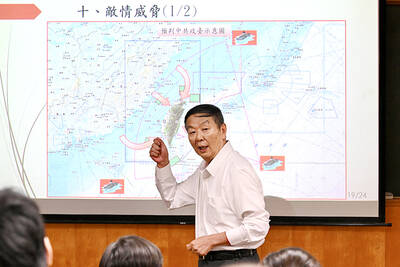
RETHINK? The defense ministry and Navy Command Headquarters could take over the indigenous submarine project and change its production timeline, a source said Admiral Huang Shu-kuang’s (黃曙光) resignation as head of the Indigenous Submarine Program and as a member of the National Security Council could affect the production of submarines, a source said yesterday. Huang in a statement last night said he had decided to resign due to national security concerns while expressing the hope that it would put a stop to political wrangling that only undermines the advancement of the nation’s defense capabilities. Taiwan People’s Party Legislator Vivian Huang (黃珊珊) yesterday said that the admiral, her older brother, felt it was time for him to step down and that he had completed what he
Taiwan has experienced its most significant improvement in the QS World University Rankings by Subject, data provided on Sunday by international higher education analyst Quacquarelli Symonds (QS) showed. Compared with last year’s edition of the rankings, which measure academic excellence and influence, Taiwanese universities made great improvements in the H Index metric, which evaluates research productivity and its impact, with a notable 30 percent increase overall, QS said. Taiwanese universities also made notable progress in the Citations per Paper metric, which measures the impact of research, achieving a 13 percent increase. Taiwanese universities gained 10 percent in Academic Reputation, but declined 18 percent

BULLY TACTICS: Beijing has continued its incursions into Taiwan’s airspace even as Xi Jinping talked about Taiwan being part of the Chinese family and nation China should stop its coercion of Taiwan and respect mainstream public opinion in Taiwan about sovereignty if its expression of goodwill is genuine, the Ministry of Foreign Affairs (MOFA) said yesterday. Ministry spokesman Jeff Liu (劉永健) made the comment in response to media queries about a meeting between former president Ma Ying-jeou (馬英九) and Chinese President Xi Jinping (習近平) the previous day. Ma voiced support for the so-called “1992 consensus,” while Xi said that although the two sides of the Taiwan Strait have “different systems,” this does not change the fact that they are “part of the same country,” and that “external

UNDER DISCUSSION: The combatant command would integrate fast attack boat and anti-ship missile groups to defend waters closest to the coastline, a source said The military could establish a new combatant command as early as 2026, which would be tasked with defending Taiwan’s territorial waters 24 nautical miles (44.4km) from the nation’s coastline, a source familiar with the matter said yesterday. The new command, which would fall under the Naval Command Headquarters, would be led by a vice admiral and integrate existing fast attack boat and anti-ship missile groups, along with the Naval Maritime Surveillance and Reconnaissance Command, said the source, who asked to remain anonymous. It could be launched by 2026, but details are being discussed and no final timetable has been announced, the source


 RSS
RSS