


A buzz in California has caught the attention of the world's biggest coffee companies.
In a growing movement reminiscent of the grape boycott in the 1970s, anti-globalization and human rights advocates in California have been promoting the purchase of Fair Trade certified coffee -- coffee that guarantees a so-called living wage to poor coffee farmers in developing countries. An estimated 25 million of these farmers have suffered because raw coffee prices have fallen below the cost of production.
Students in California have helped to pressure the Sara Lee Corp, the maker of the Hills Bros. and Chock Full o' Nuts brands, to start buying small amounts of Fair Trade coffee. On Nov. 5, voters in Berkeley, California, a longtime redoubt of student activism, will vote on a measure that would require the city's restaurants and supermarket cafes to restrict sales of brewed coffee to blends that are Fair Trade, organic or shade grown, which are considered more environmentally friendly than conventional, mass-produced varieties. Violators could face US$100 fines and six-month jail terms.
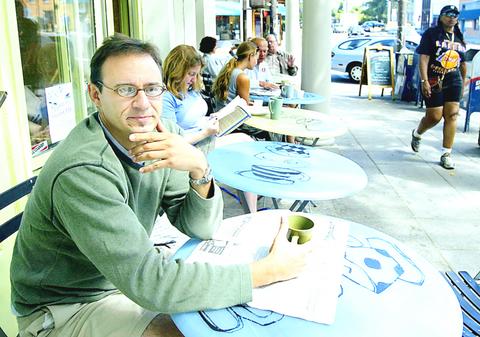
PHOTO: NY TIMES
Major coffee companies have denounced the Berkeley measure. But at least one, Procter & Gamble, which sells the Folger's brand, said it would work with beverage servers to comply if the measure passed.
Fair Trade coffee, a pet project of the anti-globalization movement, has become a growing segment of the US$55 billion coffee industry. Although Fair Trade coffee is only about 2 percent of the global supply, sales rose 36 percent last year in the US, the biggest single market for coffee. About 7,000 retail outlets across the country sell Fair Trade coffee, according to TransFair USA, a nonprofit group in Oakland, California, that monitors food company compliance with Fair Trade standards.
Last week, Green Mountain Coffee, a wholesaler in Waterbury, Vermont, signed an agreement to sell Fair Trade coffee under the Newman's Own Organics label, the food company owned by the actor Paul Newman, next year in supermarkets nationwide.
The economic argument for Fair Trade coffee got a lift in September when Oxfam, the British charity, released a report saying that a global oversupply of coffee had pushed prices to their lowest levels in 100 years, adjusted for inflation, impoverishing millions of coffee farmers in developing countries.
In Latin America, Africa and Asia, the report said, farmers are paid roughly US$0.24 a pound for beans, while the four multinational companies that buy nearly half of the world's coffee -- Sara Lee, Kraft, Procter & Gamble and Nestl? -- sell those beans at an average price of US$3.60 a pound and "are laughing all the way to the bank."
Fair Trade coffee, which can cost more than double the price of conventional blends at the checkout counter, is comparable in quality and price with premium blends.
Small farmer cooperatives are guaranteed to receive about US$1.25 a pound for Fair Trade coffee.
To help these farmers, Oxfam proposed to the International Coffee Organization, a group of 40 major importers and exporters, that it cut the oversupply, and help raise prices, by destroying stockpiles of the lowest-quality beans.
Organization members generally oppose that approach, arguing that stimulating demand is a better way to raise price than reducing supply. Many also reject the Fair Trade approach, saying it supports prices artificially and could worsen the glut.
"Fair Trade isn't a viable solution," said Gordon Gillet, Nestl?'s senior vice president for purchasing and exports. "First, it favors the few and, secondly, it provides an incentive to farmers to increase coffee production at a time when they should perhaps be seriously considering alternative crops."
Anneke Theunissen, a spokeswoman for Fairtrade Labelling Organizations International, the group that oversees Fair Trade certification, disagreed. "At this moment, Fair Trade labeling is the only way for the disadvantaged small farmers to survive in the market," she said.
As for the Berkeley initiative, the industry has largely dismissed it as a quirky extreme, saying customers should decide what coffee they want.
"Berkeley has always distinguished itself, to put it politely, by a surprising originality," said Francois-Xavier Perroud, a Nestl? spokesman.
Berkeley, though, may be a natural place for the coffee controversy to percolate. The city is known as a coffee Mecca where couples go to coffee houses on dates rather than to bars, and where drinkers debate the merits of one roast over another the way the French debate the merits of wines. Peet's Coffee & Tea, a famous Berkeley roaster, was the training ground for the founders of Starbucks, the biggest and most successful coffee bar chain in the world. Both were early sellers of Fair Trade beans, along with other coffees.
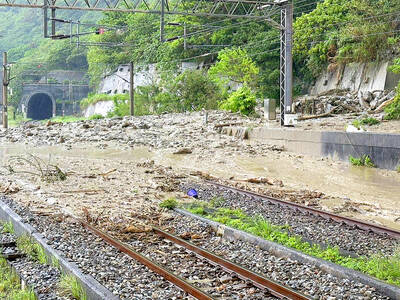
ROLLER-COASTER RIDE: More than five earthquakes ranging from magnitude 4.4 to 5.5 on the Richter scale shook eastern Taiwan in rapid succession yesterday afternoon Back-to-back weather fronts are forecast to hit Taiwan this week, resulting in rain across the nation in the coming days, the Central Weather Administration said yesterday, as it also warned residents in mountainous regions to be wary of landslides and rockfalls. As the first front approached, sporadic rainfall began in central and northern parts of Taiwan yesterday, the agency said, adding that rain is forecast to intensify in those regions today, while brief showers would also affect other parts of the nation. A second weather system is forecast to arrive on Thursday, bringing additional rain to the whole nation until Sunday, it

CONDITIONAL: The PRC imposes secret requirements that the funding it provides cannot be spent in states with diplomatic relations with Taiwan, Emma Reilly said China has been bribing UN officials to obtain “special benefits” and to block funding from countries that have diplomatic ties with Taiwan, a former UN employee told the British House of Commons on Tuesday. At a House of Commons Foreign Affairs Committee hearing into “international relations within the multilateral system,” former Office of the UN High Commissioner for Human Rights (OHCHR) employee Emma Reilly said in a written statement that “Beijing paid bribes to the two successive Presidents of the [UN] General Assembly” during the two-year negotiation of the Sustainable Development Goals. Another way China exercises influence within the UN Secretariat is

CHINA REACTS: The patrol and reconnaissance plane ‘transited the Taiwan Strait in international airspace,’ the 7th Fleet said, while Taipei said it saw nothing unusual The US 7th Fleet yesterday said that a US Navy P-8A Poseidon flew through the Taiwan Strait, a day after US and Chinese defense heads held their first talks since November 2022 in an effort to reduce regional tensions. The patrol and reconnaissance plane “transited the Taiwan Strait in international airspace,” the 7th Fleet said in a news release. “By operating within the Taiwan Strait in accordance with international law, the United States upholds the navigational rights and freedoms of all nations.” In a separate statement, the Ministry of National Defense said that it monitored nearby waters and airspace as the aircraft

Taiwan’s first drag queen to compete on the internationally acclaimed RuPaul’s Drag Race, Nymphia Wind (妮妃雅), was on Friday crowned the “Next Drag Superstar.” Dressed in a sparkling banana dress, Nymphia Wind swept onto the stage for the final, and stole the show. “Taiwan this is for you,” she said right after show host RuPaul announced her as the winner. “To those who feel like they don’t belong, just remember to live fearlessly and to live their truth,” she said on stage. One of the frontrunners for the past 15 episodes, the 28-year-old breezed through to the final after weeks of showcasing her unique


 RSS
RSS