


Taiwanese electronics conglomerate New Kinpo Group (新金寶集團) yesterday said operations at its new factory in the Philippines would begin later this quarter as part of efforts to move some labor-intensive production away from China.
The factory, operated by group member Kinpo Electronics Inc (金寶電子), is to formally open next month or in March and start by focusing on low-end electronics like calculators, chief executive officer Simon Shen (沈軾榮) told reporters ahead of the group’s Lunar New Year party.
The group’s Chinese factory will shift its focus to high-end manufacturing to target the domestic market amid rapid increases in wages and signs of resilience in hiring there, he said.
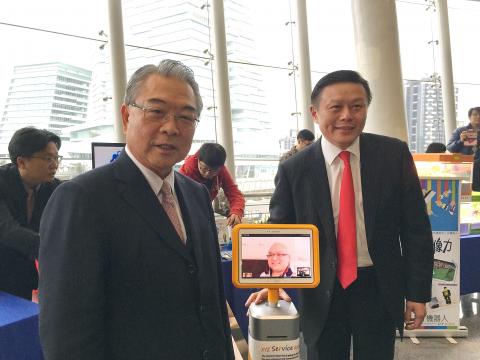
Photo: Cho Yi-chun, Taipei Times
New Kinpo invested NT$1 billion (US$31.5 million) to set up the Philippine factory last year, with plans to invest another NT$1 billion this year in the facility, which is forecast to account for about 10 to 30 percent of the group’s total revenue by the end of this year, Shen said.
Established in 1973, the group has 23 member companies, led by Cal-Comp Electronics and Communications Co (泰金寶), Kinpo Electronics and AcBel Polytech Inc (康舒科技). It has seven listed firms and employs 80,000 people.
XYZprinting Inc (三緯), one of its units, aims to become the world’s largest 3D printer maker this year by shipping more than 100,000 printers worldwide. Last year, the firm shipped about 30,000 units, Shen said.
“We have the capability to become the world’s No. 1 and we must achieve that goal,” Shen said.
Founded in 2013, XYZprinting is the world’s second-biggest manufacturer of 3D printers, after Makerbot Industries LLC of the US.
Shen said XYZprinting expanded its product range last year to food printers and a dual-color model with a scanner, and will launch a “secret weapon” later this year to woo the market. He did not give any details about the new product.
XYZprinting’s revenue is forecast to jump 384 percent this year to NT$2.2 billion (US$69.3 million), Hsu said.
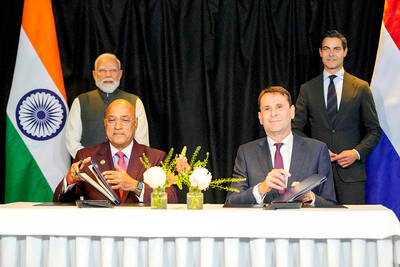
NEW MARKET: The partnership opens up India to the Dutch company, which already has a strong hold in the semiconductor market of South Korea, Taiwan and China ASML Holding NV entered into a partnership agreement with Tata Electronics Pvt Ltd aimed at ramping up India’s goal to develop domestic chip-manufacturing capabilities. The Dutch company’s technology would help power Tata Electronics’ planned 300 millimeter (mm) semiconductor foundry in Gujarat, according to a joint statement from the two companies on Saturday. The signing of a memorandum of understanding coincides with a visit by Indian Prime Minister Narendra Modi to the Netherlands, which is looking to deepen bilateral relations with New Delhi. ASML, whose top customers include Taiwan Semiconductor Manufacturing Co (台積電) and Samsung Electronics Co, makes lithography machines that can print
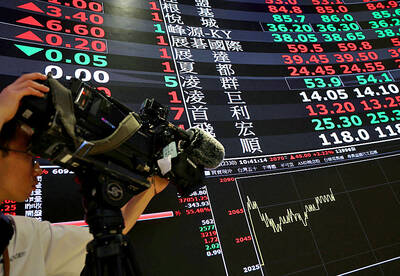
After several years flying high as Asia’s best Nvidia Corp proxy, Taiwan Semiconductor Manufacturing Co (TSMC, 台積電) is increasingly vying with other artificial intelligence (AI) stocks for investor attention. Stock traders are chasing a wider array of beneficiaries as mainstream usage of AI creates demand for hardware beyond the most-advanced chips TSMC makes for Nvidia. Subthemes from the deepening memory crunch to advances in robotics are also luring bids. At the same time, investment caps on single stocks are pushing funds to diversify, while retail investors long familiar with TSMC through its US depositary receipts are being offered a broader set of

TECH RELIANCE: Growth is increasingly reflecting an unequal K-shaped distribution, where technology sectors outperform and other industries struggle, an expert said Standard Chartered Bank has significantly raised its forecast for Taiwan’s economic growth to 9.5 percent this year, up from 7.6 percent previously, citing surging artificial intelligence (AI) demand driving exports, semiconductor production and investment. The upgrade reflects a sustained AI supercycle that continues to fuel demand for advanced chips and technology infrastructure, which form the backbone of Taiwan’s exports, the bank said in a report this week. “We raise our 2026 growth forecast to reflect a much stronger-than-expected first-quarter GDP figure,” Standard Chartered senior economist for greater China and Asia Tommy Wu (胡東安) said in the report. Driven largely by a 35.3 percent
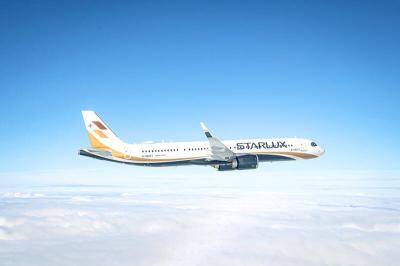
Two of Taiwan’s international carriers, Starlux Airlines Co (星宇航空) and EVA Airways Corp (長榮航空), have retained the five-star airline rating awarded by international airline review organization Skytrax. Starlux was awarded the distinction for a second consecutive year, while EVA Air received it for the 11th straight year, Skytrax said in statements released yesterday and on Thursday last week, respectively. The five-star rating is considered one of the airline industry's highest honors and is awarded following professional audits of airline product and frontline service standards, Skytrax said. The ratings are based on in-depth assessments using unified global quality standards rather than customer review scores


 RSS
RSS