


The Financial Supervisory Commission (FSC) said on Friday it would strengthen regulations on banks and financial holding companies’ fund-raising through private placements to better safeguard the public interest.
The FSC said in a statement that its banking bureau invited several academics, banking representatives and related industry agencies to a meeting on Friday to discuss the appropriateness of financial firms raising capital via private placements or private equity funds.
Participants reached a two-point consensus, the statement said.
“First, it is better for banks and financial holding companies to raise funds via private placements only when they are experiencing financial and operational difficulties and are in urgent need of capital injection,” the statement said.
“Second, financially strong banks and financial holding companies should not sell stakes to private equity funds because of the leverage risk and financial instability involved,” it said.
The commission said it suggested financial institutions raise capital via public offerings instead of private placements because private placements have uncertainties related to the lack of information transparency and the qualifications of major shareholders.
The FSC’s statement came after Chinatrust Financial Holding Co (中信金控) president Daniel Wu (吳一揆) on Thursday said that the firm’s proposed fund-raising plan via either public offerings or private placement was concerned more with strategic investment than capital need.
Chinatrust plans to raise up to NT$41.13 billion (US$1.28 billion) by issuing 2.5 billion new shares, which its shareholders approved on June 30.
Wu said there was no urgent need to raise funds since the firm’s acquisition of Nan Shan Insurance Co (南山人壽) remained uncertain and the company’s plan to set up a subsidiary in China had fallen through. He said the firm must also consider market conditions and other details related to the timing of the fund-raising.
Although the company has not decided which method to adopt, Wu said that there was no lock-up period for investors for the public offerings, which was not necessarily good for the firm.
While a private placement poses concerns for investors because of a massive share dilution, banking analysts such as Bradford Ti (鄭溫煌) at Citigroup Global Markets have said this method of selling securities to select investors offers companies access to more capital with a relatively lower cost than public offerings, also providing them with the favored clients of strategic partners.
Apart from Chinatrust, other financial firms that have had their private placement plans approved by shareholders this year include Ta Chong Bank Ltd (大眾銀行), Cosmos Bank Taiwan (萬泰銀行), Fubon Financial Holding Co (富邦金控) and China Development Financial Holding Co (中華開發金控).
Ta Chong plans to either sell as many as 3.6 billion common shares worth NT$36 billion in a private placement or issue global depositary receipts, the lender said in a stock exchange filing on June 29.
Fubon Financial plans to raise up to NT$35 billion via domestic convertible bonds, overseas convertible bonds, global depositary receipts, a private placement or a combination of these methods, the firm said in an exchange filing on June 28.
Cosmos will raise up to NT$10 billion through a private placement of common shares to strengthen its financial structure, it said in a filing on June 18, while China Development Financial plans to raise up to NT$18 billion to strengthen its working capital, either by issuing 600 million common shares via a private placement or by issuing global depositary receipts, it said in a separate filing on the same day.
ADDITIONAL REPORTING BY TED YANG
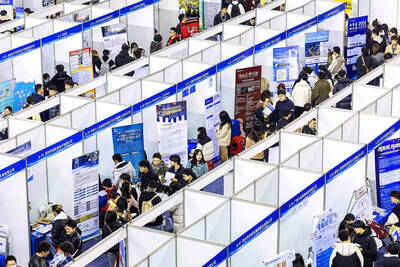
Stephen Garrett, a 27-year-old graduate student, always thought he would study in China, but first the country’s restrictive COVID-19 policies made it nearly impossible and now he has other concerns. The cost is one deterrent, but Garrett is more worried about restrictions on academic freedom and the personal risk of being stranded in China. He is not alone. Only about 700 American students are studying at Chinese universities, down from a peak of nearly 25,000 a decade ago, while there are nearly 300,000 Chinese students at US schools. Some young Americans are discouraged from investing their time in China by what they see

MAJOR DROP: CEO Tim Cook, who is visiting Hanoi, pledged the firm was committed to Vietnam after its smartphone shipments declined 9.6% annually in the first quarter Apple Inc yesterday said it would increase spending on suppliers in Vietnam, a key production hub, as CEO Tim Cook arrived in the country for a two-day visit. The iPhone maker announced the news in a statement on its Web site, but gave no details of how much it would spend or where the money would go. Cook is expected to meet programmers, content creators and students during his visit, online newspaper VnExpress reported. The visit comes as US President Joe Biden’s administration seeks to ramp up Vietnam’s role in the global tech supply chain to reduce the US’ dependence on China. Images on
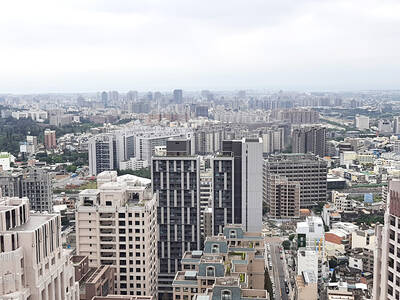
New apartments in Taiwan’s major cities are getting smaller, while old apartments are increasingly occupied by older people, many of whom live alone, government data showed. The phenomenon has to do with sharpening unaffordable property prices and an aging population, property brokers said. Apartments with one bedroom that are two years old or older have gained a noticeable presence in the nation’s six special municipalities as well as Hsinchu county and city in the past five years, Evertrust Rehouse Co (永慶房產集團) found, citing data from the government’s real-price transaction platform. In Taipei, apartments with one bedroom accounted for 19 percent of deals last
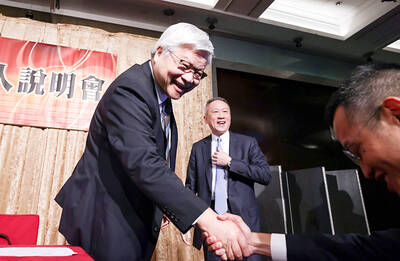
US CONSCULTANT: The US Department of Commerce’s Ursula Burns is a rarely seen US government consultant to be put forward to sit on the board, nominated as an independent director Taiwan Semiconductor Manufacturing Co (TSMC, 台積電), the world’s largest contract chipmaker, yesterday nominated 10 candidates for its new board of directors, including Ursula Burns from the US Department of Commerce. It is rare that TSMC has nominated a US government consultant to sit on its board. Burns was nominated as one of seven independent directors. She is vice chair of the department’s Advisory Council on Supply Chain Competitiveness. Burns is to stand for election at TSMC’s annual shareholders’ meeting on June 4 along with the rest of the candidates. TSMC chairman Mark Liu (劉德音) was not on the list after in December last


 RSS
RSS