


While the government has vowed to scrap a controversial article in the draft statute for promoting innovative industries (產業創新條例), pundits said the key was to offer incentives to all companies across every sector in Taiwan rather than favor big enterprises.
The controversial Article 30 included in the draft statute states that multinational corporations among the Fortune 500 top companies in the world that establish operational headquarters in Taiwan could enjoy a flat business income tax of 15 percent, instead of the 20 percent tax rate applied to other companies.
“Attracting foreign firms to set up operational headquarters here may not necessarily boost the economy or the employment market,” Norman Yin (殷乃平), a money and banking professor at National Chengchi University, said by telephone on Friday.
Some headquarters may be blank shells that do not really invest in Taiwan by operating factories or production lines, he said.
Steve Lin (林祖嘉), an economics professor at National Chengchi University, said in a commentary published on the Chinese-language Economic Daily News on Friday that tax credit is not the only option to entice foreign companies to set up headquarters here.
“It also needs to develop [Taiwan] into a more competent and freer investment environment to woo foreign companies,” Lin wrote.
Terry Gou (郭台銘), chairman of Hon Hai Precision Industry Co (鴻海精密), had earlier threatened to pull the company’s headquarters out of Taiwan if the article was killed.
Since then he has been low-key, making no comment after Minister of Economic Affairs Shih Yen-shiang (施顏祥) said on Friday he had spoken to Gou on the issue and obtained the latter’s understanding.
Hon Hai, which operates under the trade name Foxconn (富士康), is the world’s biggest electronics contract maker and Taiwan’s largest conglomerate in terms of turnover.
“In fact, scrapping Article 30 in fact doesn’t really hurt Hon Hai much,” said an economics official, who declined to be named. “It could still enjoy other tax rebates stipulated in Article 29.”
Article 29 allows companies to be exempted from paying business tax when they repatriate income from overseas management services, royalties, investment disposals and research and development (R&D).
But the anger from Acer Inc (宏碁) continues as the world’s second-largest PC maker is now considered a services-oriented company, a status that does not subject it to the same incentives enjoyed by manufacturers like Hon Hai in terms of R&D and personnel training.
“Acer is stomping its feet as it may not enjoy those R&D incentives,” the ministry official said. “It is better off with Article 30 to pay a flat tax of 15 percent.”
The ministry is now working to initiate other incentives, such as relaxation of the requirement to obtain R&D subsidies, in order to benefit services companies as a whole, the official said.
Despite the government’s attempt to scrap Article 30, whether the draft statute can clear the legislative floor during this session is still uncertain. Against this backdrop, the ministry said it was planning to host four meetings with domestic manufacturers, beginning today, in Taoyuan and then in other cities, in a bid to gain more support from the industry sector for the draft statute.
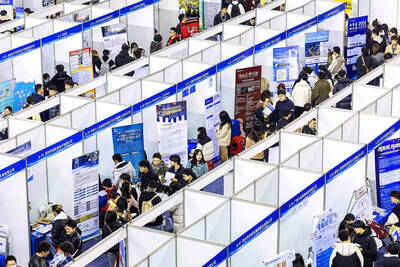
Stephen Garrett, a 27-year-old graduate student, always thought he would study in China, but first the country’s restrictive COVID-19 policies made it nearly impossible and now he has other concerns. The cost is one deterrent, but Garrett is more worried about restrictions on academic freedom and the personal risk of being stranded in China. He is not alone. Only about 700 American students are studying at Chinese universities, down from a peak of nearly 25,000 a decade ago, while there are nearly 300,000 Chinese students at US schools. Some young Americans are discouraged from investing their time in China by what they see
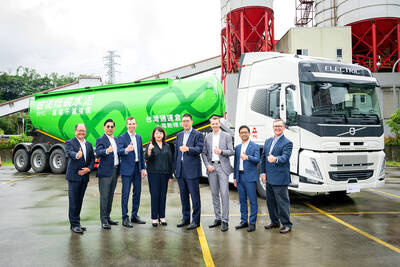
Taiwan Transport and Storage Corp (TTS, 台灣通運倉儲) yesterday unveiled its first electric tractor unit — manufactured by Volvo Trucks — in a ceremony in Taipei, and said the unit would soon be used to transport cement produced by Taiwan Cement Corp (TCC, 台灣水泥). Both TTS and TCC belong to TCC International Holdings Ltd (台泥國際集團). With the electric tractor unit, the Taipei-based cement firm would become the first in Taiwan to use electric vehicles to transport construction materials. TTS chairman Koo Kung-yi (辜公怡), Volvo Trucks vice president of sales and marketing Johan Selven, TCC president Roman Cheng (程耀輝) and Taikoo Motors Group

MAJOR DROP: CEO Tim Cook, who is visiting Hanoi, pledged the firm was committed to Vietnam after its smartphone shipments declined 9.6% annually in the first quarter Apple Inc yesterday said it would increase spending on suppliers in Vietnam, a key production hub, as CEO Tim Cook arrived in the country for a two-day visit. The iPhone maker announced the news in a statement on its Web site, but gave no details of how much it would spend or where the money would go. Cook is expected to meet programmers, content creators and students during his visit, online newspaper VnExpress reported. The visit comes as US President Joe Biden’s administration seeks to ramp up Vietnam’s role in the global tech supply chain to reduce the US’ dependence on China. Images on
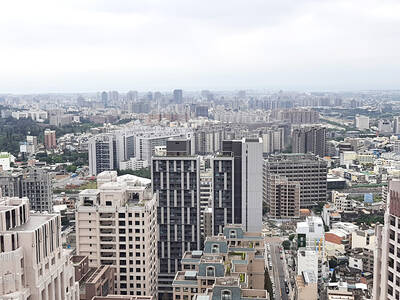
New apartments in Taiwan’s major cities are getting smaller, while old apartments are increasingly occupied by older people, many of whom live alone, government data showed. The phenomenon has to do with sharpening unaffordable property prices and an aging population, property brokers said. Apartments with one bedroom that are two years old or older have gained a noticeable presence in the nation’s six special municipalities as well as Hsinchu county and city in the past five years, Evertrust Rehouse Co (永慶房產集團) found, citing data from the government’s real-price transaction platform. In Taipei, apartments with one bedroom accounted for 19 percent of deals last


 RSS
RSS