


Amid a rebound in exports and foreign capital inflows, Taiwan’s balance of payments surplus stood at a record US$17.66 billion in the fourth quarter last year, with the current account surplus rising to US$11.81 billion, the central bank said yesterday.
Boosted by a recovering global economy and a lower base effect, exports and imports rose 17.3 percent and 17.2 percent respectively from a year earlier, which reversed the previous contraction, the central bank said.
“Of current accounts, the services account surplus rose US$470 million on a yearly basis,” Chen E-dawn (陳一端), deputy chief of the central bank’s economic research department, told a media briefing.
Chen attributed the increase in services account surplus to growth in net income from merchanting services and travel receipts.
“Tourism revenue rose 17.2 percent from a year earlier to US$6.59 billion last year,” she said.
The balance of payments — including current account, financial account and capital account — summarizes a nation’s economic transactions with the rest of the world during a time period.
In terms of the financial account, direct and portfolio investment exhibited a net outflow of US$890 million and US$4.12 billion respectively, the result of more bond investments abroad by local insurance firms and an increase in residents’ investment in foreign mutual funds, she said.
For the full year, Taiwan had a surplus of US$54.13 billion in its balance of payments, the largest amount on record and an increase in the central bank’s reserve assets.
The current account also posted a record surplus of US$42.57 billion last year, while the financial account exhibited a net inflow of US$13.98 billion, the highest amount on record, central bank data showed.
Chen said the inflow of US$13.98 billion in the financial account last year was a result of a net inflow of US$25.76 in investment assets, including government, banking and private sector assets.
“As the nation emerged from the financial crisis, local banks reduced their short-term overseas lending and private sectors wired back their deposits to Taiwan,” she said.
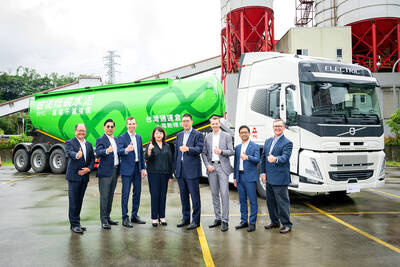
Taiwan Transport and Storage Corp (TTS, 台灣通運倉儲) yesterday unveiled its first electric tractor unit — manufactured by Volvo Trucks — in a ceremony in Taipei, and said the unit would soon be used to transport cement produced by Taiwan Cement Corp (TCC, 台灣水泥). Both TTS and TCC belong to TCC International Holdings Ltd (台泥國際集團). With the electric tractor unit, the Taipei-based cement firm would become the first in Taiwan to use electric vehicles to transport construction materials. TTS chairman Koo Kung-yi (辜公怡), Volvo Trucks vice president of sales and marketing Johan Selven, TCC president Roman Cheng (程耀輝) and Taikoo Motors Group

Among the rows of vibrators, rubber torsos and leather harnesses at a Chinese sex toys exhibition in Shanghai this weekend, the beginnings of an artificial intelligence (AI)-driven shift in the industry quietly pulsed. China manufactures about 70 percent of the world’s sex toys, most of it the “hardware” on display at the fair — whether that be technicolor tentacled dildos or hyper-realistic personalized silicone dolls. Yet smart toys have been rising in popularity for some time. Many major European and US brands already offer tech-enhanced products that can enable long-distance love, monitor well-being and even bring people one step closer to
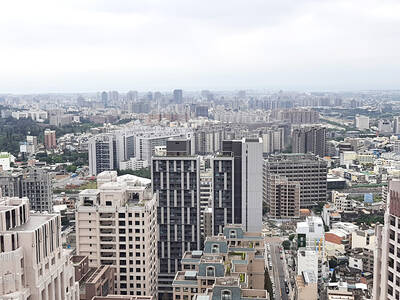
New apartments in Taiwan’s major cities are getting smaller, while old apartments are increasingly occupied by older people, many of whom live alone, government data showed. The phenomenon has to do with sharpening unaffordable property prices and an aging population, property brokers said. Apartments with one bedroom that are two years old or older have gained a noticeable presence in the nation’s six special municipalities as well as Hsinchu county and city in the past five years, Evertrust Rehouse Co (永慶房產集團) found, citing data from the government’s real-price transaction platform. In Taipei, apartments with one bedroom accounted for 19 percent of deals last

RECORD-BREAKING: TSMC’s net profit last quarter beat market expectations by expanding 8.9% and it was the best first-quarter profit in the chipmaker’s history Taiwan Semiconductor Manufacturing Co (TSMC, 台積電), which counts Nvidia Corp as a key customer, yesterday said that artificial intelligence (AI) server chip revenue is set to more than double this year from last year amid rising demand. The chipmaker expects the growth momentum to continue in the next five years with an annual compound growth rate of 50 percent, TSMC chief executive officer C.C. Wei (魏哲家) told investors yesterday. By 2028, AI chips’ contribution to revenue would climb to about 20 percent from a percentage in the low teens, Wei said. “Almost all the AI innovators are working with TSMC to address the


 RSS
RSS