


An environmentally friendly distillery in Scotland may be forced to cut jobs and abandon efforts to reduce energy use because of new rules defining how traditional malt whisky is made.
The award-winning Loch Lomond Distillery, which makes the UK’s third most popular blended whisky, may have to close or change more than half of its production if plans to define malt whisky as spirit made only from old-fashioned pot stills are passed in parliament.
Loch Lomond, which produces more than 20 million bottles of High Commissioner whisky a year, has been at the forefront of attempts to modernize a traditional industry with the use of more efficient distillation methods.
It already uses lightweight glass to reduce the amount of packaging sent to landfill and was recently awarded a prize for outstanding achievement by the Carbon Trust after installing a revolutionary system that recycles heat and water used in the distilling process.
For the past two years the company, based in Alexandria near Glasgow, has been producing almost 12 million liters of grain alcohol and 4 million liters of single malt annually. Some has been produced using a single-still method that cuts carbon dioxide emissions by thousands of tonnes every year. Distillery bosses say they have already smashed government climate change targets for 2011 by cutting energy use by 7 percent.
However, under the new definition of what constitutes “Scotch malt whisky” due to come into force on Nov. 23, Loch Lomond will have to close the still or see millions knocked off the value of its product because it can no longer be classified as malt whisky.
The Scotch Whisky Association (SWA), which helped draw up the amendments to the Scotch Whisky Order 1990, says a true malt will only be classed as such if it is made “by batch distillation in pot stills.”
Even though Loch Lomond’s light medium-weight Speyside-style malt is made with malted barley and looks, tastes and is matured like malt, it cannot be classed as such.
“We have a method that produces a very good malt spirit but are being penalized because we are innovators,” said John Peterson, distilling director of Loch Lomond.
“We want to make the process better and save considerable amounts of energy. As it is, we prevent more than 1,400 tonnes of carbon dioxide being released every year and they want us to go back to the old inefficient ways,” he said. “The SWA wants us to call it grain whisky, but it’s not; if anything, that’s an even more misleading description. Politicians are quick to shout about climate change and how industry has to find new ways to reduce carbon output, but when we try to do something innovative we get slapped down for it,”
However, a spokesman for the SWA said the government had considered every representation made during consultation on the new regulations and concluded such a practice was not traditional.
“The new regulations help to ensure that consumers get clear and consistent information,” he said. “It helps to protect Scotch whisky around the world from unfair competition and that will bring significant economic benefits.”
Environmental groups, however, have applauded Loch Lomond Distillery for trying to address the climate change issue.
“The Scottish whisky industry is becoming a hotbed of innovation for the adoption of renewable and low-energy technologies,” said Duncan McLaren, chief executive of Friends of the Earth Scotland.

Stephen Garrett, a 27-year-old graduate student, always thought he would study in China, but first the country’s restrictive COVID-19 policies made it nearly impossible and now he has other concerns. The cost is one deterrent, but Garrett is more worried about restrictions on academic freedom and the personal risk of being stranded in China. He is not alone. Only about 700 American students are studying at Chinese universities, down from a peak of nearly 25,000 a decade ago, while there are nearly 300,000 Chinese students at US schools. Some young Americans are discouraged from investing their time in China by what they see

MAJOR DROP: CEO Tim Cook, who is visiting Hanoi, pledged the firm was committed to Vietnam after its smartphone shipments declined 9.6% annually in the first quarter Apple Inc yesterday said it would increase spending on suppliers in Vietnam, a key production hub, as CEO Tim Cook arrived in the country for a two-day visit. The iPhone maker announced the news in a statement on its Web site, but gave no details of how much it would spend or where the money would go. Cook is expected to meet programmers, content creators and students during his visit, online newspaper VnExpress reported. The visit comes as US President Joe Biden’s administration seeks to ramp up Vietnam’s role in the global tech supply chain to reduce the US’ dependence on China. Images on

Taiwan Transport and Storage Corp (TTS, 台灣通運倉儲) yesterday unveiled its first electric tractor unit — manufactured by Volvo Trucks — in a ceremony in Taipei, and said the unit would soon be used to transport cement produced by Taiwan Cement Corp (TCC, 台灣水泥). Both TTS and TCC belong to TCC International Holdings Ltd (台泥國際集團). With the electric tractor unit, the Taipei-based cement firm would become the first in Taiwan to use electric vehicles to transport construction materials. TTS chairman Koo Kung-yi (辜公怡), Volvo Trucks vice president of sales and marketing Johan Selven, TCC president Roman Cheng (程耀輝) and Taikoo Motors Group
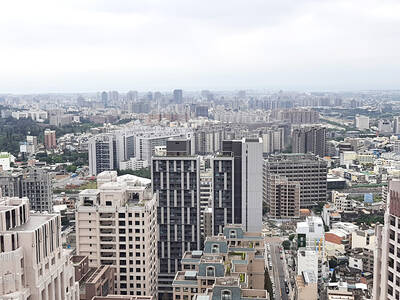
New apartments in Taiwan’s major cities are getting smaller, while old apartments are increasingly occupied by older people, many of whom live alone, government data showed. The phenomenon has to do with sharpening unaffordable property prices and an aging population, property brokers said. Apartments with one bedroom that are two years old or older have gained a noticeable presence in the nation’s six special municipalities as well as Hsinchu county and city in the past five years, Evertrust Rehouse Co (永慶房產集團) found, citing data from the government’s real-price transaction platform. In Taipei, apartments with one bedroom accounted for 19 percent of deals last


 RSS
RSS