


Thirty-nine-year-old Huang Chih-chia (黃志佳) earned NT$1 million (US$30,000) from a property sale four years ago and has been following the sector’s ups and downs ever since.
For the full-time construction engineer, residential properties are “the best” investment targets. Huang had bought two newly built apartments in Sinjhuang (新莊), Taipei County, and a four-bedroom apartment in Linkou (林口), Taipei County, for his own use in the past two years for more than NT$15 million.
Huang planned to sell the refurbished apartments for a profit after a new president came to power. However, with the economic downturn driving the real estate sector down, he had to rethink his plans.
Huang put both the Sinjhuang apartments up for rent and has been counting on monthly rentals to repay mortgages.
“Rental income still gives me a 3 percent return [on my property investments], higher than interest earnings from time deposits if I were to put the money in the bank,” he said.
His next goal is to look for a bargain property in Taipei City, hoping to reap the benefits when the market rebounds given the government’s plan to open the sector to Chinese investment.
The opening will be “a shot in the arm for the property market in years to come,” Huang said.
Like Huang, property tycoon Chao Teng-hsiung (趙藤雄), chairman of Farglory Group (遠雄集團), expects sales to boom when the property market is opened to Chinese buyers.
Speculation on market liberalization has already enticed some home shoppers.
“We’ve seen sales more than double this month, compared with April,” Chao said on Wednesday.
Once the government gives the go-ahead, Farglory will form a joint venture with Country Garden Holdings Co (碧桂園) from China and undertake their first housing project there “by the year’s end at the earliest,” he said.
In Taiwan, Farglory is seeking to buy land in Taipei, Taoyuan and Hsinchu counties to launch new community development projects with its future Chinese business partner, Chao said, urging the government to accelerate its market-opening policies.
Chuang Meng-han (莊孟翰), professor of industrial economics at Tamkang University, warns of the risks of potential capital injection or the inflow of “hot money” from China.
“The news [on opening to Chinese investors] has already provided a boost to domestic property prices, which would otherwise have declined to a more reasonable level and benefited more domestic home buyers,” he said.
Rising property foreclosures in recent months run counter to arguments that property prices have become affordable to the middle class, he said.
Although Taiwan has a high home ownership rate of about 85 percent, Chuang said most home owners are the rich, who own more than one property while the majority can’t afford to buy a house.
The professor urged the government to keep Chinese investors out of the local residential real-estate sector, while encouraging them to invest in the retail and commercial property market.
“These pro-China policies may provide a boost to the nation’s economic growth, but will likely hurt the socially disadvantaged,” whose dream of owning a home would become even harder to realize if Chinese property speculators were allowed in, he said.
Chuang said domestic retail and commercial properties could witness a boom “in the second half of this year at the latest” when Chinese buyers enter the market.
Kevin Peng (彭培業), CEO of Taiwan Realty (台灣房屋), forecast an up to 50 percent hike in commercial property prices in Taipei City’s seven major business districts after Chinese investors are allowed to invest.
Peng was most optimistic about commercial properties, including office buildings and storefronts along Dunhua N Road, which currently sell for about NT$700,000 per ping or rent for NT$4,000 per ping.
With the support of office workers in the area and the residential crowd, “the storefronts may see a hike of between 30 percent and 50 percent in the next three years,” Peng told an outlook briefing on Wednesday.
The upscale Xinyi District (信義), where several big-name department stores and shopping malls are located, may be competitive in attracting businesses, but storefronts nearby hardly benefit as crowds of shoppers are concentrated on the main street, Peng said.
Peng predicted a small price hike of between 5 percent and 10 percent in three years for the district.

Taiwan Transport and Storage Corp (TTS, 台灣通運倉儲) yesterday unveiled its first electric tractor unit — manufactured by Volvo Trucks — in a ceremony in Taipei, and said the unit would soon be used to transport cement produced by Taiwan Cement Corp (TCC, 台灣水泥). Both TTS and TCC belong to TCC International Holdings Ltd (台泥國際集團). With the electric tractor unit, the Taipei-based cement firm would become the first in Taiwan to use electric vehicles to transport construction materials. TTS chairman Koo Kung-yi (辜公怡), Volvo Trucks vice president of sales and marketing Johan Selven, TCC president Roman Cheng (程耀輝) and Taikoo Motors Group

Among the rows of vibrators, rubber torsos and leather harnesses at a Chinese sex toys exhibition in Shanghai this weekend, the beginnings of an artificial intelligence (AI)-driven shift in the industry quietly pulsed. China manufactures about 70 percent of the world’s sex toys, most of it the “hardware” on display at the fair — whether that be technicolor tentacled dildos or hyper-realistic personalized silicone dolls. Yet smart toys have been rising in popularity for some time. Many major European and US brands already offer tech-enhanced products that can enable long-distance love, monitor well-being and even bring people one step closer to
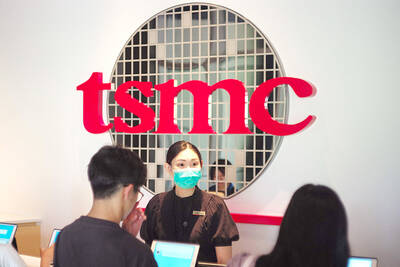
RECORD-BREAKING: TSMC’s net profit last quarter beat market expectations by expanding 8.9% and it was the best first-quarter profit in the chipmaker’s history Taiwan Semiconductor Manufacturing Co (TSMC, 台積電), which counts Nvidia Corp as a key customer, yesterday said that artificial intelligence (AI) server chip revenue is set to more than double this year from last year amid rising demand. The chipmaker expects the growth momentum to continue in the next five years with an annual compound growth rate of 50 percent, TSMC chief executive officer C.C. Wei (魏哲家) told investors yesterday. By 2028, AI chips’ contribution to revenue would climb to about 20 percent from a percentage in the low teens, Wei said. “Almost all the AI innovators are working with TSMC to address the

Malaysia’s leader yesterday announced plans to build a massive semiconductor design park, aiming to boost the Southeast Asian nation’s role in the global chip industry. A prominent player in the semiconductor industry for decades, Malaysia accounts for an estimated 13 percent of global back-end manufacturing, according to German tech giant Bosch. Now it wants to go beyond production and emerge as a chip design powerhouse too, Malaysian Prime Minister Anwar Ibrahim said. “I am pleased to announce the largest IC (integrated circuit) Design Park in Southeast Asia, that will house world-class anchor tenants and collaborate with global companies such as Arm [Holdings PLC],”


 RSS
RSS